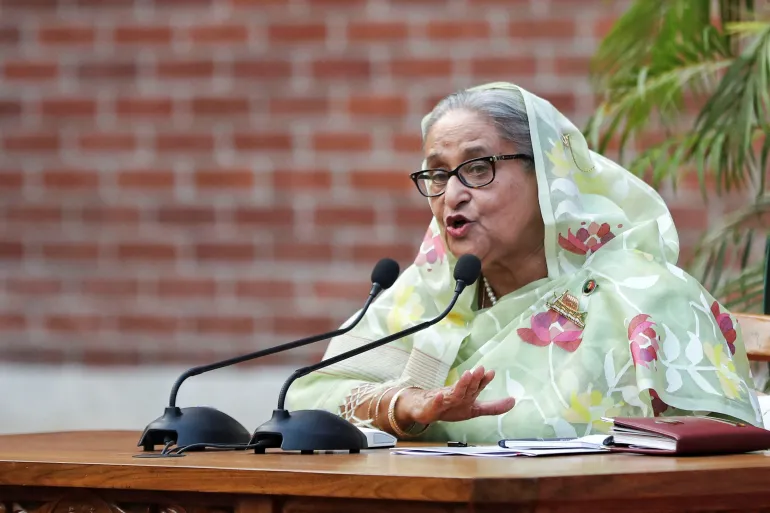
Former Bangladesh Prime Minister Sheikh Hasina has declared that she intends to return to Bangladesh "this year," nearly two years after leaving the country following political upheaval that ended her tenure. Her remarks come months after a Bangladeshi tribunal sentenced her to death in a case linked to the deadly 2024 crackdown on anti-government protests.
In an interview with NDTV, the Awami League leader dismissed the verdict as politically motivated, alleging that it was designed to weaken her party and erase its leadership.
"The verdict against me is not justice. It is part of an illegal, unconstitutional and politically motivated process. The judiciary has been turned into an instrument of political revenge to make the Awami League leaderless. Such attempts have been made before. They failed then, and they will fail again," Hasina said.
Hasina said years of political violence and personal tragedy had strengthened her resolve rather than intimidated her. Recalling the 1975 assassination of her father, Bangladesh's founding leader Sheikh Mujibur Rahman, and several attempts on her own life, she said she remained committed to returning home.
"I do not fear death. In 1975, I lost my parents, my brothers and almost my entire family. On August 21, there was an attempt to kill me with grenades. Many conspiracies have been hatched against me. But I stood beside the people of Bangladesh. I was elected Prime Minister five times by the people's vote and worked for the country's unprecedented development," she said.
Reaffirming her political intentions, Hasina added:
"Overcoming every obstacle and every conspiracy, I will return to my country this year."
The former Prime Minister was convicted by Bangladesh's International Crimes Tribunal, which held her responsible for "ordering, inciting and failing to prevent" the violent suppression of student-led protests that swept the country in July 2024.
The tribunal found her guilty on multiple counts, including allegations related to the use of helicopters, drones and live ammunition against protesters, as well as responsibility for killings in the Dhaka region.
The United Nations has estimated that as many as 1,400 people may have died during the unrest, making it one of the deadliest episodes in Bangladesh's recent political history.
Hasina and the Awami League have consistently denied all allegations, maintaining that the tribunal proceedings were intended to sideline the party from Bangladesh's political landscape.
The former Prime Minister has described the trial as "biased, rigged and politically motivated," accusing the country's interim administration of using legal institutions to target political opponents.
Her latest comments indicate that, despite the conviction and the death sentence, she has no intention of withdrawing from politics.
India, where Hasina has remained since leaving Bangladesh, has avoided commenting directly on the tribunal's verdict.
The Ministry of External Affairs has reiterated that New Delhi supports peace, stability and democratic processes in Bangladesh, while continuing to engage with stakeholders in the neighbouring country.
Hasina's announcement of a possible return is likely to add a fresh dimension to Bangladesh's already volatile political situation, with the country remaining sharply divided over the events of 2024 and the future of the Awami League.