
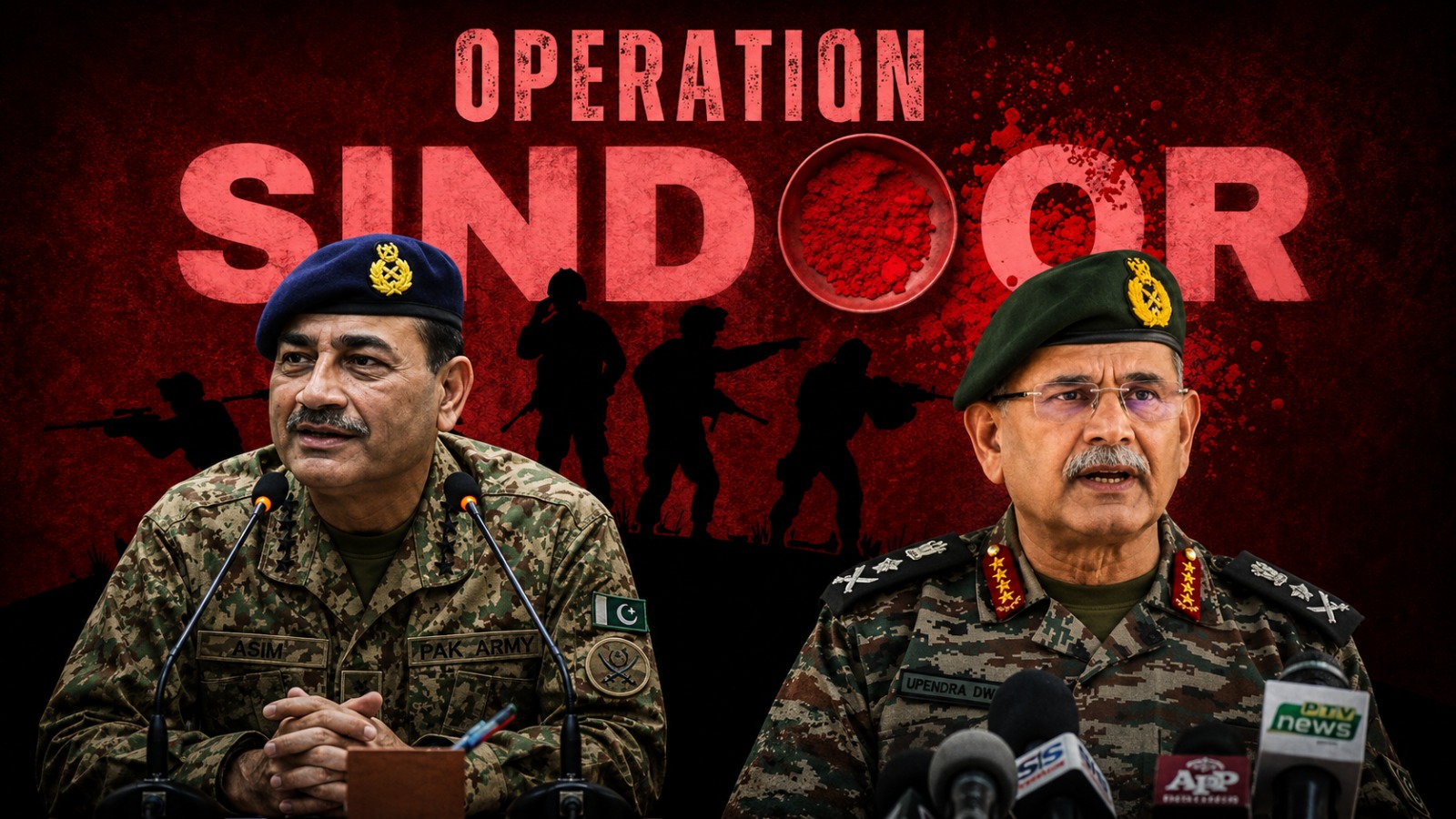
Pakistan’s military has sharply criticised an Indian documentary on Operation Sindoor, accusing its makers of presenting a one-sided and heavily dramatised version of the four-day military confrontation between India and Pakistan in May 2025.
The criticism came from the Inter-Services Public Relations (ISPR), the Pakistan military’s media wing, in response to the Discovery docuseries Declassified: Operation Sindoor. The two-part documentary features senior Indian political and military figures, including National Security Adviser Ajit Doval, recounting India’s account of the operation.
‘Bollywood-style’ reconstruction
In a strongly worded statement, ISPR accused the documentary of rewriting the events of the conflict through selective interviews, emotional narration and cinematic reconstruction.
“To achieve this mutilation of history, Indian content creators have produced a highly dramatised, coloured and factually inaccurate account of so-called Operation Sindoor,” the Pakistani military said.
It further described the production as a “Bollywood-style” reconstruction, alleging that it was designed to present India’s version of the conflict as a military success.
“For its lack of nuance and seriousness, the documentary can be characterised as a tragedy and a comedy at the same time,” ISPR said, adding that “selectively edited interviews, emotional narration and cinematic Bollywood style reconstruction” had been used to alter what it called established facts.
Pakistan disputes India’s ‘100 per cent mission success’ claim
ISPR also challenged the documentary’s portrayal of Operation Sindoor as a complete military success.
The Pakistani military said the documentary’s claim of “100 per cent mission success” was “equally detached from operational record” and alleged that Pakistan had successfully resisted Indian military action during the confrontation.
“India has not declassified the truth. It has cobbled together a propaganda video to project a military blunder as a successful endeavour,” the statement said.
The Pakistani side also claimed that Indian military leadership’s own accounts acknowledged Pakistani missile and drone activity, fighting along the Line of Control and the activation of Indian air-defence systems.
According to ISPR, these accounts were difficult to reconcile with what it described as the documentary’s portrayal of Pakistan as having been decisively defeated.
ISPR questions the Pahalgam link
The statement also took aim at the documentary’s chronology surrounding the April 22, 2025 Pahalgam terror attack, which killed 26 people, and the subsequent launch of Operation Sindoor on May 7.
ISPR objected to what it said was an attempt to link a speech by Pakistan’s army chief on April 16 with the Pahalgam attack six days later, calling the alleged connection an attempt at “conjuring a conspiracy theory out of nothing.”
The Pakistani military further questioned India’s stated objective of targeting those responsible for the Pahalgam attack, pointing to India’s later announcement that three alleged perpetrators had been identified and killed on July 28, 2025.
“Yet the documentary presents so-called Operation Sindoor as the punishment for those responsible for Pahalgam,” ISPR said, asking: “If the alleged perpetrators were eliminated on July 28, India must explain, who it claims to have punished on May 7, 2025?”
India’s account highlights decisive military response
The documentary presents a sharply different account of the operation. In the two-part series, Ajit Doval said India’s “generosity and tolerance should not be mistaken for weakness” and argued that New Delhi was prepared to take risks and strike hard when necessary.
The stated objective, according to Doval, was to destroy terrorist camps, particularly those linked to the Pahalgam attack. India launched Operation Sindoor on May 7, 2025, carrying out precision strikes against what it described as terrorist infrastructure in Pakistan and Pakistan-occupied Kashmir.
The military confrontation lasted nearly four days before India and Pakistan reached an understanding to halt hostilities on May 10.
Dispute over how the conflict ended
ISPR also challenged the documentary’s portrayal of the ceasefire, arguing that the account itself showed that the fighting ended following communication between the two countries’ Directors General of Military Operations.
“The documentary’s account of the cessation of hostilities is no less revealing,” ISPR said, arguing that the ending contradicted an attempt to portray Operation Sindoor as “a unilateral Indian military triumph.”
It added that “a cessation of hostilities, facilitated by the United States, cannot subsequently be repurposed as evidence of unconditional victory.”
The Pakistani military concluded its statement with another warning, saying it remained committed to regional peace while asserting that Pakistan’s armed forces were prepared to respond to any future military action.
“No amount of cinematic reconstruction can change the chronology, erase aircraft losses, conceal military casualties, alter the military engagements that actually took place or convert a battlefield defeat into a self-proclaimed victory,” ISPR said.
The exchange highlights how Operation Sindoor has become not only a disputed military episode but also a continuing battle over the narrative surrounding the 2025 India-Pakistan conflict, with both sides presenting sharply contrasting accounts of the operation, its outcome and the circumstances that brought the fighting to an end.