
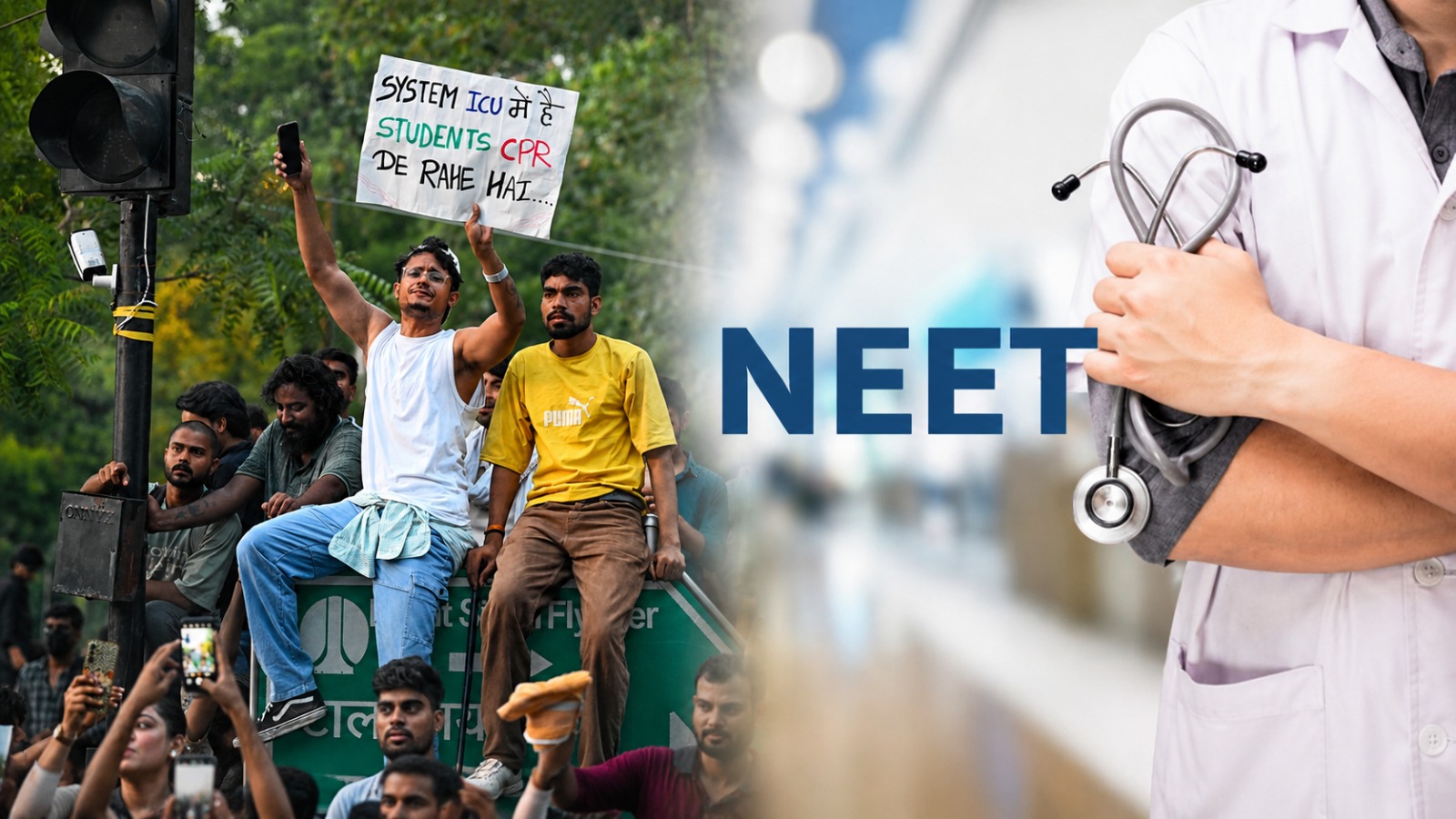
A fresh controversy has engulfed the National Testing Agency after candidates and subject experts alleged that artificial intelligence was used recklessly to draft and translate portions of the UGC-NET June 2026 question papers, producing glaring errors that undermined the integrity of a high-stakes examination for teaching and research eligibility. The NTA has firmly denied that generative AI authored the disputed papers, insisting they underwent human review.
The row centres on the Sociology, English and Commerce papers. Aspirants reported misspelt names of major scholars, awkward phrasing, grammatical breakdowns, questions that appeared outside the syllabus, and extensive repetition from earlier cycles. In the Sociology paper, George Ritzer was rendered as “Putzer,” Talcott Parsons as “Parsow,” G.S. Ghurye as “Ghunye,” A.R. Desai as “A.K. Desai,” and Martha Nussbaum as “Nusbaut.” Hindi translations were described by candidates as barely coherent. In English, roughly 67 of 150 questions were alleged to have been copied from the December 2024 paper, complete with the same order of options. Commerce papers showed similar recycling of questions on taxation, break-even analysis and related topics.
Subject experts familiar with the process alleged that AI tools were employed not only for generating questions but also for translation and assembly, with insufficient subsequent scrutiny by qualified academics. A faculty member from Jawaharlal Nehru University observed: “The larger issue is not simply whether automated systems were used. The bigger concern is how much these systems were relied upon to translate, organise and assemble high-stakes examination material, and whether sufficient human academic review took place after that process was completed.”
IIT Madras Director V. Kamakoti, speaking more broadly on AI in national examinations, has stressed the limits of the technology. “I do not think AI can independently set a question paper. AI may be able to generate questions, but someone still has to review them,” he said, adding that translations across multiple languages also require careful human examination to preserve meaning and fairness.
NTA Director General Abhishek Singh rejected the charge that generative AI authored the papers. He stated that the material was subjected to a “human review” after preparation. When asked how such basic errors escaped notice despite that review, no detailed explanation was offered. The agency has pointed to its established grievance mechanism and noted that incorrect questions can be dropped, as has happened in the past. An expert committee later confirmed significant repetition and other defects, prompting the NTA to cancel the three papers and schedule re-examinations on September 9 and 10 for more than 1.57 lakh candidates.
The episode comes against a backdrop of the NTA’s own expressed interest in greater use of AI. Earlier this year, Singh had spoken of deploying AI to build larger question banks and reduce the human element in paper-setting, arguing that over-reliance on individuals increases leak risks. Critics now argue that any such technology must be tightly constrained by rigorous, transparent academic oversight rather than treated as a shortcut.
Candidates who spent months preparing say the episode has eroded trust. One aspirant wrote on social media that the Sociology paper “crossed all limits of academic deceit and accountability,” citing AI-style questions, random thinkers and “50 per cent” of the paper marred by terrible spelling and grammar. Education observers have called for full disclosure of the paper-setting workflow: whether AI tools were used at any stage, which ones, who authorised them, and how thoroughly subject experts independently vetted every item and translation.
The UGC-NET serves as a gateway for lectureship and research fellowships across Indian universities. When basic factual and linguistic accuracy falters, the damage extends beyond inconvenience to the credibility of the selection process itself. Experts insist that while AI can assist in expanding question banks or speeding translation, high-stakes national examinations cannot afford reckless reliance on automated drafting without ironclad human accountability at every step. The NTA maintains its processes included human review; the volume and nature of the errors have left many unconvinced.