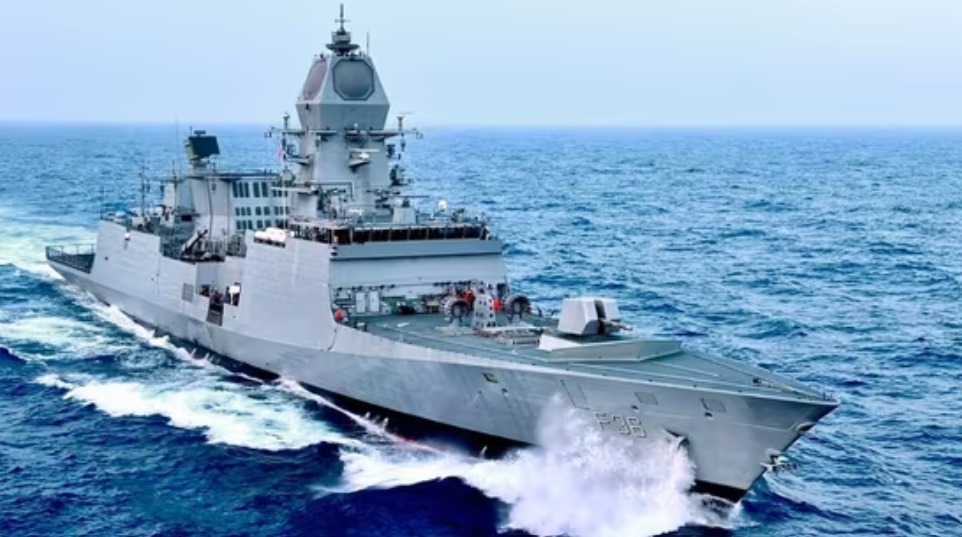
Prime Minister Narendra Modi on Sunday commissioned three indigenously built naval platforms at Syama Prasad Mookerjee Port in Kolkata, describing the event as a significant step in India's drive towards defence self-reliance and maritime strength. The three vessels, INS Dunagiri, INS Sanshodhak and INS Agray, were designed by the Indian Navy's Warship Design Bureau and constructed by Kolkata-based Garden Reach Shipbuilders and Engineers (GRSE). West Bengal Governor RN Ravi, Chief Minister Suvendu Adhikari and Chief of the Naval Staff Admiral Krishna Swaminathan were among the dignitaries present at the commissioning ceremony.
In a post on social media, the Prime Minister said the induction of the three vessels reflected India's growing capabilities at sea. "The three ships reflect India's growing maritime capabilities, our commitment to safeguarding national interests across the seas and the remarkable strides being made towards self-reliance in defence manufacturing guided by the vision of Aatmanirbhar Bharat," PM Modi wrote.
Addressing the gathering, the Prime Minister underscored the strategic importance of maritime power in the modern world. "No nation can emerge as a major power without strong maritime capabilities. Development, security and prosperity are closely linked to the oceans. Most of the world's trade moves through sea routes, while vast global data networks operate beneath the oceans," he said.
PM Modi also highlighted West Bengal's potential role in India's maritime future, stating that the State could emerge as a major centre for coastal and maritime industries. "West Bengal is poised to become a major hub for India's Blue Economy, maritime manufacturing, logistics and coastal development," he said. The commissioning comes weeks after the BJP formed its first government in West Bengal and a day after the Prime Minister attended Paschimbanga Divas celebrations in the State.
Chief of Naval Staff Admiral Krishna Swaminathan said the simultaneous induction of the three vessels demonstrated the rapid progress of India's domestic shipbuilding capabilities. The Admiral noted that the event came just 17 months after the Navy's first-ever simultaneous commissioning of three warships in Mumbai in January 2025. "India's warship-building capability is gaining new speed in modern technology, self-reliance and self-confidence," he said.
INS Dunagiri: New-Generation Stealth Frigate
Among the three vessels, INS Dunagiri is the most heavily armed and technologically advanced. It is the fifth ship of the Nilgiri-class under Project 17A, the Navy's programme for next-generation stealth-guided missile frigates. The warship is equipped with advanced combat systems, including BrahMos supersonic cruise missiles and the Medium Range Surface-to-Air Missile (MRSAM) system, significantly enhancing the Navy's operational capability.
INS Dunagiri operates on a Combined Diesel or Gas (CODOG) propulsion system, allowing fuel-efficient cruising on diesel engines and rapid acceleration using gas turbines when required. The vessel measures 149 metres in length and displaces approximately 6,670 tonnes.
According to the Ministry of Defence, the frigate was delivered in 80 months, an improvement over the construction timeline of INS Nilgiri, the lead ship of the class, which took 93 months to complete. The project involved more than 200 small and medium enterprises and generated employment for nearly 4,000 people directly and over 10,000 indirectly. "Designed and built in India, the vessels showcase the talent of Indian industries, the expertise of Indian engineers and the hard work of Indian workers," Mr Modi said.
Two more vessels, INS Mahendragiri and INS Vindhyagiri, remain to be commissioned to complete the seven-ship Project 17A programme.
INS Sanshodhak: Advanced Survey and Ocean Mapping Vessel
The Navy also inducted INS Sanshodhak, the fourth and final vessel in the Survey Vessel (Large) class. Designed for hydrographic and oceanographic missions, the ship will be used to map the seabed, chart navigational routes and gather critical maritime data for naval and civilian operations. The vessel is equipped with Autonomous Underwater Vehicles (AUVs), Remotely Operated Vehicles (ROVs), multi-beam echo sounders and advanced side-scan sonar systems for underwater surveys and object detection.
Officials said the vessel contains more than 80 per cent indigenous content. PM Modi noted that the commissioning coincided with World Hydrography Day. "It is a remarkable coincidence that India's most advanced hydrographic survey vessel, INS Sanshodhak, is commissioned on the same day," he said. Apart from survey operations, the vessel can also be deployed for humanitarian assistance and disaster relief missions.
INS Agray: Strengthening Coastal Anti-Submarine Warfare
The third vessel commissioned was INS Agray, part of the Arnala-class Anti-Submarine Warfare Shallow Water Craft programme. The class has been specifically developed to detect, track and neutralise enemy submarines operating in shallow coastal waters, where conventional anti-submarine operations are often more challenging.
INS Agray is equipped with indigenous sonar systems, lightweight torpedoes and rocket launchers designed for anti-submarine warfare. The vessel is approximately 77 metres long and has a displacement of around 900 tonnes.
Unlike conventional ships, it uses waterjet propulsion technology, which significantly reduces underwater noise and improves manoeuvrability, making it particularly effective in submarine-hunting operations.
Highlighting the broader defence manufacturing ecosystem, PM Modi said India's military strength must be built on domestic capability rather than dependence on foreign suppliers. "The strength of the nation's military cannot be measured by its dependence on global markets but by its ability to become self-reliant," he said.
The Prime Minister noted that India's annual defence production had increased from around ₹40,000 crore in 2014 to nearly ₹1.8 lakh crore at present. "India seeks to become a producer and a manufacturer, because nations that manufacture become decisive players on the global stage," he said. According to the Prime Minister, more than 40 indigenously built warships have been inducted into the Indian Navy in recent years, while another 45 naval platforms are currently under construction across the country.