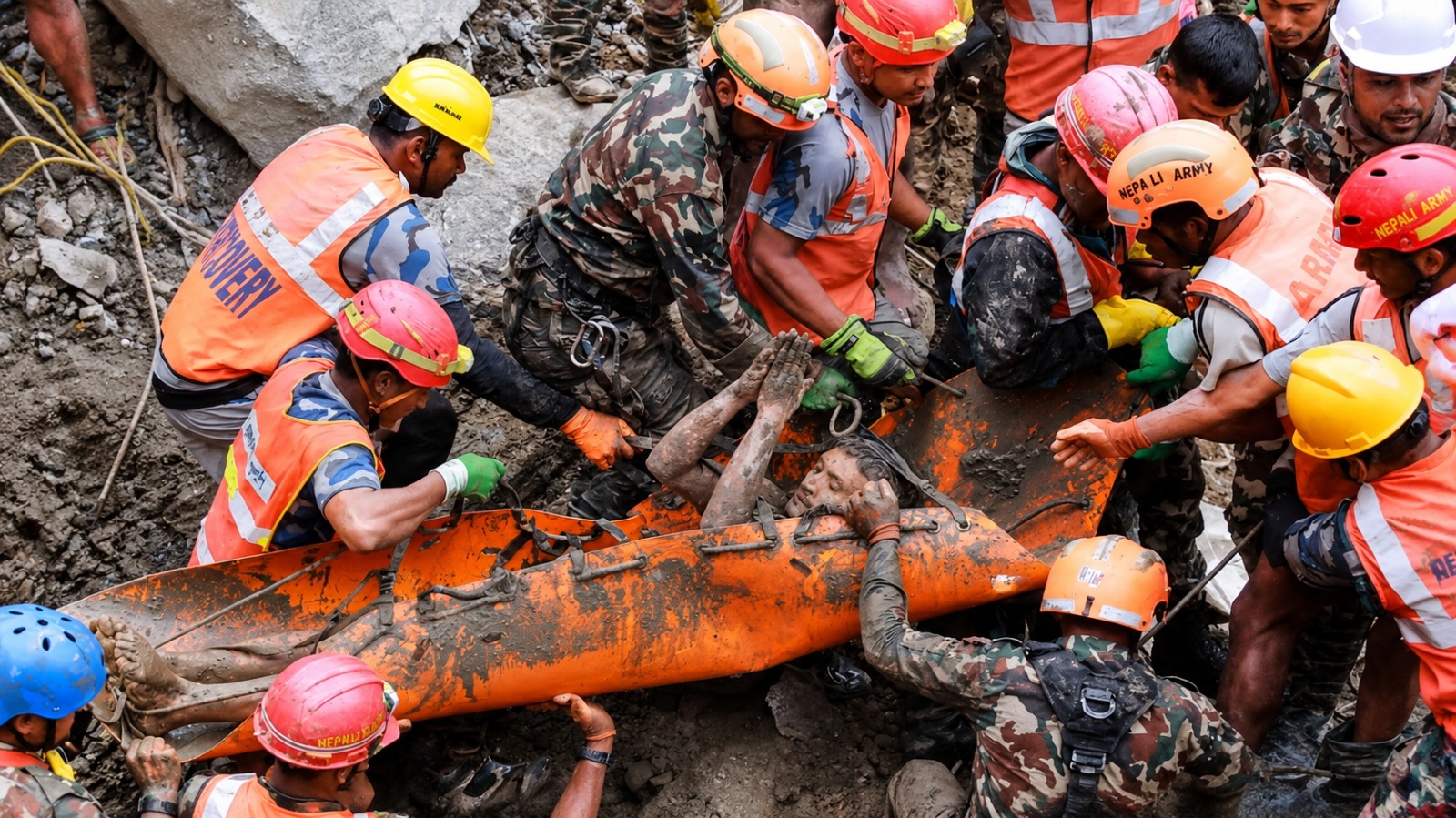
In a moment that has been called a miracle across Nepal and beyond, two hydropower workers were pulled alive on Friday from a debris-choked tunnel at the Upper Trishuli 3A project, nine days after catastrophic flash floods buried the Himalayan valley. Mechanical foreman Sanjay Sah, 30, and supervisor Kabir Maharjan, 45, emerged from roughly 170 metres inside the mountain after rescuers crawled through a narrow gap they had painstakingly carved through mud, rock and wreckage.
The footage released by the Nepal Army has since spread widely. It shows helmeted soldiers and rescue workers clustered around a small, dark, muddy opening in the hillside. One man, face and clothes caked in grey sludge, is helped to his feet and then carried on a rescuer’s back; he raises a hand. Another is lifted onto an orange stretcher. Cheers break out. Army doctors later fit an oxygen mask and check vital signs in a nearby tent. The Army described the extraction as a “rebirth” after ten days of struggle and an “astonishing victory of hope.” Viewers have called the images both heartbreaking and extraordinary.
The August 26 disaster began high on the Nepal-Tibet border when an ice-and-rock avalanche collapsed into the river system. A wall of water, mud and boulders tore down the Bhotekoshi and Trishuli corridors, wiping out villages, roads, bridges and multiple hydropower sites. The landscape itself was rewritten; tunnels that once sat on a hillside were suddenly buried. Locating the Trishuli 3A entrance took nearly six days.
How the Rescue Was Carried Out -
Nepal Army teams, supported by the Armed Police Force, Nepal Police, engineers and technical specialists, worked around the clock. Australian tunnelling expert Arnold Dix, president of the International Tunnelling and Underground Space Association and a veteran of the 2023 Silkyara tunnel rescue in India, advised the operation remotely. Teams used satellite imagery, old topographic maps, as-built drawings and surface clues such as power poles to pinpoint where the buried portal should be.
Once they found it, they faced car-sized boulders, deep mud and incoming water. Some rocks had to be carefully broken with explosives inside the confined space. Rescuers then opened a crawlway along the top of a cable tunnel so they could move forward while calling out. Early on Friday they heard a faint reply in Nepali - an acknowledgement that someone was still there. They pressed on another 10 to 15 metres. Sanjay Sah was brought out first, followed shortly by Kabir Maharjan. Both were given immediate medical attention on site and then airlifted toward Kathmandu hospitals. Sah was reported more stable; Maharjan was in more serious condition.
Sah, a Nepal Electricity Authority employee from Saptari district, later told rescuers he had been in the control room when the flood hit. On a normal day only a handful of people would have been there; that morning there may have been 40 or 45. He said he stayed behind to warn others and urge them to run. By the time he tried to leave, the way was gone. In the darkness he chanted the Hare Krishna mahamantra. He remained in contact by shouting with three or four others and believes more people could still be deeper in the tunnel or the powerhouse. After he was carried out, one of his first questions was simply: “What day is it?”
The Wider Human Cost -
The two men are the first confirmed survivors pulled from the hydropower tunnels themselves, though a small group escaped another site in the hours after the flood. Hundreds of workers remain unaccounted for across half a dozen projects along the river. Estimates for Trishuli 3A alone have ranged from around 40 people possibly still inside to more than 100 in the main tunnel complex. Industry groups have said more than 500 to 900 people from various hydropower sites are missing. Search teams have continued after Friday’s breakthrough, listening for further voices.
National figures keep rising as bodies are recovered from the river corridor. Nepal’s National Disaster Risk Reduction and Management Authority reported more than 1,280 confirmed deaths by Friday, with district totals highest in Chitwan, followed by the two Nawalparasi districts, Nuwakot and Rasuwa. Around 5,000 people were still listed as missing, including more than 2,000 each in Rasuwa and Nuwakot and 583 foreign nationals. Security forces said they had already rescued more than 13,000 people overall. On the Chinese side of the border, authorities have reported 21 deaths and 541 missing in Tibet’s Gyirong County. Tens of thousands have been displaced; roads and power infrastructure remain shattered in the worst-hit valleys.
The viral rescue video has given families of the missing a sliver of hope even as identification of recovered bodies remains painfully slow and many communities hold symbolic rites for those who have not been found. Rescuers say they will keep working. For two men who spent nine days in the dark, Friday’s extraction was, in the Army’s words, a second life. For thousands of others, the wait continues.