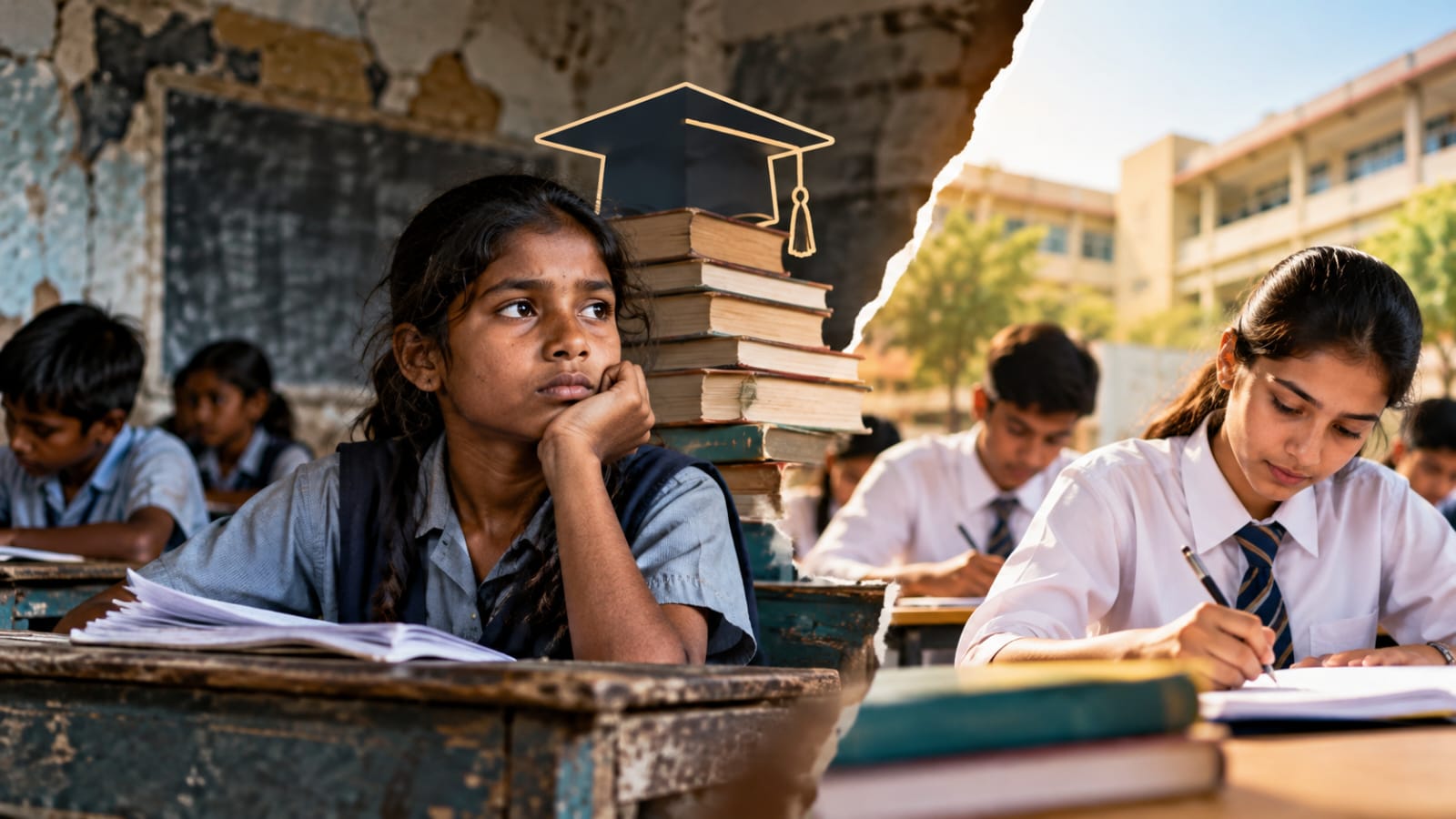
Only one in five children from India’s poorest families complete Class 12, compared with four in five from the richest households, an Oxfam report has found, highlighting deep inequalities in access to education. The findings come as the Cockroach Janata Party (CJP) pushes for better government schools through its ‘School Thik Karo’ campaign.
The report, Rigged from Birth, uses UNESCO data to compare school completion rates across nine Asian countries. In India, the gap between the richest and poorest students stands at 60 percentage points. Six of the nine countries studied: China, the Philippines, Thailand, Nepal, Bangladesh and Cambodia, have smaller gaps. Only Laos and Vietnam fare worse.
The findings come as the CJP, a youth movement founded in May, runs its ‘School Thik Karo’ campaign. Launched on 15 August, weeks after its protests over the NEET-UG paper leak ended with the resignation of Union Education Minister Dharmendra Pradhan on 25 July, the campaign urges parents to inspect village government schools for drinking water, functioning toilets, electricity, mid-day meals and teacher attendance, and film any shortcomings.
“If anything has been neglected or ignored the most in the last 80 years, it is the government schools in our villages,” CJP founder Abhijeet Dipke said in a video message announcing the campaign. “We have made a new Parliament, a new PM house. Why have we not been able to build new schools in our villages?”
More than one lakh schools in India are run by a single teacher, according to UDISE+ data for 2025–26. “In rural India, government schools have always lagged behind private schools in terms of learning levels,” Wilima Wadhwa, director of the ASER Centre, wrote in the ASER 2024 report. The survey found that fewer than one in four Class 3 students in rural government schools could read a Class 2 text, although it also recorded the sharpest gains in two decades, led by government schools.
In Thailand and the Philippines, more than 40 per cent of young people from the poorest households complete the equivalent of Class 12. In China, rich and poor students complete school at almost the same rate. Vietnam, where the gap is wider than in India, made higher secondary education free in 2025.
Since 2009, Thailand’s ‘15 Years of Free Education’ policy has covered every child from kindergarten to the end of upper secondary school, paying for tuition, textbooks, learning materials, uniforms and school activities.
In India, by contrast, the Right to Education Act guarantees free schooling only from Class 1 to Class 8. According to UDISE+ data for 2025–26, 98.5 per cent of children remain in school through the foundational stage and 83.7 per cent through the middle stage, up to Class 8. Only 51.9 per cent stay through Classes 9 to 12. Class 8 is also where the guarantee of free schooling under the Act ends.
Beyond Class 8, schooling becomes costlier. Almost four in 10 secondary school students take private coaching, according to the government’s Comprehensive Modular Survey: Education 2025. Families also spend about 10 times as much annually on a private school student as on one in a government school.
On public spending, India fares better than most of its neighbours. It spends 4.1 per cent of GDP on public education, according to UNESCO figures cited in the Oxfam report. India is one of only three Asian countries, alongside South Korea (5.4 per cent) and the Philippines (4.0 per cent), to meet the international minimum of 4 per cent. China spends 3.9 per cent, Nepal 3.7 per cent, Thailand 2.5 per cent, while Bangladesh and Cambodia spend 2.2 per cent or less.
Yet the money is not necessarily reaching the children most likely to drop out, and some funds remain unspent. Samagra Shiksha, the main scheme for school education, has used an average of 86 per cent of its funds each year, according to PRS Legislative Research. Teachers are also scarce at the stage when students are most likely to leave school.
As government schools struggle, families who can afford to do so are moving their children elsewhere. Government schools lost nearly 86 lakh students between 2023–24 and 2025–26, while private unaided schools gained more than 88 lakh, UDISE+ data show. The report warns that when better-off families opt out, public education “risks becoming undervalued and chronically underfunded”.
Poorer families are left to bear the cost. In the South Asian countries examined by Oxfam, households pay 55 per cent of total education costs, compared with about 35 per cent in East Asia. Even free government schools carry hidden costs for uniforms, books and transport, which disproportionately affect the poorest families. When money is short, the report adds, families tend to invest more in sons.
The shortcomings have also prompted student protests following the CJP’s ‘School Thik Karo’ campaign. Students in Uttar Pradesh, Rajasthan, Madhya Pradesh and Bihar took to the streets over leaking roofs, broken toilets, missing teachers and school closures, Careers360 and Scroll reported. At one school in Uttar Pradesh, nearly 1,800 students from Classes 6 to 12 demanded drinking water, clean toilets, electricity and a library.
“Board examinations are approaching, but studies are being affected because there are no teachers,” Anamika, a student in Lucknow, told Careers360.
Rural students are among those most affected by the shortcomings of India’s school system, with inadequate infrastructure, teacher shortages and the rising cost of education threatening their ability to complete schooling.
These inequalities reflect a wider economic divide. According to the World Inequality Report 2026, India’s richest 1 per cent hold about 40 per cent of the country’s wealth, while the poorest half of the population earn 15 per cent of national income. India had 188 billionaires in 2025 and ranks third globally in billionaire numbers in 2026.