
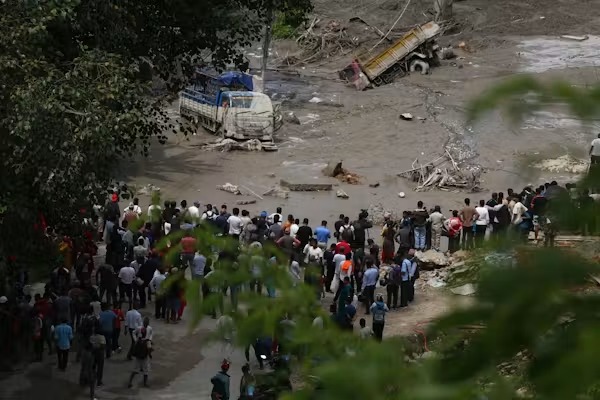
The devastating flash flood that tore through Nepal’s Bhote Koshi River valley has raised fresh concerns about the growing risks posed by melting glaciers and unstable Himalayan slopes, a report by United Nations Office for Disaster Risk Reduction (UNDRR) said.
More than 150 people have died and hundreds remain missing after a massive surge of water, ice, mud and rock travelled more than 170 kilometres down the valley, a crucial route connecting Kathmandu with Lhasa in Tibet. At least 34 Australians are also reported missing.
The disaster struck with little warning, highlighting a critical question for scientists and authorities: Can the next glacier-related disaster be predicted before it becomes deadly?
Glacier collapse may have triggered the disaster
Early analysis indicates that the catastrophe may have been caused by an enormous ice-and-rock landslide that swept down a mountain pass, gathering water, ice, rocks, trees and soil along the way.
The scale of the movement was so enormous that seismic instruments initially registered it as an earthquake, measuring around magnitude 4.4.
By the time the debris reached Gyirong Port on the China-Nepal border, it had transformed into what witnesses described as a wall of mud and debris, with early estimates suggesting the surge may have reached around 30 metres in height.
Scientists caution that the exact trigger remains unclear.
One possibility is a glacial lake outburst flood, in which water trapped behind a natural ice or landslide dam suddenly escapes. But early satellite analysis instead points towards a landslide potentially stripping away part of a glacier and triggering its collapse.
Why the Himalayas are increasingly vulnerable?
The disaster comes against the backdrop of accelerating glacier retreat across the world.
The Himalayas, often described as the “third pole” because of their enormous stores of snow and ice, are particularly vulnerable to a warming climate.
The danger is not limited to glaciers themselves. Large areas of the high Himalayas contain permafrost — rock, soil and ice that has remained frozen for years.
As temperatures rise, this frozen ground can thaw and weaken the natural bonds holding steep mountain slopes together.
That can increase the likelihood of rockfalls, landslides and sudden debris flows. An earthquake, slope failure or another disturbance can then set off a devastating chain reaction.
Nepal has experienced other deadly glacier- and flood-related disasters in recent years. A smaller flood in the same region last year killed nine people, while glacier-related debris disasters have also struck mountain communities in countries including Switzerland and Georgia.
What makes the latest Nepal disaster particularly alarming is its scale.
The combination of retreating glaciers, unstable slopes, thawing permafrost and extreme weather creates a complex chain of risks that scientists are still working to understand.
Early warning systems can save lives
Experts say disasters triggered by glacier collapse cannot always be prevented — but their human toll can be reduced.
Switzerland provided a striking example when authorities evacuated residents ahead of a major glacier collapse, preventing loss of life.
Early warning systems can track changes such as rapidly rising river levels, intense rainfall and seismic activity, potentially giving communities precious time to evacuate.
But establishing such systems in remote Himalayan regions requires substantial investment, technology and local preparedness.
Nepal has received international support aimed at improving monitoring and early warning systems for glacial flood risks.
A threat far beyond Nepal
The consequences of Himalayan glacier loss extend well beyond the mountains.
Rivers fed by Himalayan glaciers provide water to billions of people across Nepal, India, Pakistan and China.
In the short term, accelerating melt can increase river flows and, in some locations, raise flood risks. But as glaciers continue to shrink, their contribution to river systems could eventually decline, threatening water availability — particularly during dry seasons.
The Nepal disaster therefore carries a warning far beyond one flooded valley.
Reducing greenhouse gas emissions, monitoring vulnerable glaciers and permafrost, and investing in early warning systems may not stop every disaster. But they could give communities the one thing they often lack when mountains suddenly move: time.