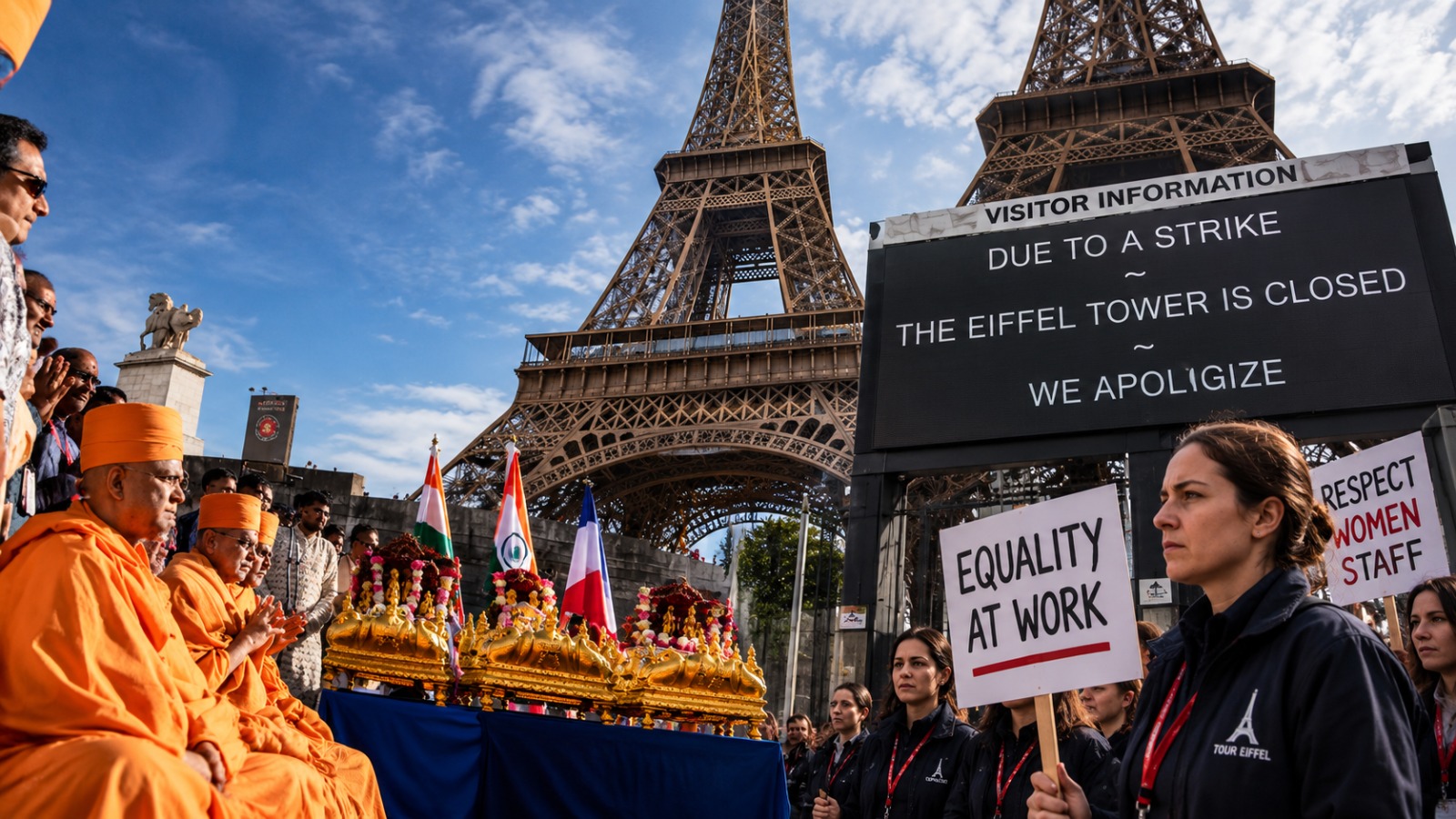
A controversy erupted in Paris after female employees at the Eiffel Tower were allegedly asked to leave their workstations or avoid certain areas during a private visit by a delegation associated with the Hindu organisation Bochasanwasi Akshar Purushottam Swaminarayan Sanstha (BAPS). The incident has prompted a staff protest, the temporary closure of the landmark and an investigation by Paris authorities. BAPS has denied that anyone was denied access to the monument and has apologised for any “pain or inconvenience” caused.
The controversy centres on a private visit by around 100 people linked to BAPS on September 5. The delegation was in France amid events connected to the inauguration of a new BAPS Hindu temple near Paris. According to Eiffel Tower staff representatives, female employees were instructed to leave certain positions while the delegation passed through. In some instances, women were reportedly replaced by male colleagues.
Diane Davoine, a representative of the Eiffel Tower staff union, said, “During the visit of this delegation, women were asked to leave their places of work in order to place men there.” She alleged that a female welcome agent was removed from operating an elevator so that a male employee could take her place. Staff representatives said some women were also instructed not to cross particular areas while the delegation was present.
The Eiffel Tower's operating company, Société d'Exploitation de la Tour Eiffel (SETE), subsequently acknowledged that the delegation had requested arrangements designed to limit “interactions with women”. SETE president Ariel Weil said the conditions “should not have been accepted”, adding that they were incompatible with the company's commitment to equality between men and women.
Staff protest and Eiffel Tower closure
The allegations led to growing anger among employees over the weekend. On September 7, staff held a meeting with management and staged a walkout, forcing the Eiffel Tower to remain closed to visitors for the day. Staff representatives said they were particularly upset by what they described as professional instructions that had “sidelined, replaced and made invisible” female employees because of their sex.
Management apologised to employees and agreed to review the circumstances surrounding the visit. Visitors holding tickets were told they would be reimbursed. Following discussions between staff and management, employees agreed to return to work, with the Eiffel Tower expected to reopen on September 8.
Management also said arrangements governing VIP delegations would be reviewed.
BAPS rejects claim that anyone was denied access
BAPS has disputed the suggestion that people were denied access to the Eiffel Tower or that its delegation sought to exclude women from the monument. In a statement, the organisation said the visit had been coordinated in advance with Eiffel Tower management and scheduled at the beginning of normal opening hours to minimise disruption to other visitors.
“To the best of our knowledge, at no point was anyone prevented access to the Eiffel Tower,” BAPS said. At the same time, the organisation added that it “sincerely apologise[s] for any pain or inconvenience caused” and said it took the concerns raised “very seriously”. BAPS said it remained committed to “the universal values of mutual respect and service to others.”
The clarification came as the controversy intensified in France, with the group seeking to distinguish its position from the allegations surrounding the treatment of female employees. The precise circumstances under which the staff instructions were issued remain a matter of investigation.
Political backlash in France
The incident quickly drew criticism from senior French political figures. Paris Mayor Emmanuel Grégoire said he would launch an investigation “as soon as possible” and called the employees' anger legitimate. He stressed that equality between women and men must apply everywhere in the city, including at historic monuments.
French Equality Minister Aurore Bergé also condemned the reported treatment, saying, “In France, we do not ask women to erase themselves.” She added that gender equality was “neither negotiable nor subject to varying standards”. National Assembly President Yaël Braun-Pivet similarly said, “Welcoming others never means giving up our values,” stressing that women are fully present in public life in France.
The dispute has therefore evolved beyond a disagreement over arrangements for a private visit. It has become a wider debate in France over gender equality, religious accommodation and the responsibility of public institutions to uphold their principles while hosting international religious and cultural delegations.
The Eiffel Tower's management has promised a “thorough review of the conditions under which this visit was organized” and said it would draw the necessary conclusions. Employees have returned to work, while Paris authorities investigate the circumstances that led to the controversial instructions.
For now, the central accounts remain contested: staff representatives say women were effectively sidelined during the BAPS visit, while BAPS says no one was denied access and that the visit was coordinated with the Eiffel Tower team. The investigation is expected to establish how the arrangements were made, who authorised them and whether the treatment of female employees breached the principles governing the landmark.