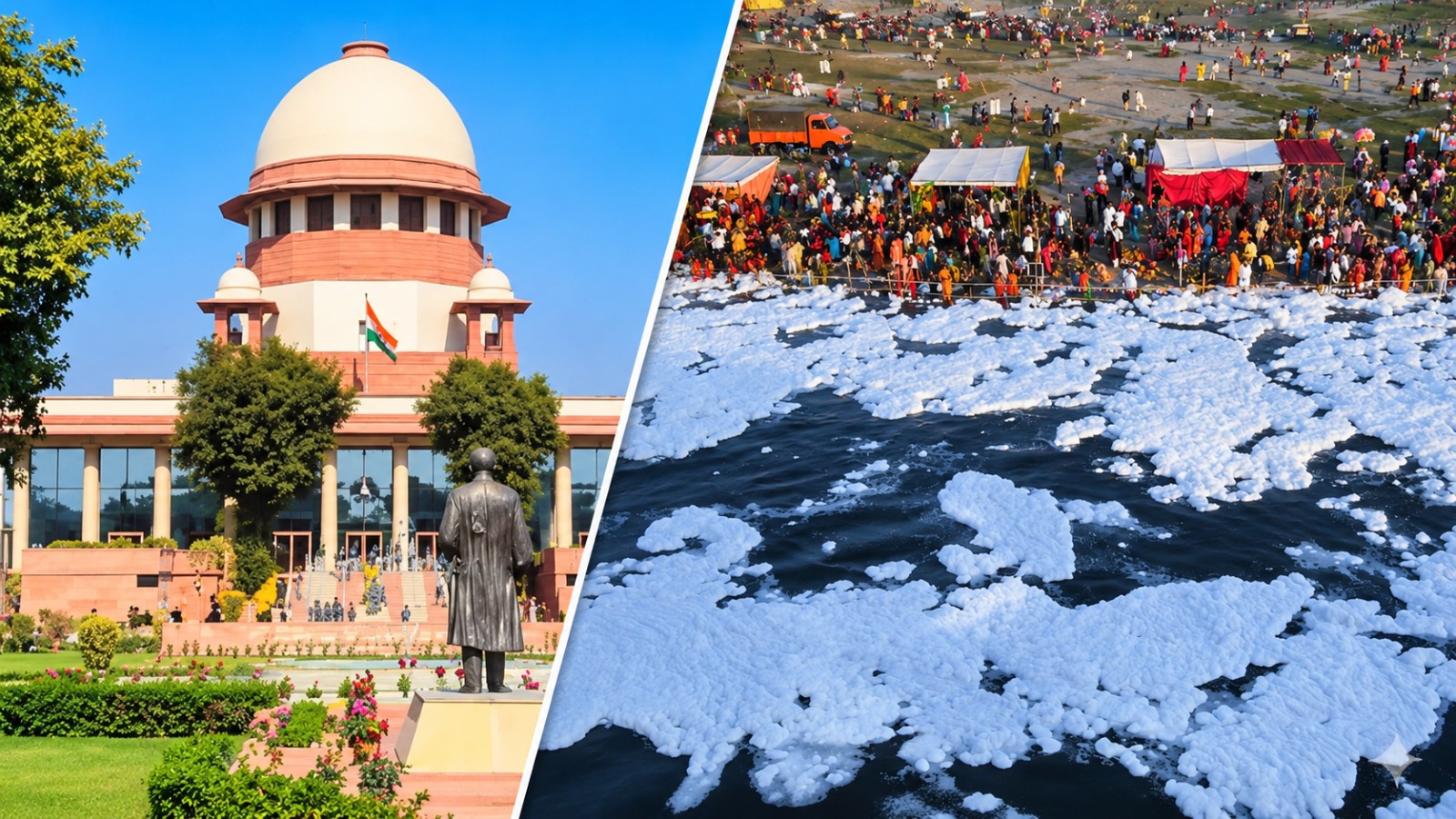
The Supreme Court has issued a stern warning to states, Union Territories and district administrations along the Yamuna, making it clear that authorities will be held accountable and face financial penalties if the river's water quality deteriorates within their jurisdictions.
During a hearing on Monday, November 16, a bench comprising Justice Manoj Misra and Justice Manmohan stressed that protecting the Yamuna cannot be the responsibility of individual states alone. Instead, all authorities through which the river flows must work together to prevent pollution and ensure that untreated wastewater and industrial effluents do not enter the river.
The court has asked the Central Pollution Control Board (CPCB) to formulate a mechanism for calculating environmental compensation or fines against jurisdictions that fail to prevent the deterioration of water quality. The proposed penalties will be deposited with the Supreme Court Registry.
The bench made it clear that states and Union Territories would be free to recover the fines from the actual polluters and government officials found negligent in discharging their duties, following an appropriate inquiry. Officials found responsible for negligence could also face departmental action.
Expressing concern over the worsening condition of the river despite substantial public expenditure on cleaning initiatives, the Supreme Court questioned why pollution levels continued to rise despite repeated government interventions.
In a strong observation, the bench remarked, "Everything that is wrong with civic administration in the towns, cities and villages situated along the banks of the river is reflected in the poor health of the river and in the 520 drains that discharge wastewater into the Yamuna."
The court further observed that the river's pollution had continued to increase despite huge sums being spent on its restoration, highlighting serious shortcomings in civic administration and pollution-control mechanisms.
The Supreme Court has directed the CPCB to closely monitor water quality at the points where the Yamuna and major drains enter and exit different states, Union Territories and districts. The monitoring will cover important parameters, including biochemical oxygen demand (BOD), chemical oxygen demand (COD), faecal coliform and total suspended solids (TSS).
The objective is to identify precisely where the river's water quality deteriorates and determine which jurisdiction should be held responsible.
The court also emphasised that the Yamuna must be treated as a shared ecological resource rather than a river divided by administrative boundaries. The river flows through Uttarakhand, Himachal Pradesh, Haryana, Delhi and Uttar Pradesh before eventually merging with the Ganga.
Meanwhile, pollution monitoring data from several locations in and around Delhi has indicated a worsening situation. Environmental experts have pointed to untreated sewage and industrial discharge as major contributors to the river's deteriorating condition, with chemical waste from industries, including tanneries, adding to the pollution burden.
The Supreme Court's intervention comes amid continuing concerns over the discharge of wastewater into the Yamuna through hundreds of drains. The bench has stressed that constructing more sewage treatment plants alone will not solve the problem unless untreated sewage and industrial pollutants are intercepted and treated at their source.