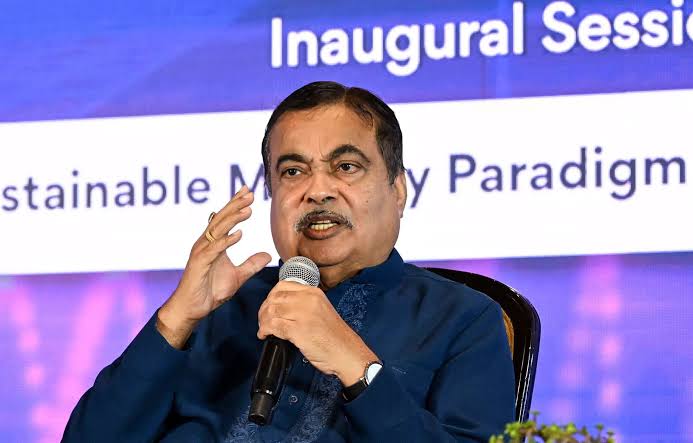
Union Minister for Road Transport and Highways Nitin Gadkari has strongly rejected allegations that the Centre's ethanol blending programme was designed to benefit his family, dismissing claims that the policy was framed to favour his son. Defending the government's biofuel initiative, Gadkari said the programme is driven by India's energy security, environmental goals and the need to improve farmers' incomes, rather than any private interest.
Addressing criticism surrounding the rollout of E20 fuel, Gadkari said consumers who do not wish to use ethanol-blended petrol are free to opt for 100% petrol by paying a higher price.
"Those who do not want to use E20 fuel can still choose 100% petrol by paying a higher price," the Union Minister said, rejecting allegations that the policy unfairly forces consumers to adopt ethanol-blended fuel.
Gadkari maintained that the ethanol blending programme is aimed at reducing India's dependence on imported crude oil, cutting carbon emissions and creating additional income opportunities for farmers by increasing demand for agricultural produce such as sugarcane, maize and bamboo.
He also reiterated the government's broader strategy of promoting multiple clean-energy alternatives, including methanol, hydrogen and electric vehicles, to strengthen India's energy security and accelerate the transition towards cleaner modes of transport.
The Minister's remarks come amid growing criticism from sections of the automobile industry and consumers over the nationwide expansion of E20 fuel. Critics have questioned the compatibility of ethanol-blended petrol with older vehicles and alleged that the policy primarily benefits sugar mills and ethanol producers.
Rejecting those concerns, Gadkari asserted that the government's approach is based on environmental and economic priorities rather than commercial interests. He further stated that all vehicles compliant with E10 fuel standards are capable of using E20 fuel.
India has steadily expanded its ethanol blending programme under the National Policy on Biofuels, with the Centre working towards achieving 20% ethanol blending in petrol. The government has consistently maintained that the initiative will help reduce the country's crude oil import bill, lower greenhouse gas emissions and promote the use of domestically produced renewable fuels.
Automobile manufacturers have also begun introducing E20-compatible vehicles, in line with the government's roadmap for cleaner and more sustainable transportation. The ethanol blending programme remains a key component of India's long-term strategy to reduce fossil fuel dependence while supporting the rural economy and domestic biofuel production.