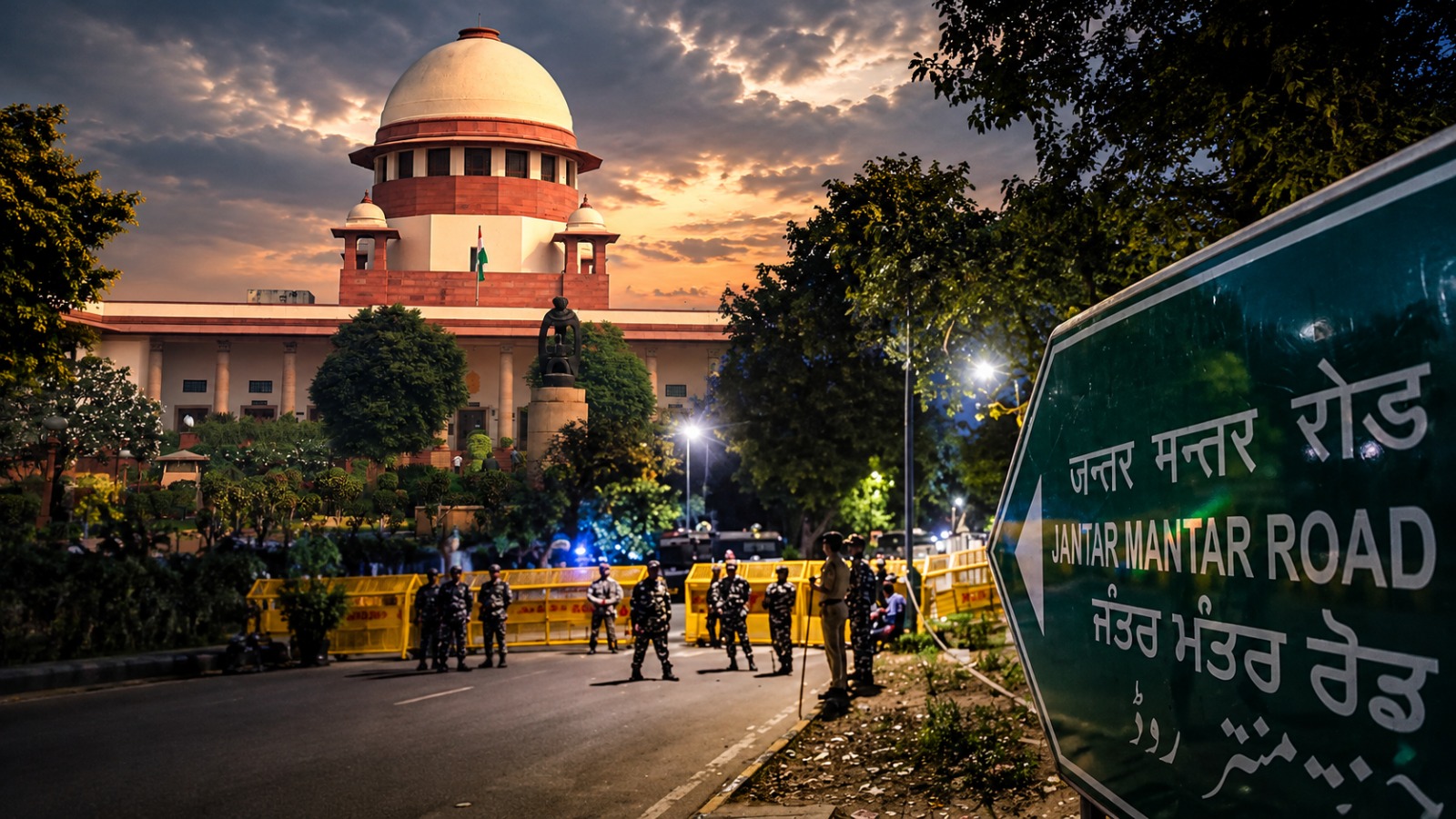
The Supreme Court on Thursday, October 15, sought the Centre’s response to a petition challenging the removal of Jantar Mantar from the list of designated protest sites in the national capital, bringing the right to peaceful demonstration and the regulation of public dissent under renewed judicial scrutiny.
A bench comprising Chief Justice of India Surya Kant and Justice Joymalya Bagchi issued notice on the plea, which challenges the decision to de-notify the historic protest venue and designate three alternative locations for demonstrations. The court said the matter required consideration and sought the government’s response before deciding on the next course of action.
Jantar Mantar replaced by three alternative venues
Delhi Police Commissioner Anurag Kumar issued an order on October 11 removing Jantar Mantar’s designated status as a protest venue. The authorities subsequently identified three alternative locations: Ramlila Maidan, Burari Ground and the CBD Ground in east Delhi.
The decision was based on recommendations from a committee constituted by the Union Ministry of Home Affairs to examine alternative venues for public demonstrations.
The move has triggered legal challenges in both the Supreme Court and the Delhi High Court, with petitioners arguing that shifting demonstrations away from Jantar Mantar could undermine the effectiveness of peaceful protests.
The venue has historically served as a prominent location for citizens, political parties and civil society groups to raise grievances and draw the attention of public authorities.
Supreme Court questions basis of decision
During Thursday’s hearing, the bench examined the circumstances surrounding the de-notification. The court sought to understand whether the decision followed the judges’ earlier observations or resulted from an independent assessment by the authorities.
Solicitor General Tushar Mehta, appearing for the Centre, clarified that the Supreme Court’s earlier order was not the basis for the government’s decision. He told the bench that a committee had been constituted before the court’s observations and had submitted a detailed report supporting the move.
The clarification followed submissions by lawyers that the de-notification had been presented before the Delhi High Court as a consequence of the Supreme Court’s October 9 order.
Senior advocate Gopal Sankaranarayanan, representing the petitioner, urged the court to restore Jantar Mantar’s status as a designated protest site. The bench, however, sought responses from the authorities before considering further directions.
‘The right to protest cannot be scuttled’
Senior advocate Mukta Gupta, appearing for the petitioner, argued that the relocation of demonstrations should not deprive citizens of their constitutional right to express dissent.
“The fundamental right of a citizen to carry out a protest cannot be scuttled because this Court has already ruled in Mazdoor Kisan Shakti Sangathan that the place has to be somewhere near where protesters can be heard,” Gupta told the bench.
She added: “New Delhi is not meant for a select few.”
The arguments highlighted the importance of a protest venue’s accessibility, visibility and proximity to government institutions. The petition contends that merely designating alternative locations does not necessarily preserve the right to protest if those venues make it difficult for demonstrators to communicate their grievances effectively.
The petition also challenges the decision on constitutional grounds, citing Articles 19(1)(a) and 19(1)(b), which protect freedom of speech and expression and the right to assemble peacefully, subject to reasonable restrictions.
Court seeks records on restrictions
The Supreme Court has also sought relevant prohibitory orders issued under Section 163 of the Bharatiya Nagarik Suraksha Sanhita, which empowers authorities to impose restrictions in certain circumstances to prevent potential disturbances.
The bench directed law-enforcement agencies to preserve CCTV footage and other recordings connected with the recent protests in Delhi. These directions form part of the court’s broader examination of petitions concerning police action, restrictions on public movement and alleged interference with demonstrations.
The case places the government’s responsibility to maintain public order alongside citizens’ constitutional protections. While authorities can regulate demonstrations to address legitimate security and logistical concerns, petitioners argue that such measures must not render peaceful dissent ineffective.
The Supreme Court has not yet ruled on the legality of the de-notification. Its decision will depend on the explanations and records submitted by the Centre and the police.