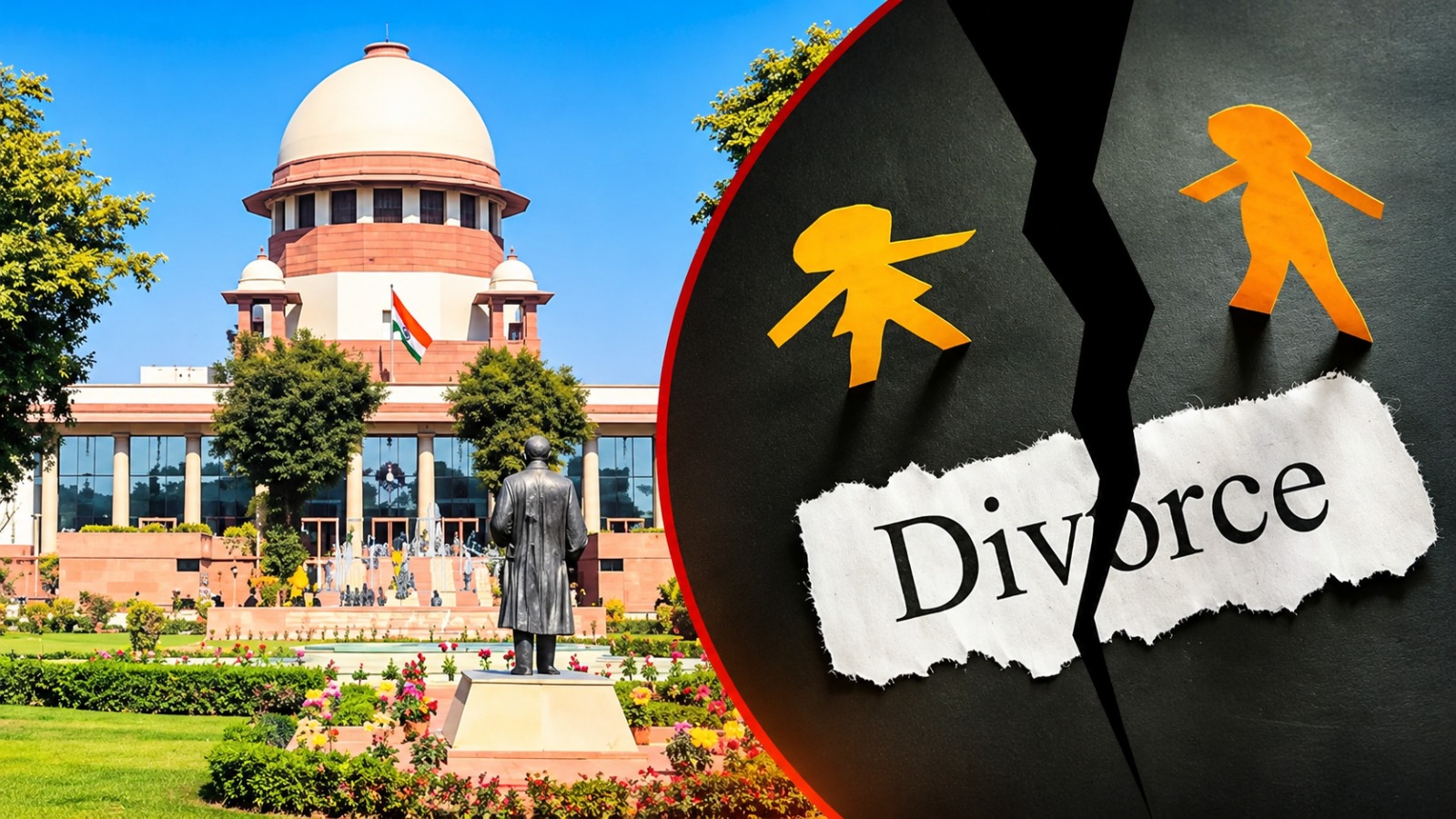
The Supreme Court has ruled that a divorce obtained from a foreign court does not automatically dissolve a marriage solemnised in India under Indian law, particularly when the grounds on which the divorce was granted are not recognised by Indian matrimonial laws.
The ruling came while the apex court refused to quash bigamy proceedings against an Indian-born man who had acquired British citizenship and married another woman in the United Kingdom after obtaining a divorce decree from a UK court.
A bench of Justices Prashant Kumar Mishra and Shree Chandrashekhar held that a foreign divorce decree granted on grounds not recognised under the Hindu Marriage Act, 1955, cannot automatically be treated as valid in India. “In our view, the foreign divorce decree was passed in contravention of the existing matrimonial law in India and on a ground that is not even recognised statutorily,” the bench observed.
Foreign Divorce on Grounds of Irretrievable Breakdown
The case concerned a man who married his first wife in April 2003 in Andhra Pradesh according to Hindu rites and customs. The couple subsequently moved to the United Kingdom, where the husband pursued his career as a doctor.
Following marital differences, the husband initially approached an Indian court seeking divorce. However, after failing to obtain the required relief and subsequently withdrawing his appeal, he initiated fresh divorce proceedings before a UK court in August 2013.
The Cambridge County Court granted him a divorce on the ground of irretrievable breakdown of marriage, making the decree final on January 29, 2014.
He subsequently married another woman in the UK on March 3, 2014.
The first wife later initiated criminal proceedings alleging bigamy and criminal conspiracy, arguing that the foreign divorce decree was not legally valid in India.
‘Change of Nationality Cannot Override Existing Marriage’
Rejecting the husband's argument that he could not face prosecution because he had acquired British citizenship and the second marriage took place outside India, the Supreme Court said the legal consequences of an existing marriage could not be avoided through a subsequent change in nationality.
The bench observed that the first marriage had been solemnised in India under Hindu rites and customs. Therefore, the question of bigamy could not be examined merely by looking at the location of the second marriage.
“Even otherwise, legal consequences flowing from the subsisting marriage cannot be defeated by a subsequent change in the nationality of accused No. 1/husband,” the court said.
The court further clarified that a foreign divorce decree must satisfy the conditions laid down under Section 13 of the Code of Civil Procedure (CPC) to be recognised in India.
Since irretrievable breakdown of marriage is not a statutory ground for divorce under the Hindu Marriage Act, the foreign decree could not automatically dissolve the couple's marriage under Indian law.
Proceedings Against Husband Continue, Parents and Second Wife Get Relief
The Supreme Court declined to interfere with the criminal proceedings against the husband under Section 494 of the Indian Penal Code, which deals with marrying again during the lifetime of a spouse.
The provision corresponds to Section 82 of the Bharatiya Nyaya Sanhita (BNS), 2023.
However, the bench quashed the criminal proceedings against the husband's parents and second wife, observing that there was insufficient material to establish their involvement in a criminal conspiracy or that the second wife had knowingly participated in the alleged offence.
The ruling reinforces the principle that individuals whose marriages are solemnised in India cannot simply rely on foreign divorce orders to bypass applicable Indian matrimonial laws and enter into another marriage.