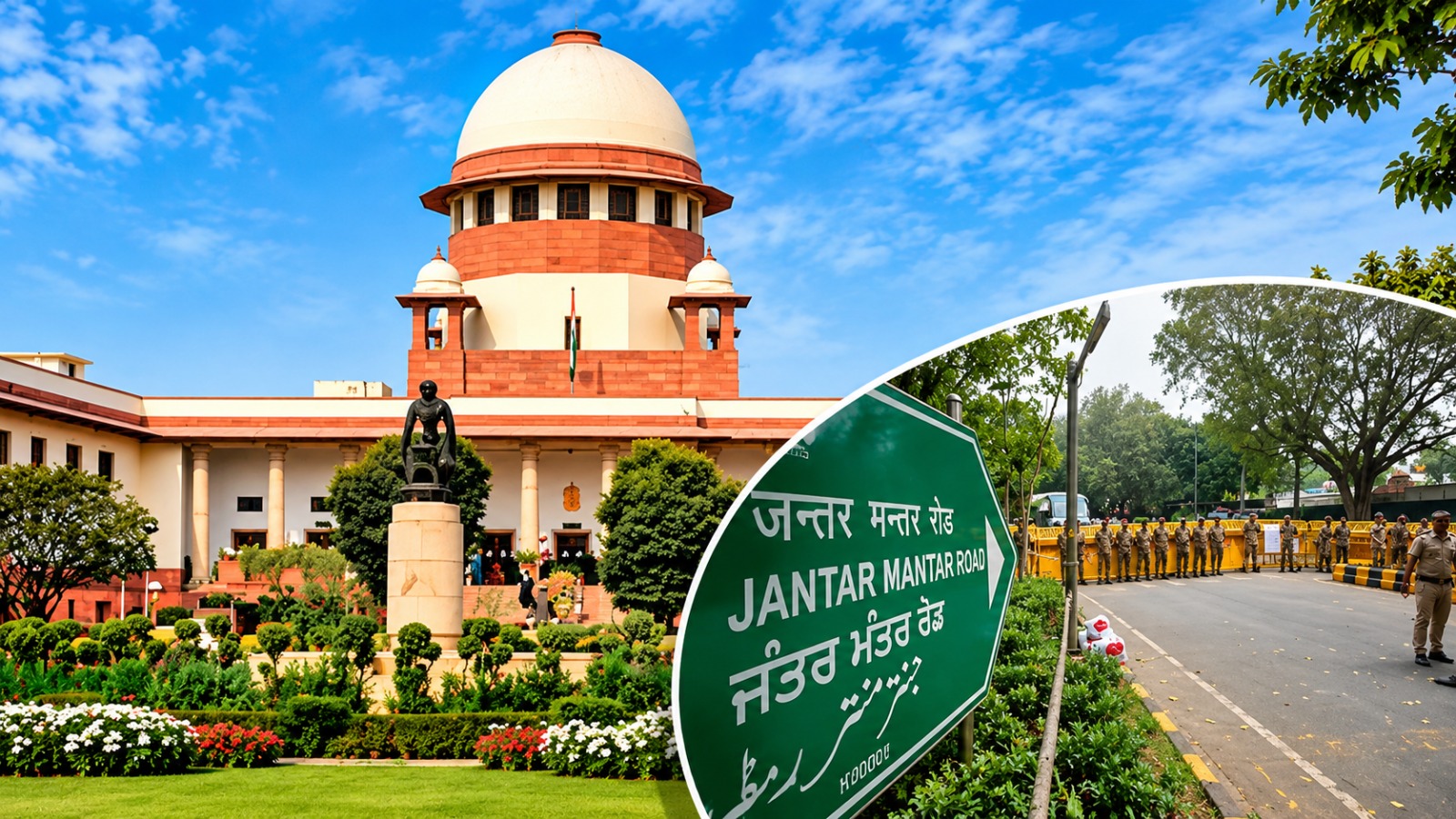
The Supreme Court on Tuesday, November 3, observed that a designated protest site cannot be occupied indefinitely by any individual, group or organisation, emphasising that the right to protest must be balanced against the rights of other citizens.
A bench comprising Chief Justice of India Surya Kant, Justice Joymalya Bagchi and Justice V Mohana was hearing a batch of petitions concerning police action during protests in Delhi against Chief Election Commissioner Gyanesh Kumar.
The court highlighted the need to ensure that public spaces remain accessible to different groups seeking to exercise their democratic rights.
“You cannot occupy a site for all times to come. There are other protesters. Where will the farmers go? Where will the workers go? Where will the trade unions go? Where will the homeless go? Everybody has a right to protest,” Chief Justice Surya Kant observed.
The bench said that designated protest venues should be allotted for specific periods so that one group does not prevent others from exercising their right to peaceful demonstration.
Supreme Court Stresses Balance Between Protest and Livelihood
The observations came amid concerns raised by traders’ associations over the impact of prolonged demonstrations on commercial activities in Delhi.
Senior advocate Mukul Rohatgi, appearing for the traders, claimed that businesses had suffered losses worth thousands of crores due to protests and disruptions during the festive season.
He urged the court to consider restrictions on demonstrations in Delhi for the next two months, arguing that traders and daily-wage workers were facing serious financial difficulties.
The bench, however, stressed that the issue involved competing constitutional rights.
“It is a competing right — your right to trade, business and earn livelihood and someone’s right to protest peacefully,” the court observed.
The Chief Justice said the right to livelihood was not limited to commercial establishments but also included daily-wage workers who depend on regular business activity for their earnings.
“There are conflicting claims. The right to protest is also a constitutionally recognised right, as is the right to trade and carry on business. We are talking about the source of livelihood of a daily-wage worker,” CJI Surya Kant said.
Traders Seek Restrictions on Protests During Festive Season
The Kirana Committee Delhi and other traders’ associations approached the Supreme Court, alleging that demonstrations around Jantar Mantar and Ramlila Maidan had adversely affected business in several parts of the capital.
Rohatgi claimed that shops in Connaught Place and other commercial areas had remained closed or experienced reduced customer footfall because of traffic restrictions and disruptions.
The traders sought a ban on protests and dharnas during the festive period, arguing that the commercial sector was already struggling to recover from the losses.
The Supreme Court issued notice on the traders’ plea but directed them to implead the organisers of the protests as parties to the proceedings.
The bench said that the organisers must also be heard before a decision could be taken on the competing claims.
Solicitor General Says Protest Site Was Occupied for 17 Days
Solicitor General Tushar Mehta, appearing for the Centre and Delhi Police, told the court that permission for a protest in July had been granted for only one day.
However, according to Mehta, the protesters continued occupying the site for 17 days.
He also alleged that the protesters subsequently attempted to march towards Parliament without permission.
The Solicitor General argued that organisers of protests must take responsibility for the consequences of their actions and that designated protest sites cannot be used beyond the period for which permission has been granted.
The court emphasised that orders granting or refusing permission for demonstrations should clearly specify the conditions and duration of the protest.
Jantar Mantar’s Status as a Protest Site Under Scrutiny
The hearing also touched upon the Delhi Police’s decision to denotify Jantar Mantar as a designated protest site and shift demonstrations to other locations, including Ramlila Maidan, Burari Ground and CBD Ground.
The court is examining whether the authorities had independently assessed the suitability of Jantar Mantar as a protest venue before taking the decision.
The proceedings also involved petitions alleging police excesses, mass detentions, internet restrictions and the closure of metro stations during the demonstrations.
Advocates raised concerns over alleged harassment of journalists, detention of lawyers and the use of facial recognition technology and surveillance at protest sites.
The Supreme Court decided to divide the connected petitions into nine categories for separate hearings.