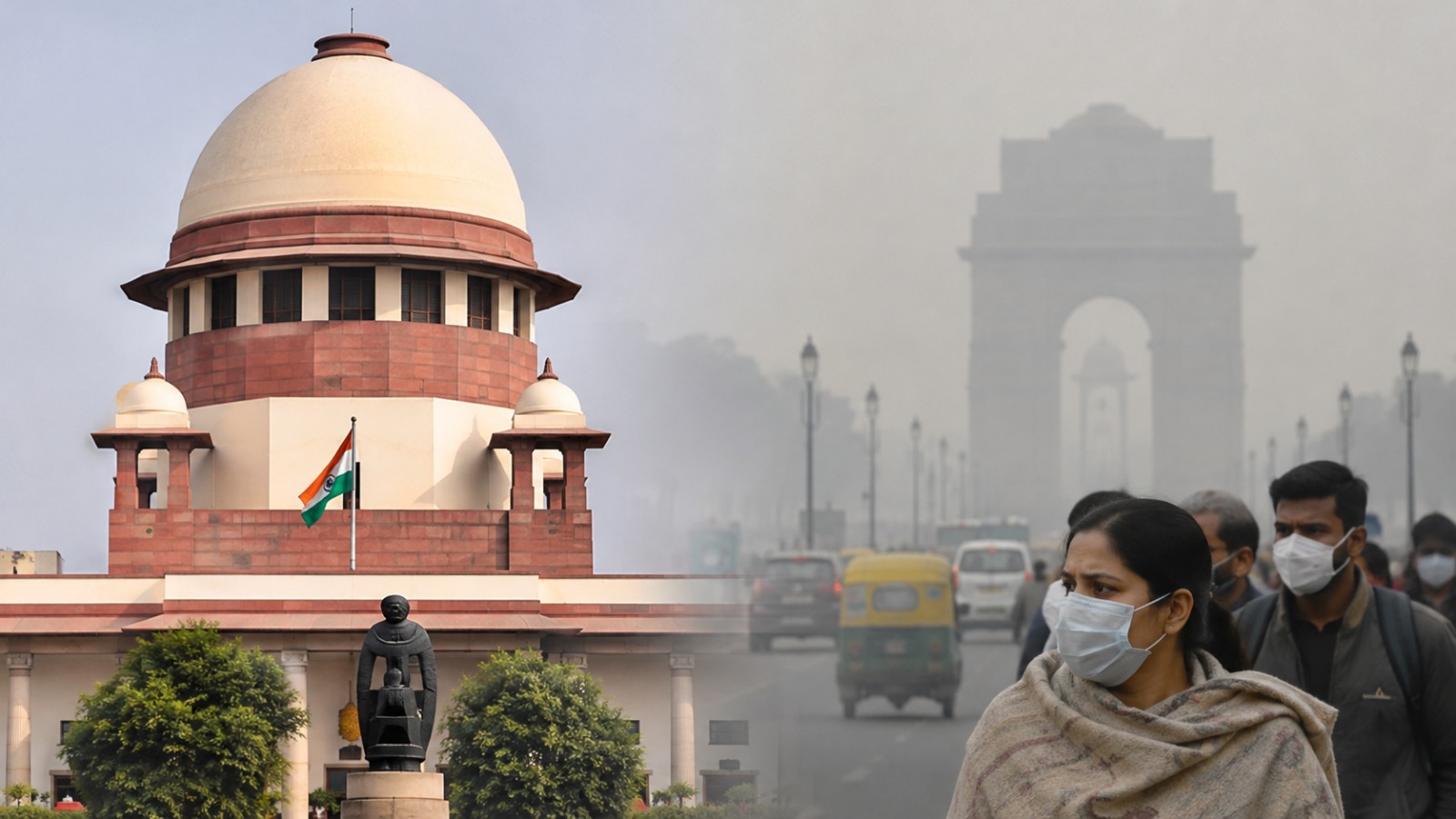
The Supreme Court on Friday began hearing the worsening air pollution crisis in Delhi-NCR with a pointed remark from Chief Justice of India (CJI) Surya Kant, who asked those present in court, “I hope you all are enjoying the weather in Delhi.”
A three-judge Bench comprising CJI Surya Kant and Justices Joymalya Bagchi and V Mohana was hearing the matter concerning deteriorating air quality in the national capital and the surrounding region.
Responding to the Chief Justice's remark, senior advocate Aparajita Singh, who is assisting the court as amicus curiae, said pollution levels were hovering around the 'severe' category and were beginning to affect people's voices. “It's like smoking 30 cigarettes a day,” Singh said, describing the impact of breathing the polluted air.
The Chief Justice subsequently observed that pollution levels had fallen because of rainfall. Aparajita Singh, however, pointed out that stubble burning had contributed 14 per cent to Delhi's pollution on November 5. “Delhi is already highly polluted,” she said, adding that farm fires further worsen the situation. She stressed the need to address both stubble burning and local sources of pollution, including waste burning.
During the hearing, the Bench questioned whether stubble burning alone could be held responsible for Delhi's pollution crisis, drawing attention to emissions from private vehicles, particularly those owned by affluent sections of society. “Stubble, we keep on talking about... You have provided equipment. Maybe some may still be hesitant about it. What about elite class people? Vehicles, high-end cars all operate...” the court remarked. Aparajita Singh agreed that transportation was a major contributor to air pollution in the National Capital Region (NCR), calling it the biggest problem that required urgent attention.
The Chief Justice also flagged the problem of vehicles moving bumper-to-bumper on roads connecting Delhi with neighbouring NCR areas, pointing to vehicular emissions as a significant source of pollution.
The Bench also emphasised the need for a more organised approach to tackling stubble burning, suggesting that procurement prices for crop residue should be announced well in advance. It said a proper stubble-management mechanism should be made available to gram panchayats so that farmers could access the necessary facilities and equipment. The Chief Justice observed that farmers would be preparing for the next sowing season, suggesting that stubble burning should have stopped by this stage.
Meanwhile, Aparajita Singh highlighted that an earlier Supreme Court directive against vehicles idling for prolonged periods at toll plazas was not being properly implemented. She said vehicles entering Delhi from the NCR were frequently stopped at the borders, where they continued running their engines and adding to pollution.
Appearing for the Centre, Additional Solicitor General Aishwarya Bhati told the court that the government had already introduced measures to tackle stubble burning and vehicular emissions. She said restrictions had been imposed on vehicles entering Delhi, with only Bharat Stage VI-compliant vehicles permitted. The government had also initiated the phased removal of diesel-powered rickshaws and introduced regulations for buses entering the capital from other cities.
Bhati further said pollution certificates were geotagged at the point of issuance and that fuel was not being supplied to vehicles without valid certificates. “I won't say there is a complete failure of these measures,” she told the Bench. The Chief Justice, however, pointed out that Delhi's Air Quality Index (AQI) was already approaching 400. “But the AQI is already touching 400,” CJI Surya Kant observed. “Yes, because many activities cause pollution,” Bhati responded, adding that the festival season had also contributed to the pollution load.
Delhi's air quality deteriorated further on Friday, with the overall AQI reaching 391, bringing the capital close to the 'severe' category, according to reports.