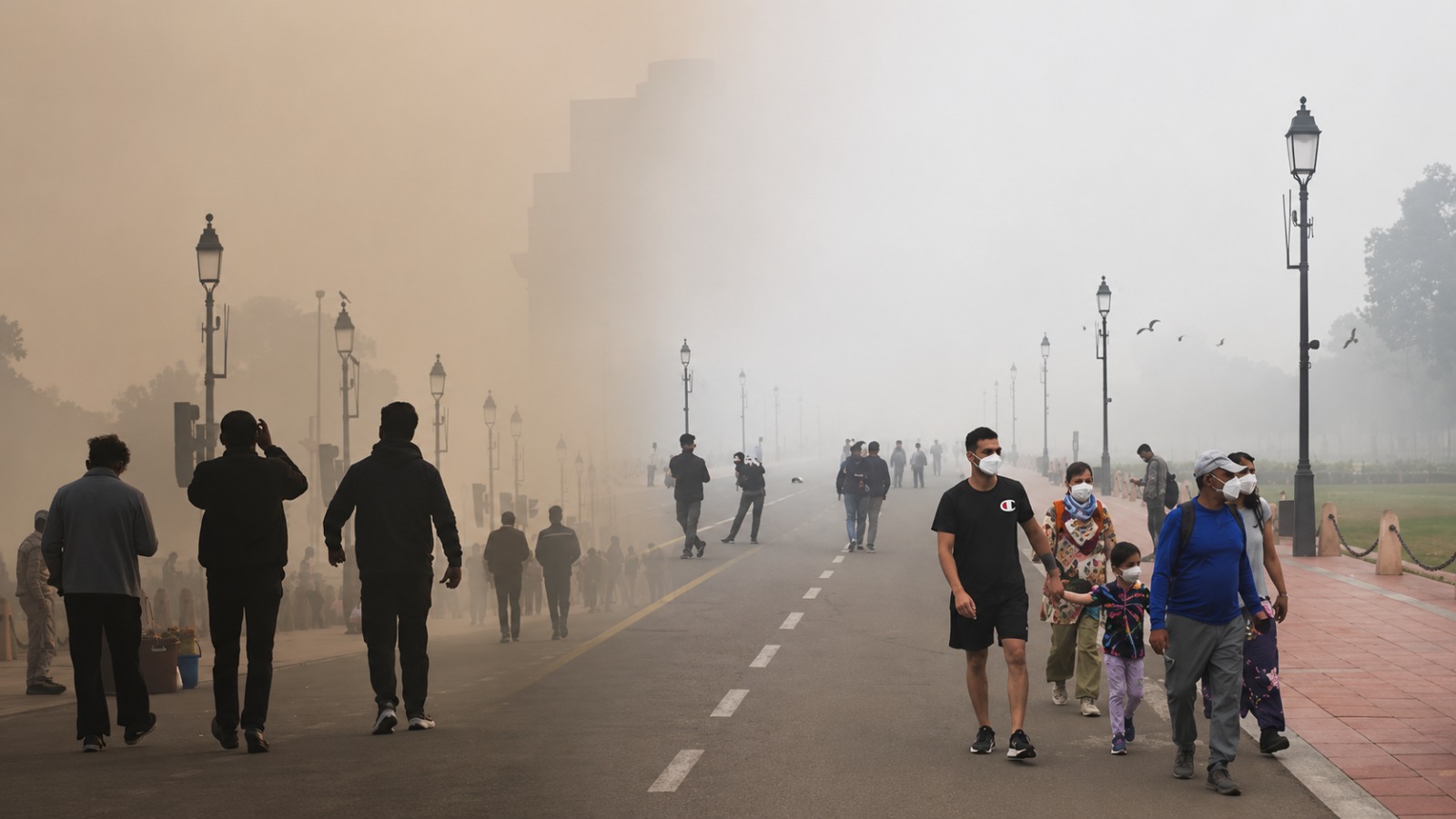
Delhi witnessed an extreme surge in air pollution during Diwali celebrations, with several monitoring stations recording hazardous concentrations of fine particulate matter (PM2.5). Jahangirpuri in northwest Delhi emerged as one of the worst-affected areas, with an hourly reading of 4,985 micrograms per cubic metre (µg/m³), nearly 83 times the national 24-hour permissible limit.
The reading was recorded at 6pm and 8pm on November 8, before pollution levels surged again the following morning, according to an analysis of real-time data by The Times of India. However, the Delhi Pollution Control Committee (DPCC) subsequently revised its figures, showing Jahangirpuri's peak PM2.5 concentration at 776 µg/m³ around midnight on Diwali.
The differing figures have raised questions about the accuracy and consistency of pollution monitoring during peak pollution hours.
The national 24-hour standard for PM2.5 is 60 µg/m³, while the World Health Organisation's daily guideline is 15 µg/m³. The initial Jahangirpuri reading was therefore more than 332 times the WHO guideline.
Multiple Delhi neighbourhoods record hazardous pollution
Jahangirpuri was not the only area to experience an extraordinary rise in pollution. Mundka in west Delhi recorded an hourly PM2.5 concentration of 3,744 µg/m³ at 2am on Monday, rising sharply from 245 µg/m³ at 7pm on Diwali.
Other monitoring stations also registered alarming readings. JNU recorded 3,023 µg/m³ at 4am on Monday, while NSUT's west campus registered 3,008 µg/m³. Mandir Marg recorded a peak of 2,908 µg/m³.
Among other locations, Nehru Nagar recorded 2,808 µg/m³, Wazirpur 2,721 µg/m³, Talkatora Garden 2,599 µg/m³, Patparganj 2,597 µg/m³, Ashok Vihar 2,589 µg/m³ and the Commonwealth Games Sports Complex in Akshardham 2,471 µg/m³.
The sharpest increases were largely recorded around midnight, coinciding with widespread firecracker use. Pollution levels remained elevated across several parts of the capital until at least 6am on Monday.
Experts warn of serious health consequences
Sunil Dahiya, founder of environmental think tank Envirocatalyst, said people across Delhi were exposed to extremely high concentrations of fine particulate matter during Diwali night.
“Through Diwali night, people across Delhi inhaled PM2.5 averaging 450 to 550 µg/m³. That is eight to nine times the national 24-hour standard and 30 to 37 times WHO’s guideline,” he said.
Warning about the health implications, Dahiya added, “Even a few hours at these levels can trigger asthma attacks, worsen lung diseases and raise the risk of heart attacks and strokes.”
He said children, elderly people, pregnant women, outdoor workers and those with existing heart or respiratory conditions were particularly vulnerable.
“Fine particles reach deep into their lungs and bloodstream, and the coarser PM10 inflames airways and eyes,” Dahiya said.
He also pointed out that Delhi's air quality was already more than twice the safe limit before the Diwali celebrations began.
PM10 levels also cross permissible limits
The pollution spike was not restricted to PM2.5. Several parts of Delhi recorded extremely high concentrations of PM10, which includes larger inhalable particles.
Punjabi Bagh recorded an hourly PM10 concentration of 4,697 µg/m³, nearly 47 times the national 24-hour standard of 100 µg/m³ and more than 104 times the WHO daily guideline of 45 µg/m³.
Other high readings included 3,929 µg/m³ at Patparganj, 3,490 µg/m³ at Anand Vihar, 2,881 µg/m³ at RK Puram, 2,879 µg/m³ at Nehru Nagar and 2,671 µg/m³ at Wazirpur.
The readings underline the scale of the pollution episode during the festival, with firecracker emissions contributing to a sharp deterioration in air quality across the national capital.