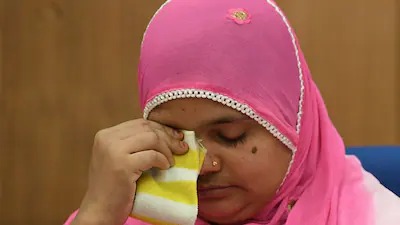
More than two decades after the 2002 Gujarat riots shattered her life, Bilkis Bano is once again preparing for a legal battle. The survivor of the gang rape and murder case has strongly criticised the Supreme Court's decision to suspend the life sentences of two convicted men and grant them bail, questioning why she was neither informed nor given an opportunity to be heard before the order was passed.
In an emotional statement issued on November 16 through her lawyer, senior advocate Shobha Gupta, Bano said the development had revived fears that she had struggled for years to overcome. She also announced that she would challenge the latest order, making it clear that she was not prepared to abandon her fight for justice.
"I still cannot believe that once again, for the second time, an order has been passed by the Supreme Court without calling me up and without hearing me. I learnt of this through press reports," Bano said.
The latest controversy centres on a Supreme Court order dated October 28, under which a bench of Justices M M Sundresh and P B Varale suspended the life sentences of Bipinchand Kanaiyalal Joshi and Pradeep Ramanlal Modhiya. Both men were among the 11 people convicted in the Bilkis Bano gang rape and murder case arising from the 2002 Gujarat riots.
The court granted them bail while their appeals against conviction and sentence remain pending.
'I am scared for myself, my family and my children'
Recounting the trauma she has endured since the Gujarat riots, Bano said she was only 19 years old when the attack destroyed her family and changed her life forever.
She was gang-raped during the communal violence, while seven members of her family, including her three-year-old daughter Saleha, were murdered.
"For 24 long years since that day, I have stood up to fight for justice – for myself and for women everywhere – again and again and again," she said.
Bano acknowledged the support she had received from people throughout her prolonged legal struggle. She said she had appeared in court after court, gradually rebuilt her life with the help of family and friends, and attempted to regain her faith in the justice system.
However, the latest development has left her deeply unsettled.
"Yet today I find myself losing the very justice I had fought so hard to win. Familiar fears are resurfacing. I am scared once again. For myself, my family, and my children. And I am scared of losing faith in justice, yet again," she said.
Questioning the circumstances in which the two convicts received relief, she asked why the court had not ensured that she was informed about the proceedings.
"How could the honourable Supreme Court simply suspend the sentence of the men who did this to me? How could they not even inform me? How could they not even make sure my voice was heard in their courtroom?" she asked.
Why did the Supreme Court grant bail?
The Supreme Court's October 28 order came while hearing appeals filed by the two convicts against their convictions and life sentences.
The bench took note of the fact that both men had spent more than 17 years in prison. It also considered the severe physical handicap of one of the appellants and observed that several questions of fact and law remained to be examined in the pending appeals.
In its order, the bench observed: "Having heard the parties, suffice it to state that the appellants have been under incarceration for a period of more than 17 years, and also the fact remains that one of the appellants has a severe handicap. Certainly, there are issues to be decided in the appeal, both on fact and law."
The court subsequently ordered the suspension of their sentences and granted bail subject to conditions to be imposed by the concerned trial court.
Importantly, the order does not overturn their convictions. The appeals challenging their convictions and sentences are still pending before the Supreme Court.
From the 2022 remission controversy to the latest setback
The latest development comes against the backdrop of another major legal controversy involving the 11 convicts.
In August 2022, the Gujarat government granted remission to all 11 men, allowing them to walk free after spending years in prison. Their release triggered widespread outrage and a legal challenge before the Supreme Court.
On January 8, 2024, the Supreme Court quashed the remission orders, ruling that the Gujarat government did not have the authority to grant relief in the case because the trial had been transferred to Maharashtra. The convicts were subsequently directed to surrender and return to prison.
The January 2024 ruling was widely seen as a significant development in Bano's prolonged fight for justice.
The latest suspension of sentences for two of the convicts has, however, reopened questions surrounding the case and brought Bano's concerns back into the spotlight.
'I will fight this order. I must'
Despite expressing fear and disappointment, Bano has made it clear that she intends to continue her legal fight.
In her statement, she said her struggle was not limited to her own experience but was also about ensuring that other survivors of sexual violence are not forced to spend their entire lives seeking justice.
Referring to her murdered daughter Saleha, she said:
"I do this for my three-year-old Saleha who deserved to live, and whose memory demands justice. I do this for women everywhere."
She added that no survivor should have to endure a lifetime of uncertainty and repeatedly fight to have their voice recognised.
"Because no woman, no survivor, no citizen should have to endure this eternal test of belonging and equality, and fight for justice for the rest of her life," she said.
Bano ended her statement with a firm declaration of intent: "I will fight this order. I must."