
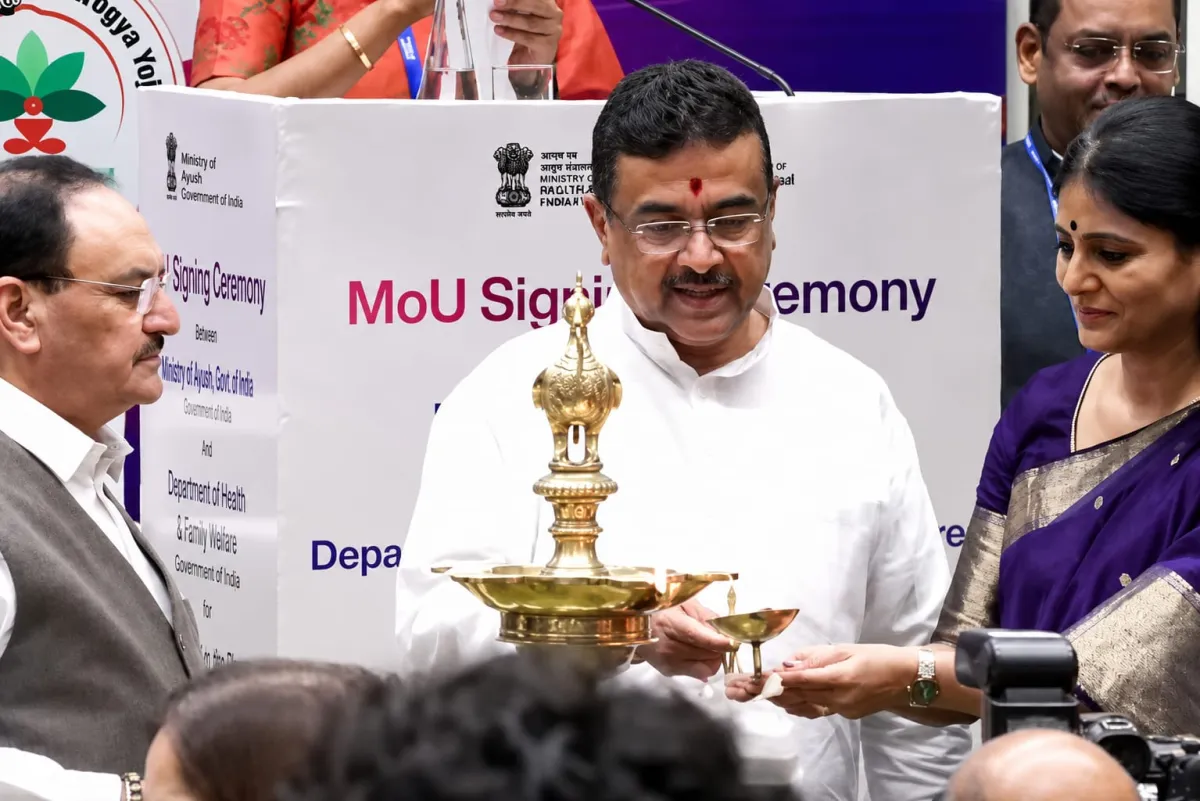
In a significant development for the healthcare sector, the West Bengal government has formally signed a Memorandum of Understanding (MoU) with the Centre for the implementation of the Ayushman Bharat Pradhan Mantri Jan Arogya Yojana (AB-PMJAY), bringing the state into the fold of the country’s flagship public health insurance programme.
With the signing of the agreement between the National Health Authority (NHA) and the West Bengal Department of Health and Family Welfare, the state becomes the 36th State/Union Territory to implement Ayushman Bharat, a scheme widely described as the world’s largest publicly funded health assurance programme.
The MoU was signed at Vigyan Bhawan in New Delhi in the presence of senior representatives of both the Union and state governments. The development marks the culmination of a long-standing debate over the implementation of the central health insurance scheme in West Bengal and is being viewed as a major policy shift in the state’s healthcare landscape.
According to the Union Health Ministry, the inclusion of West Bengal is expected to strengthen efforts toward universal health coverage and improve access to quality healthcare services, particularly for economically vulnerable sections of society. The Centre described the move as a “major milestone” in ensuring equitable and accessible healthcare across the country.
Ayushman Bharat PM-JAY provides eligible beneficiary families with cashless health insurance coverage of up to ₹5 lakh per family annually for secondary and tertiary hospitalisation. The scheme covers a wide range of medical procedures, including surgeries, diagnostics, hospitalisation expenses and post-treatment care. Senior citizens aged 70 years and above are also eligible under the programme irrespective of income status.
Officials said the rollout is expected to significantly widen access to healthcare benefits across the state. Reports indicate that over one crore families could potentially come under the scheme’s ambit, while existing beneficiaries of state-run health programmes may also be integrated into the new framework through a phased process.
The implementation of Ayushman Bharat has long remained a politically sensitive issue in West Bengal. For years, the state relied on its own health insurance initiative, Swasthya Sathi, while staying outside the central scheme. The latest agreement effectively ends that standoff and opens the door for integration with the national healthcare network.
Healthcare experts say one of the major advantages of Ayushman Bharat is portability, allowing beneficiaries to access treatment at empanelled hospitals across India. This could particularly benefit migrant workers, patients requiring specialised treatment outside the state, and families seeking access to a wider network of healthcare facilities.
The Centre has repeatedly maintained that the scheme is designed to reduce out-of-pocket medical expenditure and protect economically weaker households from catastrophic healthcare costs. The programme currently operates across almost the entire country and has facilitated millions of hospital admissions since its launch.
While the signing of the MoU marks the formal beginning of the process, officials indicated that enrolment, beneficiary verification, and operational integration will take place in phases. Detailed guidelines regarding implementation, beneficiary databases, and coordination with existing state healthcare programmes are expected to be released in the coming weeks.
The agreement is expected to have far-reaching implications for healthcare delivery in West Bengal, with policymakers presenting it as a step towards expanding financial protection and improving access to quality medical treatment for millions of residents across the state.