In its first full Budget since assuming office, the BJP-led West Bengal government on Monday unveiled an expansive package of welfare, employment and infrastructure measures, headlined by a 20 per cent increase in Dearness Allowance (DA) for state government employees and a large-scale recruitment drive across government departments. The Budget was presented in the West Bengal Assembly by Finance Minister Swapan Dasgupta.
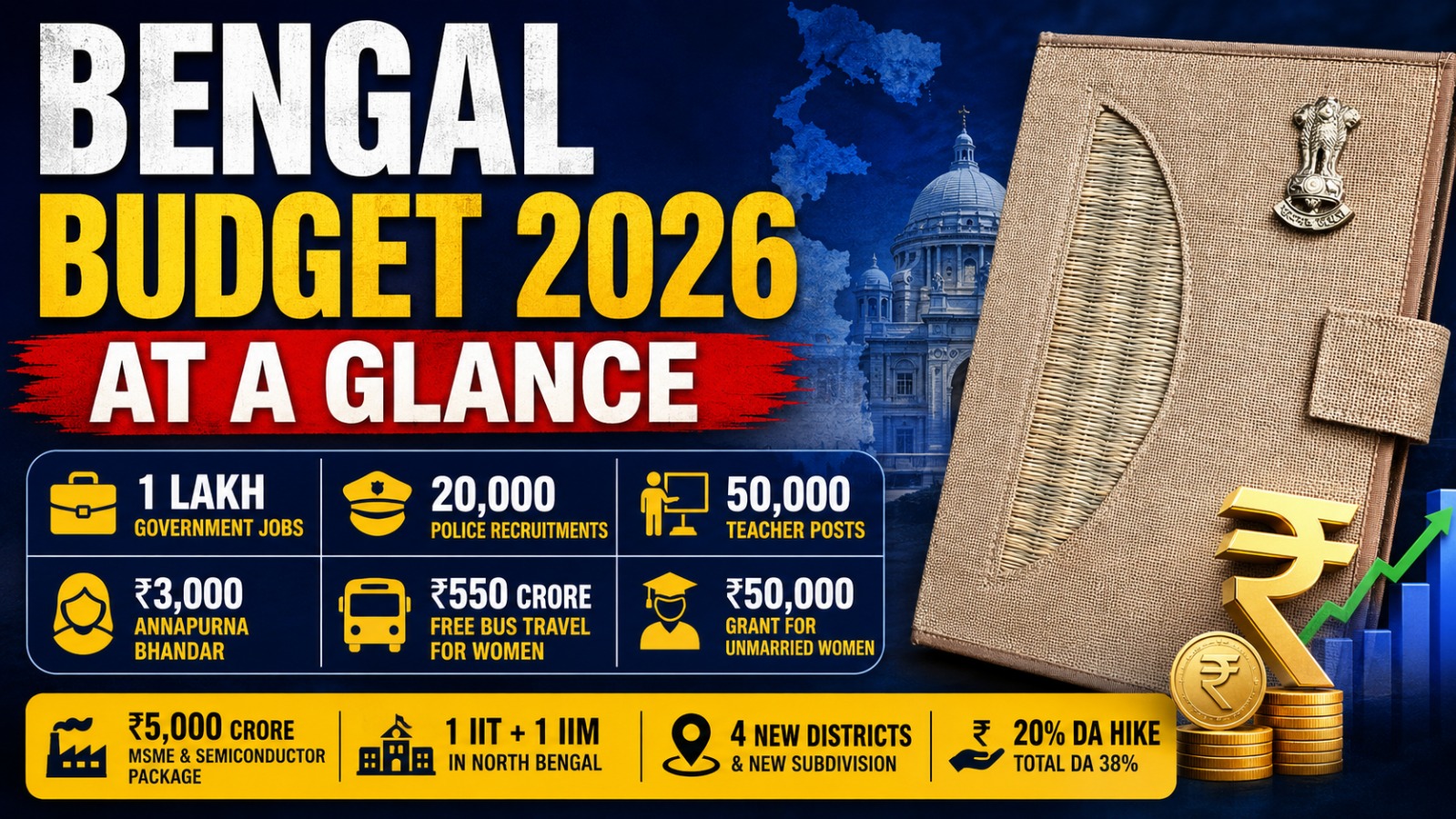
The DA hike, one of the most closely watched announcements, will raise the total DA payable to state government employees to 38 per cent. Pensioners will also receive a corresponding 20 per cent increase in Dearness Relief (DR), with the revised rates coming into effect from October 1, 2026. The government also announced a monthly pension of ₹5,000 for retired journalists.
In a significant push towards employment generation, the government announced recruitment for one lakh vacant government posts, with 33 per cent reservation for women. The Budget also proposes 20,000 new recruitments in the police force and 50,000 teacher appointments. Candidates seeking government employment will receive upper-age relaxation for the next two years.
The government introduced a new welfare programme, Bharosa, replacing the previous Yuva Sathi scheme. From October, unemployed graduates between the ages of 21 and 45 will receive a monthly allowance of ₹3,000, while other eligible beneficiaries will receive ₹2,000 per month. Students of government and government-aided colleges preparing for competitive examinations will also be entitled to a one-time grant of ₹25,000.
Women-centric welfare measures featured prominently in the Budget. The government announced Annapurna Bhandar, under which women beneficiaries will receive ₹3,000 per month. A sum of ₹550 crore has been allocated to provide free transportation for women on state-run buses. Under the PM Matri Vandana Yojana, pregnant mothers will receive financial assistance of ₹21,000 along with six nutritional kits.
The Budget also announced a one-time grant of ₹50,000 for unmarried women pursuing higher education at the time of college admission. Social welfare allocations saw a further boost, with old-age, widow and disability allowances being increased by ₹500. The old-age pension has been raised from ₹1,000 to ₹1,500 per month.
For frontline personnel, the government announced a monthly honorarium increase of ₹2,000 for Civic Volunteers, Green Police personnel, NVF members, Pranibandhu workers and Pranimitra workers. Anganwadi and ASHA workers will receive a monthly salary increase of ₹5,000.
The agriculture sector received several targeted interventions. Farming families will receive annual assistance of ₹3,000 for the purchase of seeds, while subsidised electricity for submersible pumps and the Annapurna Income Protection Scheme were also announced. The government additionally proposed cold storage facilities for potato farmers and flower cultivation clusters in Howrah, Nadia and Purba Medinipur districts.
A major focus of the Budget was higher education and regional development, particularly in North Bengal. The government proposed establishing an Indian Institute of Technology (IIT) and an Indian Institute of Management (IIM) in North Bengal. It also announced an Adivasi University in Jhargram district with an allocation of ₹10 crore and proposed the creation of a Sports University.
Sports infrastructure received attention through a proposal for an international-standard stadium in North Bengal, backed by an allocation of ₹20 crore. A new 3D Animation course was also announced as part of the government's skill development initiatives.
In the infrastructure sector, the government proposed new airports at Balurghat and Malda, expansion of Cooch Behar Airport, and a second greenfield airport near Kalyani. Support was also announced for the expansion of Hasimara and Kalaikunda Air Force Stations.
Urban connectivity projects include a proposed elevated corridor linking Chingrighata and New Town, while metro rail systems have been proposed for Durgapur and Asansol. The Budget also includes plans for a deep-sea port at Dadanpatrabar and a four-lane bridge over the Mayurakshi River in Birbhum.
One of the major infrastructure announcements was an allocation of ₹1,200 crore for the long-pending Ghatal Master Plan, which the government said would be implemented with assistance from the Centre. The Budget also announced Ganga dredging works aimed at reducing flood risks.
Industry and entrepreneurship featured prominently in the government's growth agenda. A new Startup Policy will be introduced, supported by two dedicated funds worth ₹40 crore and ₹60 crore respectively. The government also announced a ₹5,000 crore package for MSMEs and semiconductor sector development in North Bengal, alongside measures to revive the state's jute industry.
Food security initiatives include the establishment of new Maa Aahar centres in urban areas and the provision of fish-rice meals at a subsidised rate of ₹5.
The government also proposed a major administrative reorganisation, including the creation of four new districts, Basirhat, Sundarbans, Jangipur and Arambag, as well as a new subdivision at Gopiballavpur. Several new municipalities are also expected to be formed.
Among regulatory measures, the government announced that no new liquor shop licence would be granted within one kilometre of a school. Within the Kolkata Municipal Corporation area, the minimum distance requirement has been fixed at 500 metres.
Presenting the Budget, the government said its broader objective was to contribute towards the vision of a "Viksit Bharat" while continuing welfare schemes and restoring Bengal's prominence at the national level.