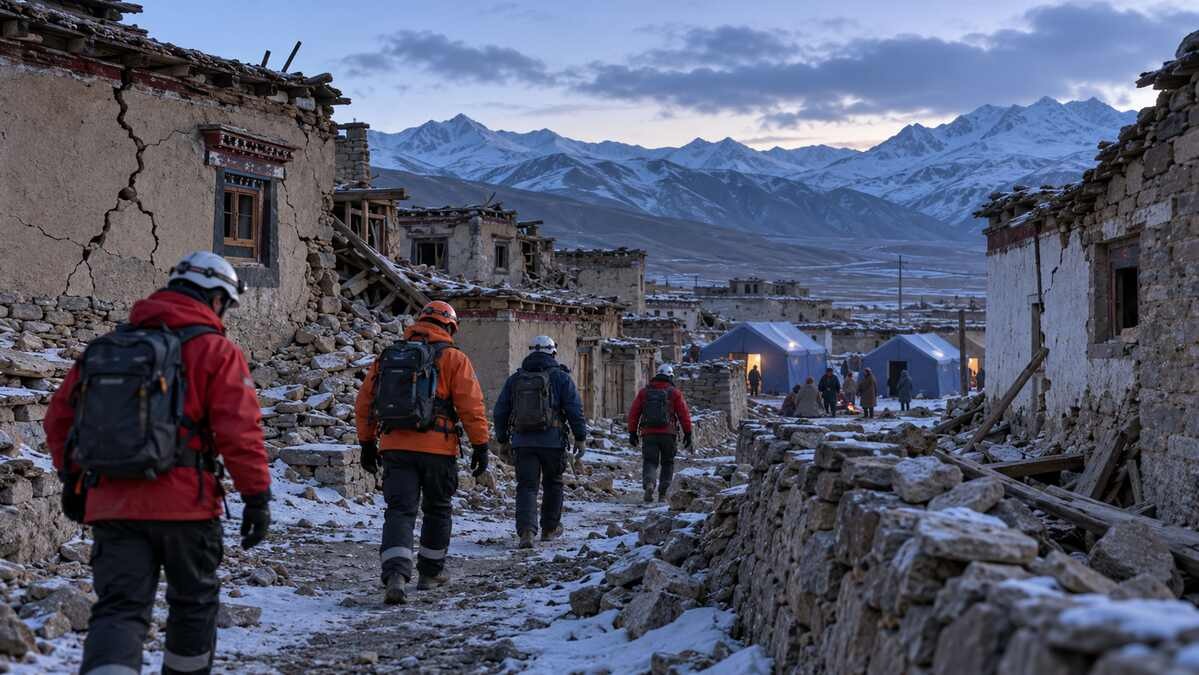
A powerful earthquake measuring 7.0 in magnitude struck China's Tibet region on Thursday night, killing at least 16 people and injuring 76, according to the latest figures released by local authorities on Friday. Rescue operations are under way, with thousands of residents relocated as officials assess the damage and warn of further risks from aftershocks.
The tremor struck at around 10.33 pm local time on 22 October, with its epicentre in Nagqu, a sparsely populated, high-altitude area in northern Tibet. The China Earthquake Networks Centre (CENC) placed the quake's depth at 10 kilometres, while the United States Geological Survey (USGS) estimated it at approximately 18 kilometres.
The earthquake is the strongest to hit China since January 2024, Reuters reported. Authorities have warned that buildings damaged during the initial tremor could remain vulnerable to collapse as aftershocks continue. According to Reuters, more than 12,000 people had been relocated to safer areas by Friday.
The scale of the destruction is becoming clearer as emergency teams reach affected communities. Local government figures cited by the Associated Press (AP) indicate that at least 339 homes and 20 livestock sheds have collapsed. More than 1,600 personnel have been mobilised for rescue and relief operations. Emergency supplies sent to the region include around 3,000 tents, folding beds, winter clothing and 1,000 prefabricated housing units to accommodate displaced residents.
The USGS placed the epicentre approximately 191 kilometres east-north-east of Nagqu. Its initial assessment recorded seven aftershocks measuring between 4.3 and 5.2 in magnitude. Reuters subsequently reported that the CENC had recorded 413 aftershocks, highlighting the continuing seismic activity in the region.
The earthquake has also affected essential infrastructure. China's state news agency Xinhua reported disruptions to communications in some areas, while railway authorities temporarily halted train movements as a precaution. Rockfalls triggered by the tremor forced the closure of a section of National Highway 317. Authorities restricted access to emergency, rescue and support vehicles while crews worked to clear debris.
The response has been complicated by the prospect of intermittent snowfall over the following three days, according to Xinhua. The cold conditions pose additional challenges for people displaced from damaged homes and for rescue workers operating in the high-altitude region.
Footage released by local state-run media showed residents leaving buildings and gathering outdoors or taking shelter in parked vehicles after the tremor. Reuters also reported that police officers were sent to inspect damaged properties, distribute supplies and help residents move to safer locations.
Authorities have urged residents to remain cautious around buildings that sustained cracks or other structural damage. Even where homes remain standing, weakened walls and foundations may pose a risk if further tremors occur. According to official reports, the priority remains locating people who may still require help, treating the injured and providing emergency accommodation to those unable to return home.
The latest earthquake has renewed concerns about seismic hazards across the Himalayan region and neighbouring parts of western China, where powerful tremors have caused extensive destruction in the past. In January 2025, an earthquake in Tingri county in Tibet killed at least 126 people. A magnitude-7.1 earthquake that struck Yushu in neighbouring Qinghai province in 2010 killed at least 2,698 people and left nearly 300 others missing, according to Reuters.
Rescue and relief operations in Nagqu are continuing as authorities assess the full extent of the damage. With aftershocks still being recorded and temperatures expected to fall, attention remains focused on the safety of displaced residents and the recovery of affected communities.