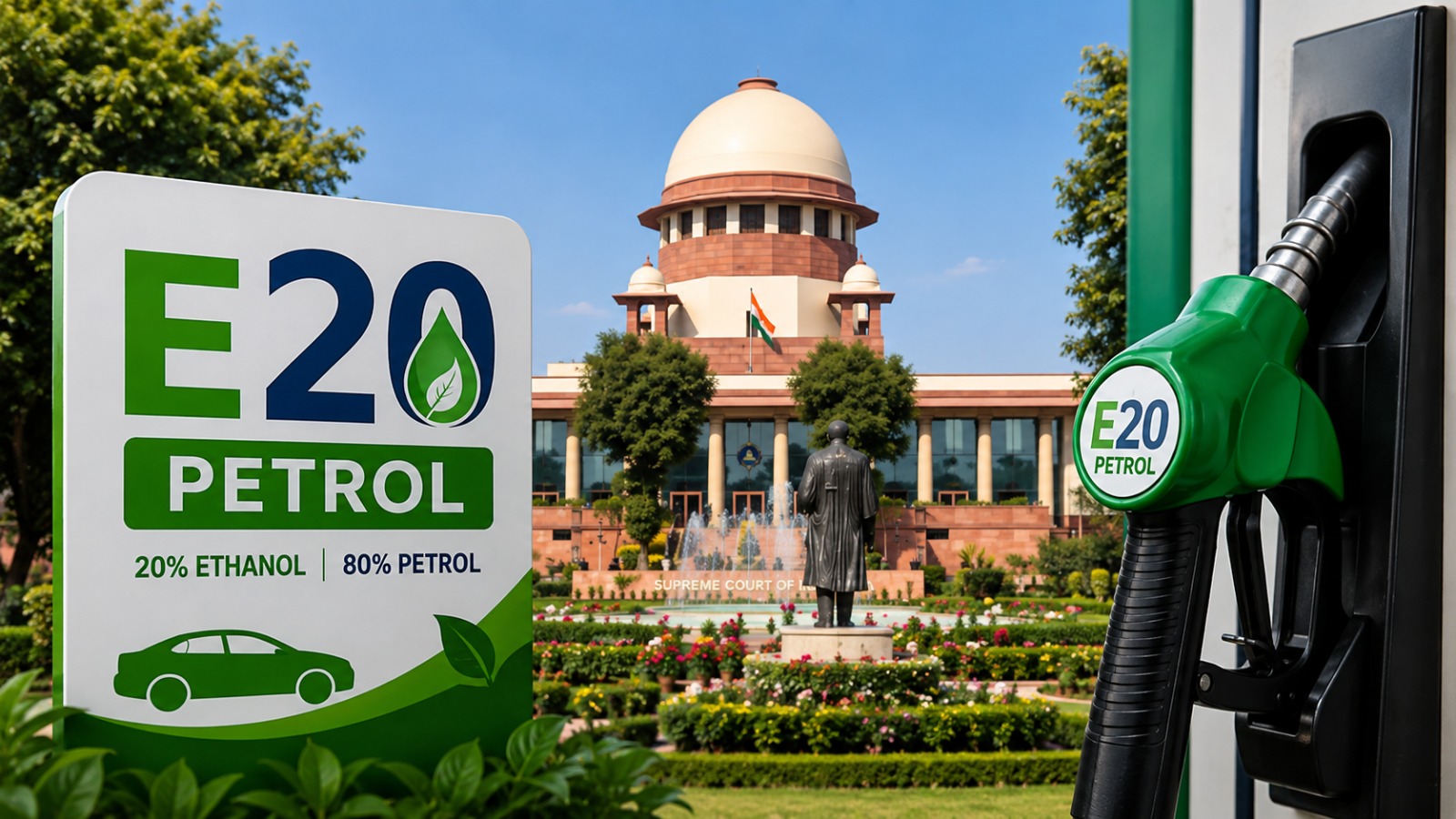
The Supreme Court on Monday declined to hear a petition that asked the Centre to force petrol pumps to display the exact ethanol share on every nozzle and print that figure on fuel bills. The court did not rule on whether such labels should exist. It only said the case should not have been filed first in the apex court under Article 32.
A Bench of Justices M.M. Sundresh and Prasanna B. Varale dismissed ‘Narendra Kumar Goswami v. Union of India’ (W.P. (C) No. 887 of 2026) at the admission stage and left the petitioner free to take the same grievance to the jurisdictional High Court or another competent authority. The short order recorded: “(Petition) dismissed. Open for petitioner to approach competent authority.”
Advocate Narendra Kumar Goswami appeared in person. He said motorists were being sold E20 petrol - a blend of 20 per cent ethanol and 80 per cent petrol — without being told, on the pump or on the receipt, how much ethanol was in the tank. “See the receipt, there is no mention of ethanol. I have the right to know,” he told the Bench. He added that he was not attacking the blending programme itself: “I am not challenging the policy. I just want to know. I have the right to know. Even when we buy a packet of biscuits we know the ingredients.”
The judges first asked why he had come straight to the Supreme Court. “Who are you? You are practising where? Go to HC and file it,” the Bench said. When Goswami pressed the point as a public right, not a personal one - “Not to me, to the citizens of India. We have right to know what we are purchasing” - the court still refused to keep the writ alive.
Attorney General R. Venkataramani, for the Union, opposed the petition as “proxy litigation.” He reminded the court that it had already turned down challenges to the ethanol-blending policy. “Your Lordships have already dismissed pleas challenging the policy,” he said. He also objected to the way the case was framed: “He wants the Govt of India to be answerable to him!” The Bench accepted that the matter did not warrant a direct Article 32 hearing.
The writ went well beyond nozzle stickers. It asked for a public, searchable database of which car models can take which ethanol blend; an independent expert panel drawn from the petroleum and transport ministries, the Bureau of Indian Standards, automobile engineers and other specialists; a national consumer-disclosure protocol; and a transition plan for older vehicles that may not be built for E20, including the option of lower-ethanol petrol where that is feasible. The petition described the present rollout as “silent compulsion” and argued that, once the State creates a nationwide compulsory fuel market, telling buyers what they are purchasing is a constitutional requirement, not a “decorative consumer slogan.” None of those prayers was examined on merits.
The background is last year’s policy challenge. On 1 September 2025 a Bench led by then Chief Justice B.R. Gavai dismissed a PIL that sought ethanol-free petrol at every pump and attacked the compulsory shift to E20. The Centre had defended blending as a measure for energy security, lower crude imports, emissions cuts and support to sugarcane farmers. Monday’s petition tried to distinguish itself from that case by asking only for information, not a rollback. The court treated the two as close enough that a fresh Article 32 writ was not the right first step.
E20 is now the regular petrol sold at most public-sector pumps. Premium grades such as XP100, Power100 and Speed100 have been kept ethanol-free, but they sell at a much higher price. The government has said it has no plan to bring E0 or E10 back as standard retail grades. Monday’s order does not change that policy. It also does not forbid a High Court from later examining labelling, invoices or compatibility data if a properly framed case is filed there.