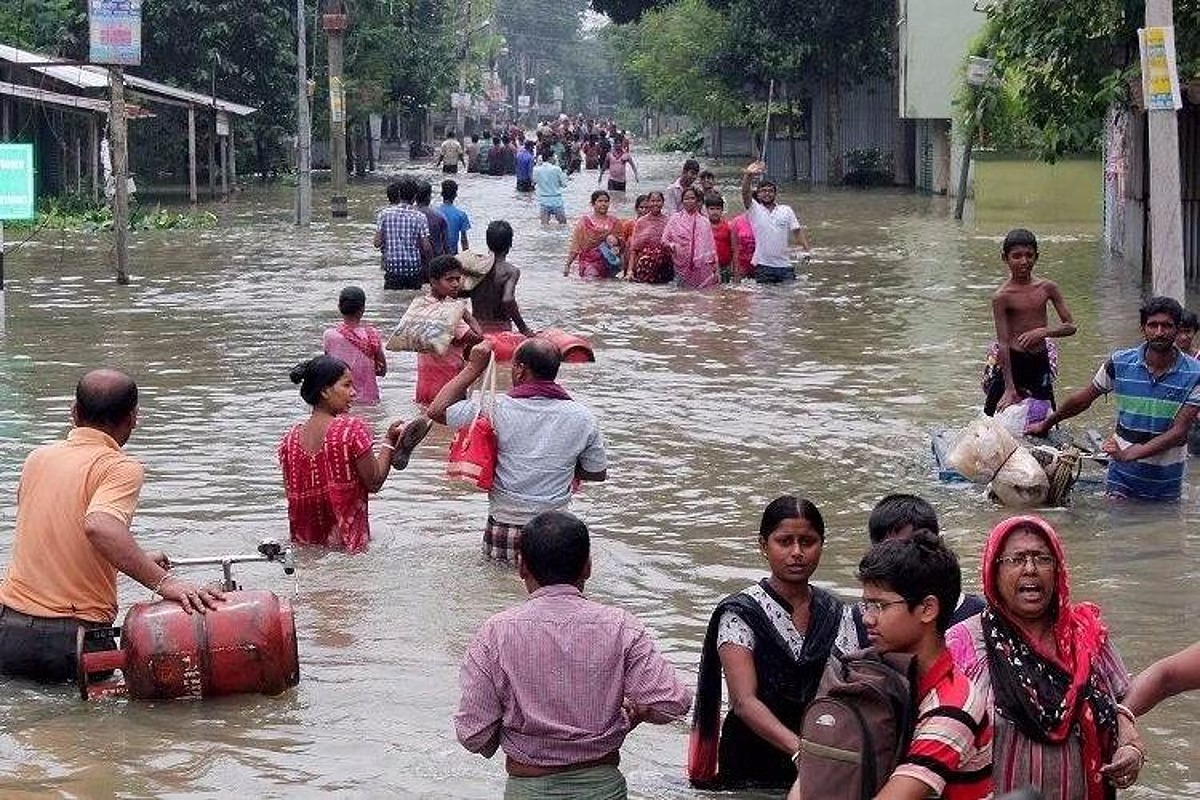
The flood situation in parts of Malda continued to deteriorate as rising waters of the Ganga inundated large areas, affecting around 1.4 lakh people and forcing medical teams to use boats to reach residents cut off by floodwaters.
The worsening situation has placed considerable pressure on the district's health and disaster-response infrastructure, with several health facilities affected by the inundation. Medical personnel are continuing to provide essential services in areas where road access has been disrupted.
The Ganga has been flowing above the extreme danger level at Manikchak, with officials warning that rising upstream water levels could further aggravate the situation. Recent reports have recorded the river at levels significantly above the extreme danger mark.
With conventional transport routes disrupted, health workers have been relying on boats to reach patients in inundated villages.
Malda chief medical officer of health Dr Sudipta Bhaduri described the situation as a major challenge, saying, “This is a very big challenge.” Medical teams, ASHA workers and ICDS personnel have been deployed in affected areas to maintain basic healthcare services.
Several health facilities have themselves been affected by the floodwaters. The health centre at Uttar Chandipur, for instance, was shifted to the first floor of the local gram panchayat office after the original premises were inundated.
According to health officials, six dedicated boats are being operated as water ambulances, allowing medical teams to move through areas where roads are no longer usable. Health workers are also continuing surveillance and preventive measures against water-borne diseases.
The swelling Ganga has caused extensive inundation across the Manikchak and Bhutni areas. Earlier, the river had risen to 25.64 metres, around 34cm above the extreme danger level, resulting in fresh areas of Uttar Chandipur being submerged.
The situation subsequently worsened. On Wednesday, the river at Malda reached 25.99 metres, nearly 70cm above the extreme danger mark of 25.30 metres, according to officials. The rise was attributed partly to increased upstream flow from Bihar.
The flooding has also damaged infrastructure and disrupted electricity supplies in several areas. Officials said electric poles, including high-tension poles, had been damaged, forcing healthcare facilities to depend on generators.
Boats deployed for rescue and relief
The administration has stepped up evacuation and relief operations as more villages come under water. Boats have been deployed to respond to distress calls and move residents to safer locations, while police personnel have also joined rescue operations.
Earlier, the Malda district administration had deployed 21 boats and shifted more than 2,000 people to safer locations. Relief camps and community kitchens were also opened in affected areas.
The administration has distributed tarpaulins, food grains, disaster-management kits and other essential supplies among affected families.
Along with flooding, severe riverbank erosion has emerged as a major concern in Bhutni. Several villages have been affected as the Ganga continues to eat away at its banks.
The crisis has already resulted in fatalities. A 32-year-old jute farmer, Dwijen Mandal, reportedly drowned in Bhutni while attempting to save his jute stored in the floodwaters, according to local residents.
A historic Shiva temple in Ratua also collapsed into the Ganga amid worsening erosion and flooding, underscoring the scale of the river's impact on settlements and infrastructure.
West Bengal Chief Minister Suvendu Adhikari has directed officials to closely monitor the situation and strengthen disaster preparedness across north Bengal. He has instructed the SDRF to coordinate with the NDRF and other response teams and to position personnel at strategic locations for quicker intervention.