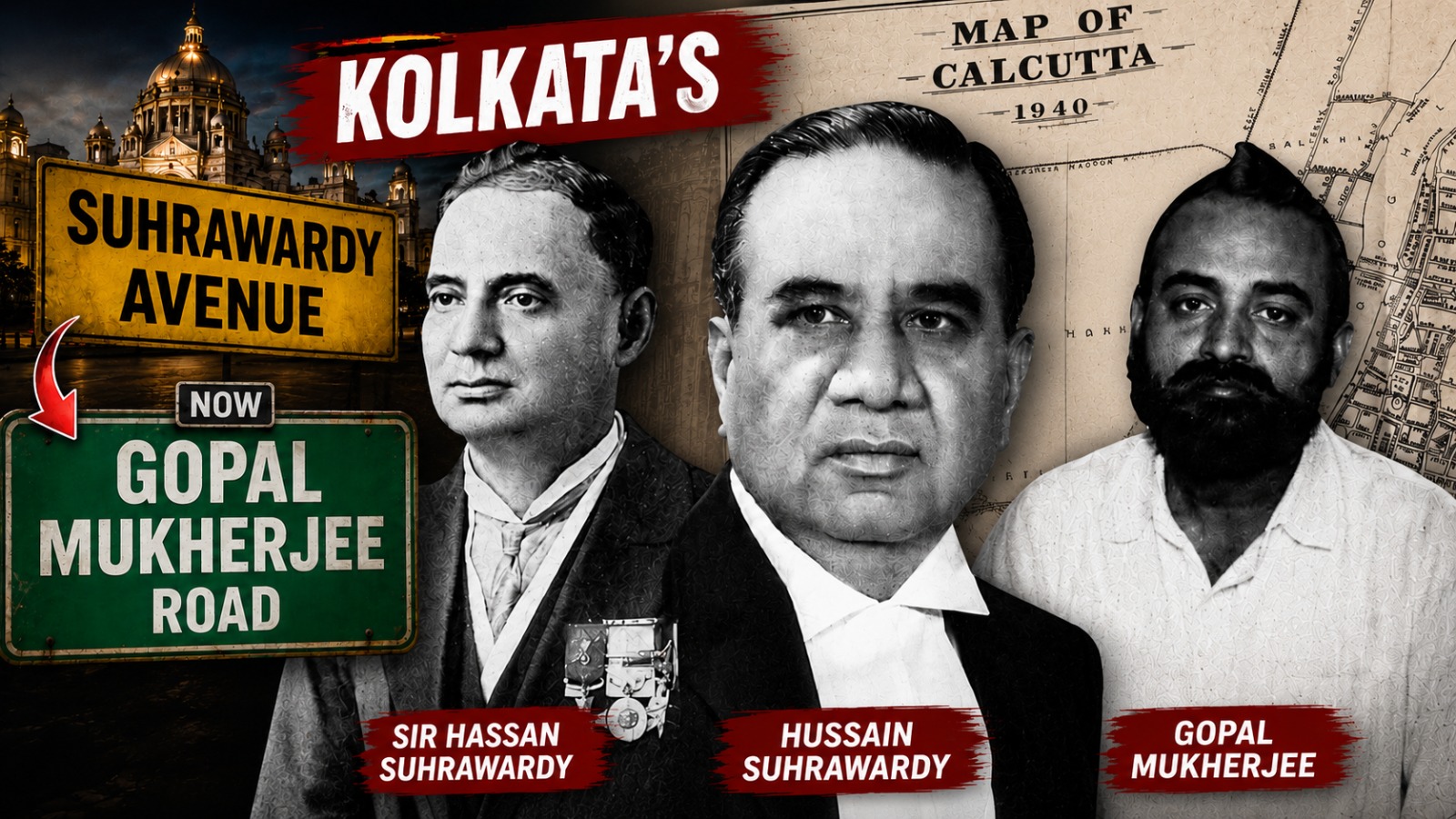
A decision by the Kolkata Municipal Corporation (KMC) to rename Suhrawardy Avenue as Gopal Mukherjee Road has triggered a political controversy in West Bengal, with the BJP government hailing the move as a correction of a historical injustice and Opposition parties accusing it of distorting history. The renaming, announced on the occasion of Paschimbanga Divas, marks one of the most prominent symbolic changes undertaken since the BJP assumed power in the State earlier this year.
The stretch, which connects the Park Circus Seven-Point Crossing with Don Bosco Circle, will now bear the name of Gopal Chandra Mukherjee, popularly known as "Gopal Patha", a figure associated with the communal violence that engulfed Calcutta during the 1946 riots.
Chief Minister Suvendu Adhikari welcomed the move, describing it as a long-overdue attempt to rectify what he termed a "historical wrong". "I commend the historic decision taken by the Kolkata Municipal Corporation on the solemn occasion of Paschimbanga Divas, which would be instrumental in rectifying a historical wrong," Mr. Adhikari said in a post on social media. "For decades, a major artery of our city bore the name of someone who wilfully misused state power as a weapon, orchestrating the massacre of innocent citizens for sheer political gain," he added.
The Chief Minister further argued that renaming the road after Gopal Mukherjee would help honour those who protected lives during one of Bengal's darkest chapters. "By renaming it after Shri Gopal Mukherjee, the fearless soul who stepped up as a protector-in-chief to defend and save thousands of innocent lives, finally restoration of historical justice will be achieved by honouring a true guardian and saviour. It's time West Bengal remembers, corrects and honours the real heroes," he said.
Contrary to claims circulating in public discourse, Suhrawardy Avenue was not named after Huseyn Shaheed Suhrawardy, the former Prime Minister of undivided Bengal who remains a controversial figure because of his role during the communal riots of 1946. Historical records show that the avenue was named after Sir Hassan Suhrawardy, a distinguished physician, academic, diplomat and former Vice-Chancellor of the University of Calcutta. According to records published in the Calcutta Municipal Gazette, the Calcutta Municipal Corporation resolved on March 8, 1933, to name the newly constructed road after Sir Hassan Suhrawardy. The decision was formally notified on April 20, 1933, years before the Great Calcutta Killings of 1946.
However, the move has drawn criticism from Opposition leaders and historians, who contend that the government has conflated two different members of the Suhrawardy family. Opposition leaders argued that the BJP government's justification for the renaming ignores these historical facts.
Congress leader Pawan Khera accused BJP leaders of confusing Hassan Suhrawardy with his nephew, Huseyn Shaheed Suhrawardy. "These BJP leaders do not even know the difference between Hasan Suhrawardy and Huseyn Suhrawardy. Such is their ignorance," Pawan Khera said in a social media post.
Senior Congress leader Jairam Ramesh also pointed out that Hassan Suhrawardy had served as Vice-Chancellor of Calcutta University and was succeeded in the post by Syama Prasad Mookerjee.
The Trinamool Congress echoed similar concerns. Party leader Kunal Ghosh said the individual associated with the 1946 communal violence was Huseyn Shaheed Suhrawardy and not Sir Hassan Suhrawardy, after whom the road had originally been named. "Hussain Shaheed Suhrawardy, who was administrative chief at that time and connected with the Calcutta killings, is Dr Suhrawardy's nephew. Both are not the same …