
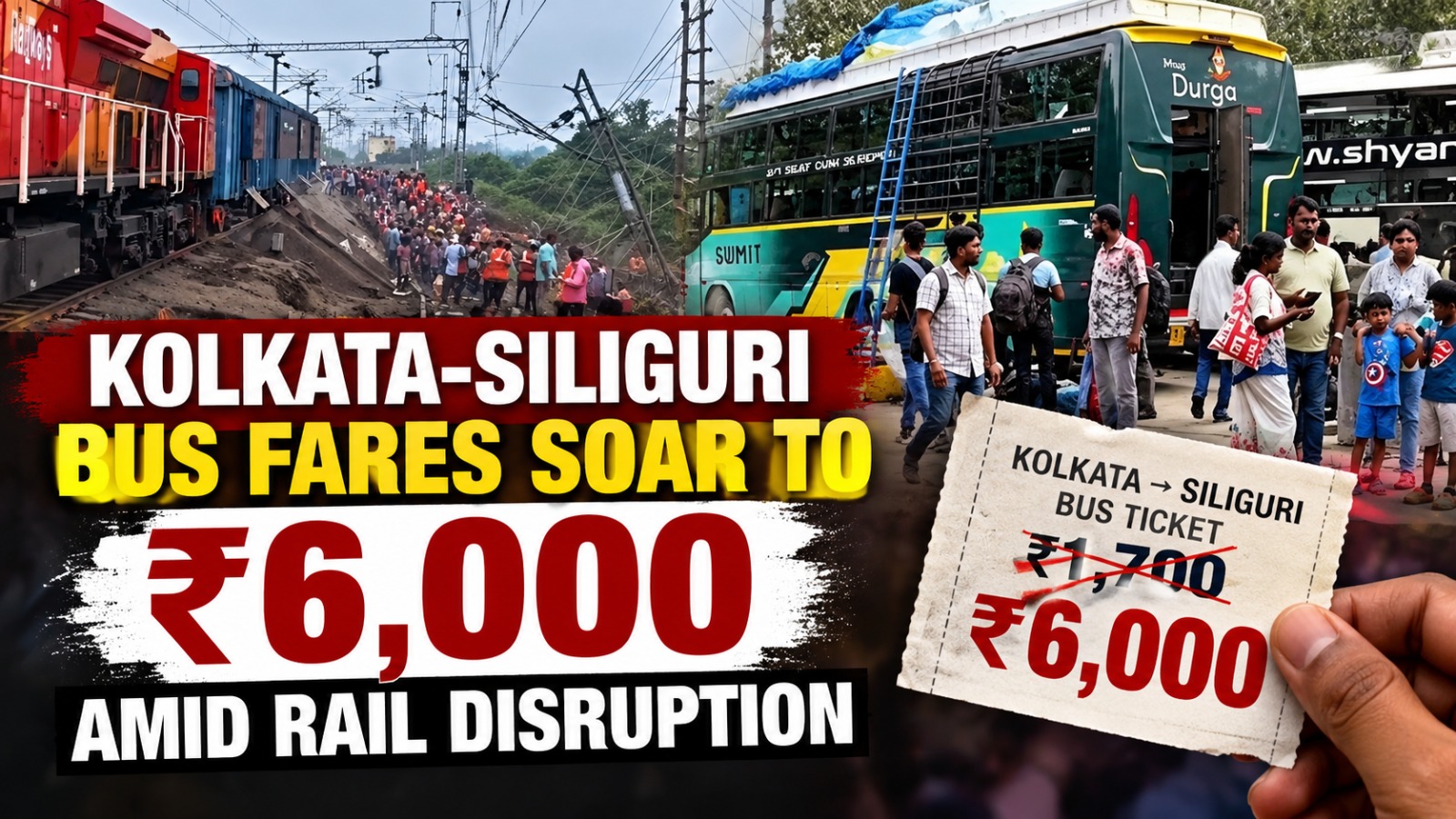
The rail disruption near New Farakka has triggered a severe travel crisis for passengers heading to and from north Bengal, with private bus operators allegedly charging as much as ₹6,000 for a Kolkata-Siliguri ticket as demand surges.
According to a report by Anandabazar Patrika, the disruption has left most trains connecting Kolkata with north Bengal cancelled, while several of the trains still operating are being diverted. The resulting rush for alternative transport has exposed passengers to sharply inflated private bus fares, even as the state government deploys additional services.
The railway disruption was caused by a subsidence beneath the tracks near New Farakka. With rail services severely affected, the state Transport Department has introduced special buses on several north Bengal routes. However, the additional services have struggled to match the volume of stranded passengers.
At Kolkata's Esplanade, the scale of the problem was particularly visible on Friday. Passengers reportedly moved from government bus counters to private operators in search of seats, only to find fares rising sharply as queues grew.
Anandabazar reported that a ticket originally priced at around ₹1,700 was allegedly being sold for nearly ₹6,000 under the label of "dynamic fares". Passengers claimed that fares changed rapidly, with one ticket reportedly rising from ₹3,000 to ₹5,900 within an hour.
The impact has been particularly severe for people travelling for medical treatment. Every day, large numbers of patients from districts including Malda, Murshidabad, Uttar Dinajpur and Dakshin Dinajpur travel to Kolkata for treatment at government hospitals, often relying on overnight trains and returning by bus after their appointments.
Among those stranded was an elderly cancer patient from Malda who had travelled to Kolkata for chemotherapy at the Chittaranjan National Cancer Institute. With train services disrupted and private bus fares soaring, his family was reportedly forced to wait at Esplanade while trying to find an affordable way home.
The pressure on government buses was equally evident. At around 3.30pm, a special Malda-bound bus with capacity for around 50 passengers reportedly had more than 300 people waiting at the terminal. Many in the queue were patients or their relatives returning after treatment at hospitals such as SSKM and NRS Medical College.
A government bus terminal employee cited by Anandabazar said the department had been operating additional services since Wednesday night but acknowledged that the increased fleet was still insufficient to absorb the passenger load created by the railway disruption.
The crisis has also affected migrant workers, students, traders and passengers travelling onward to other parts of the country. A group of migrant workers returning to Dhupguri reportedly had little option but to pay around ₹1,000 each for non-AC bus tickets.
A Bangladeshi family travelling after medical treatment was also caught in the disruption. The family reportedly found bus fares several times higher than what they had paid when travelling through Kolkata earlier. Their problems were compounded by the fire on Free School Street, which made finding accommodation in the Dharmatala area difficult.
The state government has responded by increasing bus services on several routes. According to the Transport Department notification cited in the report, 23 additional buses have been deployed between Kolkata and Siliguri. Of the 18 buses operating between Siliguri and Kolkata, 12 are additional services. Extra buses have also been introduced on the Kolkata-Balurghat, Durgapur-Balurghat and Malda-Kolkata routes.
Drivers' leave has reportedly been cancelled on an emergency basis to keep the additional services running. However, the department is also facing operational constraints, including difficulties in maintaining the usual requirement of two drivers on long-distance routes.
Meanwhile, the sharp escalation in private bus fares has become a fresh point of concern. With thousands of passengers stranded or forced to abandon their usual rail journey, the sudden surge in ticket prices has raised questions over how "dynamic pricing" is being applied during a public transport disruption.
Transport Minister Arjun Singh has warned of action if private operators are found exploiting the situation. For passengers already dealing with cancelled trains, medical emergencies and long journeys, however, the immediate question remains much simpler: how to get home without paying several times the normal fare.