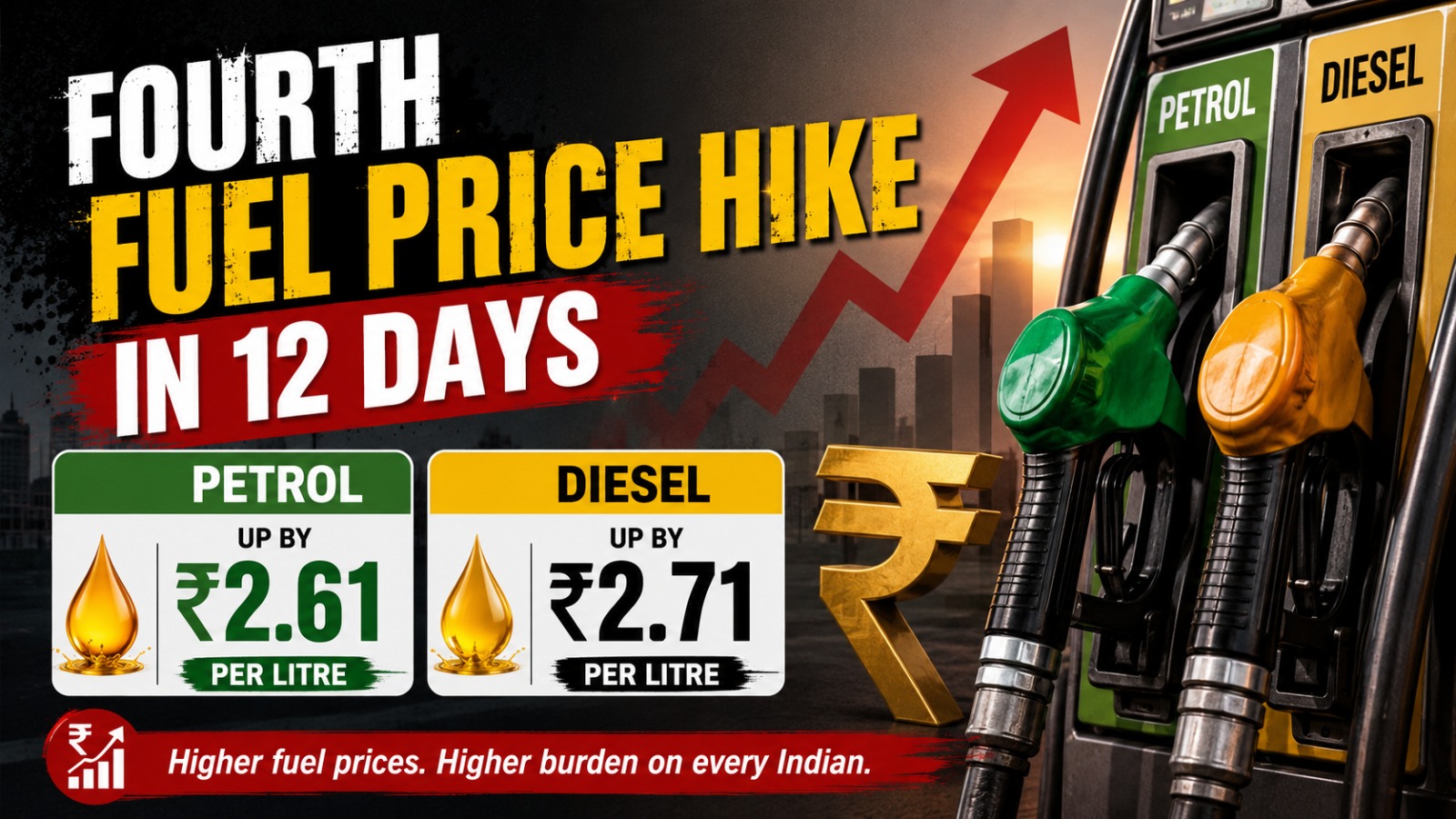
Indian consumers woke up to yet another sharp increase in fuel costs on Monday as state owned oil marketing companies raised petrol and diesel prices by more than ₹2 per litre in most major cities. This marks the fourth revision in retail fuel rates within just 12 days, pushing cumulative increases close to ₹7.5 - 8 per litre since mid-May and reigniting worries about inflation and household budgets.
In the national capital, petrol prices have now crossed the ₹100 mark in several outlets, while diesel has also seen a significant jump. In Kolkata petrol has breached ₹113. The latest adjustment comes as refiners continue to pass on the impact of elevated global crude oil prices triggered by ongoing geopolitical instability in West Asia.
The current wave of increases began after nearly four years of relative stability in retail prices:
May 15, 2026 (First Hike): Oil companies implemented an initial rise of approximately ₹3 per litre for both petrol and diesel. This was the first upward revision in retail fuel prices since April 2022. The move was driven by mounting losses at refineries due to surging international crude costs, which had escalated sharply amid disruptions in key oil supply routes.
May 19, 2026 (Second Hike): Just four days later, another increase of around 90 paise per litre was announced.
May 23, 2026 (Third Hike): Prices rose once more by 87 - 91 paise per litre across variants. By this point, the total hike in less than ten days had already reached nearly ₹5 per litre in many cities, prompting early concerns from economists and transport operators.
May 25, 2026 (Fourth Hike): Today's revision, the steepest in the current series, saw petrol climb by roughly ₹2.61 per litre and diesel by about ₹2.71 per litre in key markets. This has taken the overall increase since May 15 beyond ₹7.5 per litre in several states.
Prices vary slightly across states due to differences in local taxes and freight costs. For instance, metropolitan areas like Mumbai, Kolkata, Chennai, and Bengaluru have witnessed comparable upward movements, with some southern and western cities seeing petrol rates approach or exceed ₹110 per litre
Analysts point to a combination of factors. Global crude oil benchmarks have remained volatile following tensions in the Middle East, which have affected shipping lanes and supply reliability. Indian refiners, who process a significant portion of imported crude, were absorbing substantial losses by not passing on the full impact earlier. With international prices staying elevated, the companies have chosen a series of smaller, frequent adjustments rather than a single large hike.
The rapid succession of hikes is already being felt across sectors. Taxi drivers, logistics operators, and farmers have expressed apprehension over rising operational costs, which could eventually translate into higher prices for essential commodities. Opposition parties have called it a burden on ordinary citizens during an already challenging economic environment. Economists warn that if global oil prices do not ease soon, further revisions cannot be ruled out, potentially adding upward pressure on inflation.