A major milk adulteration racket operating across Maharashtra has come to light following separate investigations by the Food and Drug Administration (FDA), local police in Dharashiv, and the Mumbai Crime Branch.
While investigators in Dharashiv suspect that more than 2.3 crore litres of adulterated milk may have been supplied across the state, the Mumbai Crime Branch has arrested the alleged mastermind behind a fake milk packaging network that enabled the sale of diluted milk under the labels of popular dairy brands.
According to the investigation conducted by the FDA and police in Bhoom taluka of Dharashiv district, scrutiny of sales registers seized from the accused revealed that nearly 2,30,470 kilograms of low-quality milk powder had been used over the past six months to manufacture approximately 23,04,070 litres of synthetic milk. The estimated value of the synthetic milk produced is around ₹9.21 crore.
Investigators said the accused allegedly mixed 10 litres of synthetic milk with every 100 litres of pure milk, resulting in a 10 per cent adulteration ratio. Based on this pattern, officials suspect that over 2.3 crore litres of adulterated milk may have been supplied from milk collection centres in Bhoom to different parts of Maharashtra.
Authorities are now tracing the supply chain to identify where the adulterated milk was distributed.
Meanwhile, the Mumbai Crime Branch’s Unit 12 has made a significant breakthrough in a separate fake milk racket by arresting Saidulu Jangili, the alleged key accused who had been absconding. He was apprehended from Kandivali, making it the second arrest in the case.
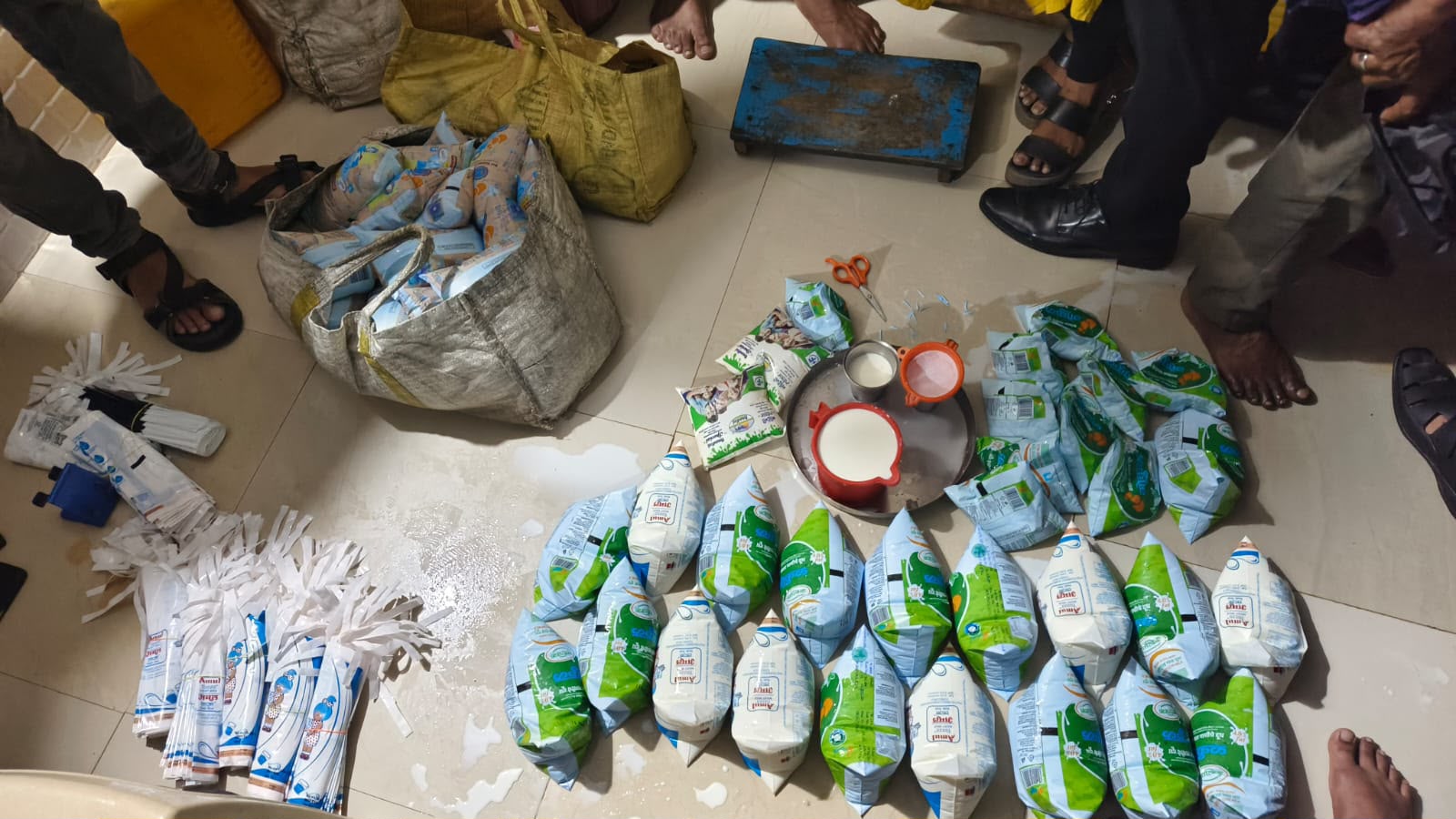
According to Crime Branch officials, Jangili allegedly got counterfeit empty milk pouches printed that closely resembled those of leading dairy brands, including Amul and Gokul, and supplied them to milk adulterators. During the operation, police recovered around 6,000 fake empty milk packets from his possession. Investigators said he sold the counterfeit pouches for ₹2.50 per packet.
Police said the arrest was based on information provided by the first accused, Lingayya Ganta, who allegedly confessed during interrogation that he had been purchasing the fake pouches from Jangili.
The investigation has revealed the gang’s modus operandi.
According to police, the accused first purchased genuine branded milk packets from the market and carefully opened the sealed edge without making the tampering visible. They allegedly removed 30 to 40 per cent of the milk from each packet and replaced the missing quantity with contaminated water before resealing the packet.
The milk extracted from the original packets was then filled into counterfeit pouches resembling branded products, where additional water was mixed. Police believe the process enabled the gang to convert one litre of genuine milk into nearly 1.5 to 2 litres of adulterated milk, significantly increasing the quantity for sale while misleading consumers.
To make the packets appear untouched, the accused allegedly used a burning candle and heated tongs to reseal the packaging, making it difficult for customers to detect any tampering.
Investigators have also found that the counterfeit packaging was allegedly printed at a printing press in Mumbai’s Wadala area. Police suspect Jangili had been running the illegal operation for nearly a year and has admitted supplying fake pouches to at least four milk adulterators. His mobile phone has been seized, and several WhatsApp chats recovered from the device are being examined for further evidence.
With the arrest of the alleged supplier of the counterfeit packaging, the Crime Branch has now turned its attention to the printing press and other individuals involved in the operation.
Officials said the investigation is underway and more arrests are expected as they work to dismantle the entire adulteration network.
The two investigations have highlighted the scale of milk adulteration in Maharashtra, raising serious concerns over food safety and public health.
Authorities are continuing their probe to identify all those involved and determine the full extent of the distribution network.