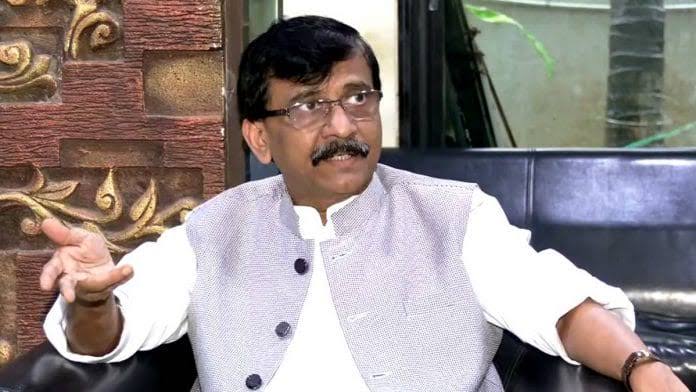
Shiv Sena (Uddhav Balasaheb Thackeray) leader and Saamana Executive Editor Sanjay Raut, through an editorial, has launched a sharp attack on the Central Government, the Bharatiya Janata Party (BJP), and various constitutional institutions, alleging that democratic values are being undermined and systematic efforts are underway to weaken opposition parties in the country.
The editorial criticises the media for giving extensive coverage to reports of defections by MLAs and MPs while allegedly ignoring more serious issues. It states that while the absence of certain MPs from a Shiv Sena meeting becomes a matter of national debate, there has been little discussion on the alleged destruction of 4,000 Electronic Voting Machines (EVMs).
According to the editorial, evidence of alleged irregularities involving EVMs used in elections in West Bengal had begun to emerge, following which a government building was allegedly set on fire and 4,000 EVMs were destroyed, thereby eliminating crucial evidence. The article argues that instead of investigating such incidents, those in power are preoccupied with engineering defections within opposition parties.
The editorial further alleges that the BJP and its allies have initiated what they describe as “Operation Tiger” with the objective of once again splitting the Shiv Sena. It characterises the prevailing political climate in Maharashtra and the country as one dominated by “deceitful wolves” operating under the guise of political strategy.
Referring to the Tenth Schedule of the Indian Constitution, which deals with anti-defection provisions, the editorial claims that despite constitutional safeguards against political defections, Speakers of the Lok Sabha and various State Legislative Assemblies have allegedly facilitated and legitimised breakaway factions. It contends that legislators who openly admit to splitting from their parties are being granted recognition in a manner inconsistent with constitutional principles.
The editorial also directs criticism at the Election Commission of India and the Supreme Court, alleging that prolonged delays in adjudicating defection-related cases have emboldened political opportunism. It argues that swift judicial intervention could have deterred such practices.
Citing recent political developments in West Bengal, the editorial accuses the BJP of targeting opposition parties by encouraging defections among elected representatives. It claims that legislators elected on the symbol of the Trinamool Congress have betrayed the mandate of the voters by switching allegiance.
Drawing comparisons with South Korea, the editorial notes that citizens there have taken to the streets over suspicions of electoral irregularities. In contrast, it argues that public discourse in India has increasingly shifted away from core democratic concerns toward narratives shaped by political and religious distractions.
The article goes on to allege that there is an attempt to impose a one-party system in India by weakening regional parties and eventually replacing the existing parliamentary framework with a presidential form of governance. It warns that such developments could undermine India’s democratic structure and constitutional ethos.
The editorial further criticises the Central Government for allegedly remaining silent on pressing issues such as inflation, unemployment, examination paper leaks, the declining value of the rupee, and crimes against women. It contends that mainstream media outlets have prioritised stories of political defections over these matters of public concern.
“In authoritarian regimes across the world, such tactics are commonplace. New controversies are manufactured daily to divert attention from the real issues affecting the people, while those in power continue with business as usual,” the editorial states. It concludes by expressing concern over what it describes as the deterioration of India’s political culture and democratic institutions.