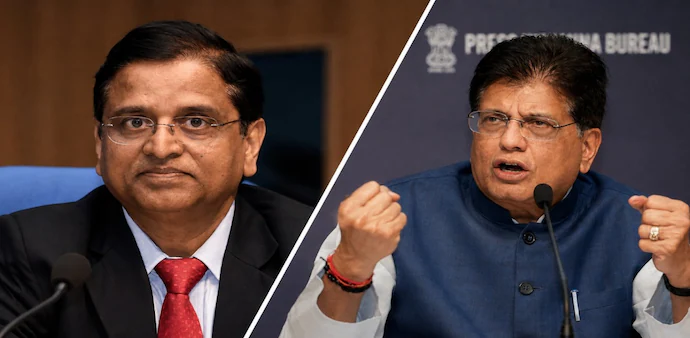
A television interview in which former Finance Secretary Subhash Chandra Garg questioned the official 7.8 per cent GDP growth figure for the April - June quarter has gone viral, triggering a sharp political and statistical debate over how India’s latest growth numbers were calculated. Prime Minister Narendra Modi had described the same data as a “herculean feat” and proof of the country’s “collective strength.”
Garg, speaking to NDTV anchor Gaurie Dwivedi, argued that the headline growth rate looked stronger because last year’s first-quarter GDP at current prices had been revised downward. “If you had not revised last year’s GDP, the growth in current prices would have been only 2.6 percent,” he said. He added that the previous year’s first-quarter GDP at current prices had originally been put at about Rs 86 lakh crore and was later shown as Rs 80 lakh crore - a reduction of roughly Rs 6 lakh crore. “By revising last year’s GDP by as much as 6 trillion rupees, the current year’s GDP in the first quarter has gone up by about 10.3 percent,” Garg told the channel.
He also noted that last year’s first-quarter growth, initially reported at 7.8 per cent, had been revised down to 6.9 per cent. “If you revise last year’s GDP down, the growth rate for the current year automatically goes up,” he said. When asked whether he was suggesting the numbers had been adjusted to look better, Garg replied that he was “responsibly making that statement” and urged the government to “recognise the reality of the Indian economic situation.”
The clip was widely shared on social media. Congress leaders, including Jairam Ramesh and Pawan Khera, cited Garg’s remarks to accuse the government of “statistical sleight of hand” and “fudging” data. Ramesh said the official claim was “the complete opposite of ground realities.”
What the official numbers show
The Ministry of Statistics and Programme Implementation (MoSPI) reported on August 31 that real GDP grew 7.8 per cent in the first quarter of 2026-27 (Q1 FY27), compared with a revised 6.9 per cent in the same quarter a year earlier. Real GDP was estimated at Rs 81.36 lakh crore against Rs 75.46 lakh crore a year ago. Nominal (current-price) growth was 10.3 per cent. The figure beat the Reserve Bank of India’s earlier 7 per cent projection.
Prime Minister Modi welcomed the data, writing that “India’s exemplary GDP growth of 7.8% during Q1 of FY 2026-27 is a herculean feat.” He credited “the collective strength of our people” despite oil-price shocks, supply-chain disruptions and global uncertainty, and added: “Doomsayers were doomed and India bloomed…yet again!” In a video message he said the nation was “filled with joy” and that some people inside the country were “echoing falsehoods and spreading despair.”
Government’s defence
MoSPI and its secretary, Saurabh Garg, rejected the charge that last year’s figures had been lowered to inflate this year’s growth. The ministry said the Rs 86.05 lakh crore figure belonged to the old 2011-12 base-year series. In February 2026 the government introduced a new GDP series with 2022-23 as the base year, using updated data sources, double deflation and revised methodologies. That exercise revised the entire time series, including Q1 of 2025-26, to about Rs 80 lakh crore.
“The change in the estimate of Q1 2025-26 does not represent a downward revision made to make the current year’s growth appear higher,” the ministry said. “It would be incorrect to compare the figure of Rs 86.05 lakh crore, based on the 2011-12 series, with the current Q1 2026-27 estimate under the revised 2022-23 series.”
Saurabh Garg, speaking to another agency, called the 2.6 per cent claim “highly unfortunate.” He said year-on-year comparisons must be made at constant prices, not current prices, and must use the same series. “We can’t compare apples to oranges,” he said. “What has been done is that current GDP of the old series, which has already become obsolete… has been compared with the current GDP of this quarter of the new series.” He pointed to strong volume growth in automobiles, cement and steel (12 to 16 per cent) as supporting evidence for the official real-growth number. The National Statistics Office, he added, had sought to remain “transparent and very open about our data, about the methodologies that we are using.”
Officials also noted that base-year revisions are standard international practice every five to seven years and that the new series had already been released months before the latest quarterly figures.
Economists remain divided. Some argue that comparing two different series is statistically invalid and that the new methodology, including double deflation and better use of GST, UPI and other high-frequency data, is an improvement. Others say the large downward revision of the previous year’s current-price GDP still leaves room for questions about how the change affects the appearance of growth. The controversy has revived a longer-running argument in India over the credibility of official economic statistics.