With West Bengal recording more than 4,000 dengue cases this year and seven officially attributed deaths, the state’s health machinery is once again stepping up its efforts to contain the mosquito-borne disease. And one of the latest preventive measures being suggested by Health Minister Sharadwat Mukhopadhyay is, quite literally, a change of clothes.
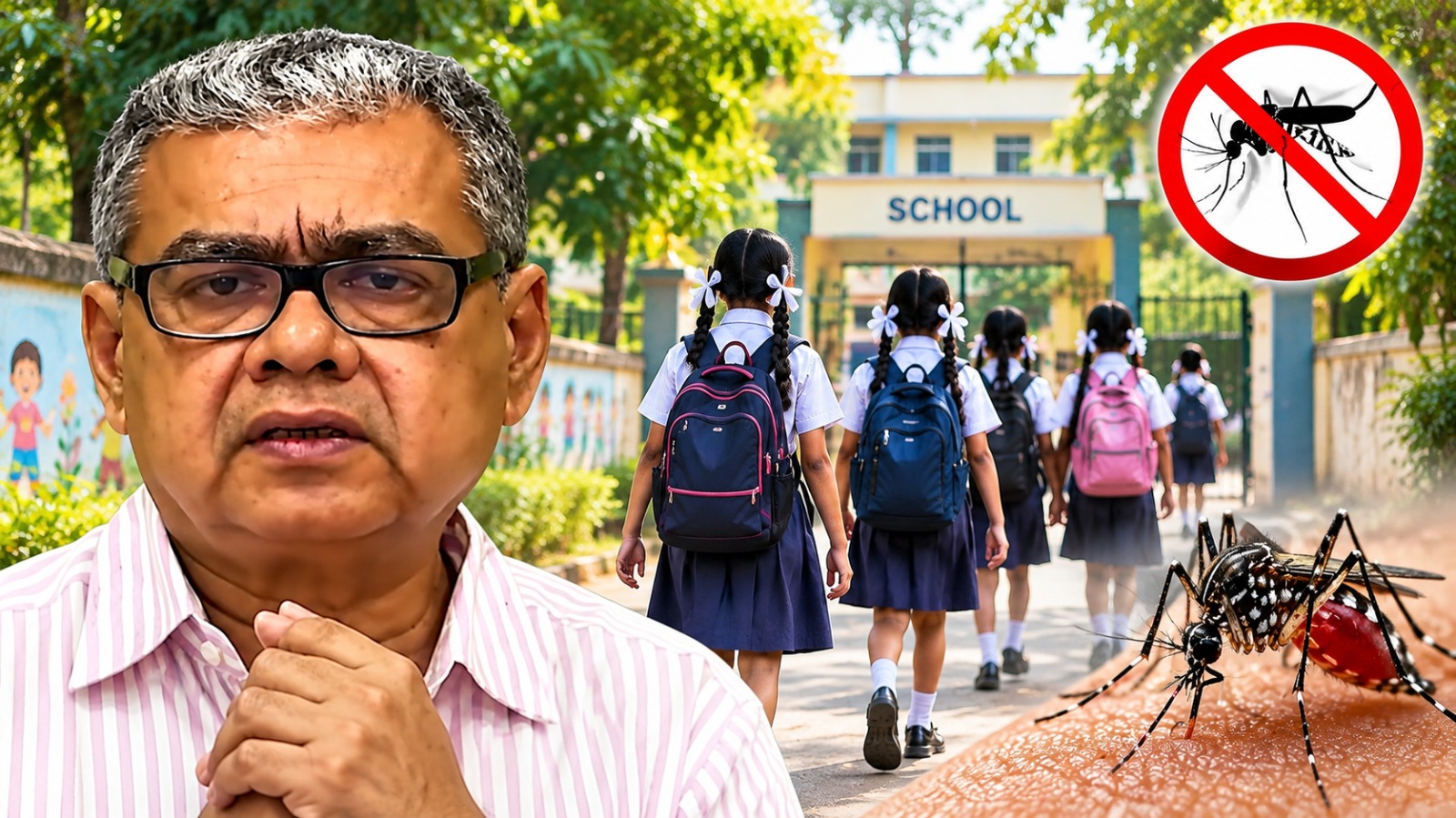
Mukhopadhyay has appealed to primary and secondary schools across the state to temporarily relax their uniform rules for the next three months, asking them to allow students to wear full-sleeved clothes and full-length trousers through September, October and November.
For girls, the minister has specifically urged schools to replace skirts with salwar that covers the legs, arguing that exposed skin increases the risk of mosquito bites.
“Please make the dress full-sleeved. I fold my hands and request you, please do not send girls to school wearing skirts. Let them wear salwar that covers their legs,” Mukhopadhyay said.
He also dismissed the idea that knee-length socks alone would offer sufficient protection.
“Even if you wear long socks, they remain close to the skin. Socks are very thin. Mosquitoes can bite through them,” he said.
For boys, his prescription is straightforward: full-sleeved shirts and full-length trousers.
The minister even said he sometimes notices students wearing skirts and deliberately asks which school they attend. “Many people I see are going to school wearing skirts. Sometimes I deliberately ask, which school?” he said.
The advice comes against the backdrop of a dengue season that the state government itself is treating with caution. Bengal had recorded more than 4,000 dengue cases by the beginning of September, compared with over 7,600 during the corresponding period last year. Chief Minister Suvendu Adhikari said there were 148 active dengue cases at the time of his September 1 review meeting and warned that the dengue season was far from over.
The state has officially attributed seven deaths to dengue so far this year. However, figures cited by TV9 Bangla put the number of dengue-positive patients who have died at 10, with the state’s death review committee determining that dengue was the primary cause in seven of those cases and other conditions accounting for the remaining three.
Five districts—Kolkata, Howrah, North 24 Parganas, South 24 Parganas and Murshidabad—have been identified as requiring heightened dengue surveillance.
Kolkata alone recorded 327 cases between January 1 and August 23, according to figures cited by The Statesman.
The government has also announced intensified sanitation and vector-control measures, including efforts to identify and eliminate stagnant water and mosquito-breeding sites. A statewide cleanliness drive was scheduled from September 3 to 5.
Against this backdrop, the health minister’s focus on school uniforms is an unusual addition to Bengal’s dengue-prevention strategy. Full sleeves and covered legs can certainly reduce a child’s exposure to mosquito bites, but the suggestion also raises a larger question: how much of Bengal’s dengue problem can really be solved by changing what children wear, when the mosquito-breeding sites remain the more fundamental challenge?
For schools, however, the instruction is relatively simple. For the government, the bigger task remains controlling the environment in which the dengue-carrying Aedes mosquito breeds.
For now, as Bengal enters the crucial September-November period, the state’s dengue battle appears to involve everything from fogging and sanitation drives to—apparently—rethinking the school wardrobe.