
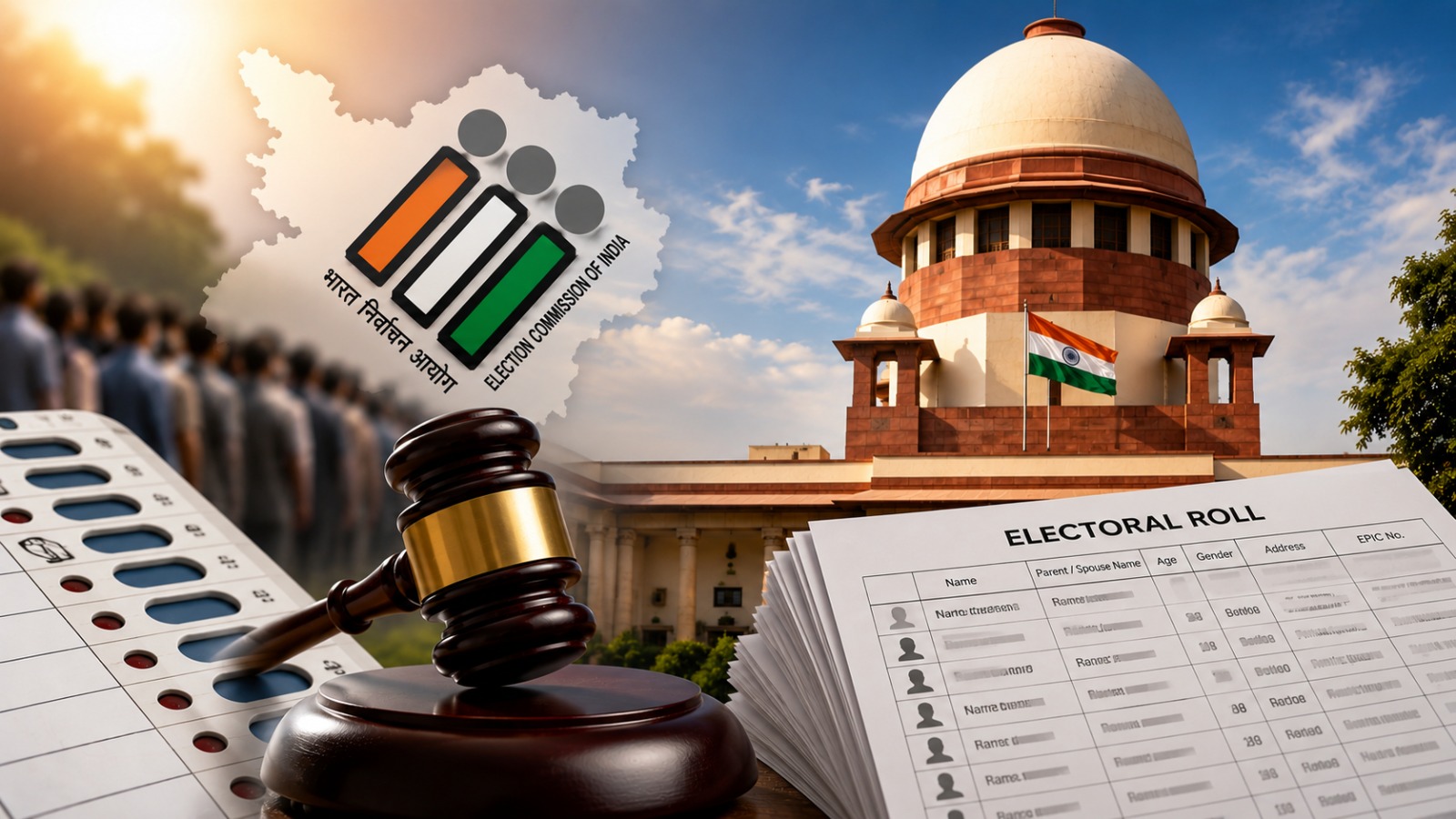
The Supreme Court on Wednesday upheld the Special Intensive Revision (SIR) of electoral rolls carried out by the Election Commission of India, ruling that the poll body acted within its constitutional and statutory powers while undertaking the exercise. Delivering its verdict on a batch of petitions challenging the legality of the SIR in Bihar, the apex court held that the revision process served a legitimate constitutional objective and was directly linked to ensuring free and fair elections.
Observing that the exercise aimed to improve the accuracy and inclusiveness of electoral rolls, the court remarked that the SIR “breathes life into the Constitution”. A Bench comprising Chief Justice Surya Kant and Justice Joymalya Bagchi pronounced the much-awaited judgment, effectively bringing to a close a year-long legal and political battle over the voter roll revision process.
The Supreme Court rejected claims that the Election Commission had acted beyond the authority granted to it under the Constitution or election laws. “SIR is a step towards an accurate and inclusive electoral roll,” the Bench observed, adding that the exercise could not be termed ultra vires merely because it differed from ordinary revision mechanisms. “It cannot be said ultra vires because the exercise is different from what is ordinarily conducted,” the court noted.
The Bench said the Election Commission was empowered under the constitutional framework and the Representation of the People Act to revise electoral rolls and that the SIR exercise had a clear connection to preserving electoral integrity. “We are equally satisfied that the object sought to be achieved by the SIR bears a direct nexus to the constitutional goal of free and fair elections,” the court said.
The court also upheld the Election Commission’s authority to examine citizenship-related concerns during the revision process. However, it clarified that deletion of a voter’s name from the electoral roll would not amount to stripping an individual of citizenship. The Bench emphasised that anyone excluded on grounds of failing to establish citizenship would still be entitled to further adjudication by a competent authority. The court directed the Election Commission to refer such cases for “suitable adjudication”, ensuring procedural safeguards remain intact.
The Supreme Court further endorsed the procedure adopted by the Election Commission during the SIR exercise, holding that the measures introduced were proportionate to the objective sought to be achieved. “Having regard to the nature of the problem sought to be addressed, the scale of the exercise undertaken and the procedural safeguards incorporated during its implementation, the measures adopted by the Commission cannot be said to be disproportionate to the objective sought to be achieved,” the judgment stated.
The court also observed that the process, as eventually implemented, struck a balance between electoral integrity and constitutional rights. “The process, as ultimately unfolded, provided multiple avenues for participation, correction and redress,” the Bench noted.
According to the court, procedural safeguards introduced by both the Election Commission and through directions issued by the Supreme Court during earlier hearings ensured that constitutional protections were maintained. “The procedural safeguards introduced both by the Commission and pursuant to the directions issued by this Court from time to time have sought to strike a balance between the need for electoral integrity and the protection of constitutional rights,” the order said.
While deciding the matter, the Supreme Court examined the challenge through four broad legal questions. These included whether the SIR was consistent with the Election Commission’s constitutional and statutory mandate, whether the methods adopted had a reasonable connection with the stated objective, whether alternative measures were available, and whether the exercise struck a fair balance between electoral goals and constitutional rights. The Bench ruled in favour of the Election Commission on all four counts.
The SIR exercise first began in Bihar in June last year, with the Election Commission describing it as an effort to remove bogus, duplicate and ineligible voters, including deceased persons and alleged illegal immigrants from the electoral rolls. The poll body had maintained that the revision was necessary to ensure that voter lists remained accurate and updated. However, opposition parties strongly criticised the exercise, accusing the Election Commission of conducting a politically motivated voter roll “clean-up” intended to favour the Bharatiya Janata Party.