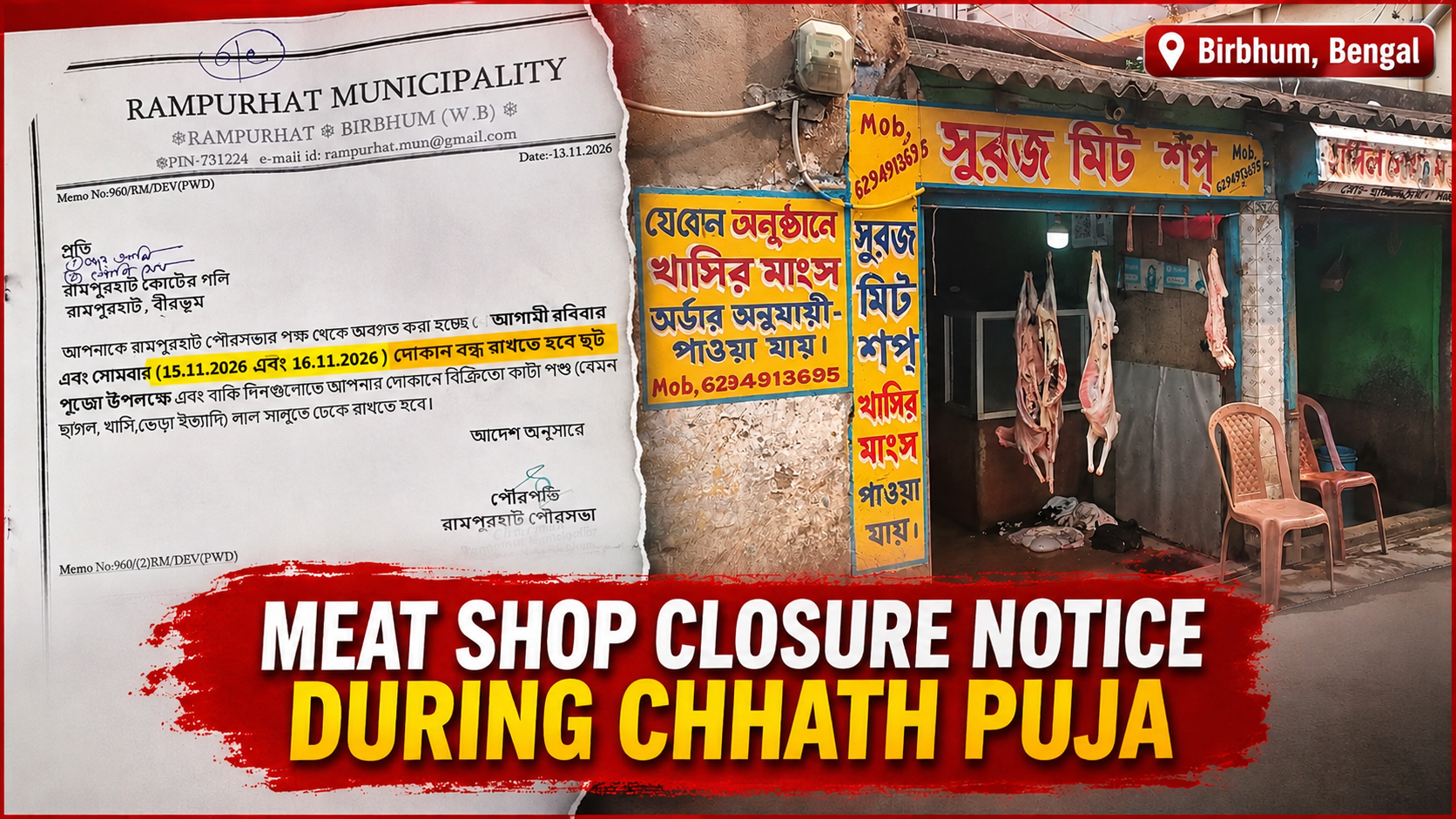
A controversy has erupted in West Bengal's Birbhum district after the Rampurhat Municipality allegedly directed three meat shops along Court Lane area to suspend operations during Chhath Puja, prompting objections from the affected traders over the restrictions and their potential impact on their livelihoods. The notices also instructed the shopkeepers to cover meat with red cloth before displaying it for sale on subsequent days.
“The Rampurhat Municipality hereby informs you that your shops must remain closed on Sunday and Monday (November 15 and 16, 2026) on account of Chhath Puja. On all other days, meat from slaughtered animals, including goats, sheep and other such animals, sold at your shops must be kept covered with red cloth,” reads the notice issued by Rampurhat Municipality.
According to reports, two notices issued on November 13 named three traders: Abdur Ali, Soni Sekh and Nur Ali Sheikh. The order, issued under Memo No. 960/RM/DEV(PWD), cited Chhath Puja as the reason for the restrictions. The meat shops are situated along Rampurhat’s Court Lane.
“Chhath Puja will be observed on Sunday night and Monday morning, and there are two to three meat shops along a lane used by devotees during the festivities. The decision to close these shops was taken following discussions between the Chhath Puja committee, the general administration, the police and the municipality,” said Soumen Bhakat, Chairperson, Rampurhat Municipality, clarifying that the shops would remain shut from Sunday afternoon until 10 am on Monday.
He further added, “The festival of Chhath is a deeply auspicious festival for the Bihari community and is observed with great devotion. Many devotees use this road while observing their fasts during the festival. At times, blood from the meat shops can be seen on the road, which may hurt the sentiments of those observing the rituals. Keeping these concerns in mind, the decision was taken.”
The affected traders, however, have questioned why they were not consulted before the directive was issued. Noor Ali Sheikh, one of the shopkeepers named in the notice, said the closure would affect business, particularly as Sunday was a busy day for meat sales. “I was served a notice directing me to keep my shop closed for two days. The authorities could have consulted us before taking such a decision. Sunday is a busy business day, and we have regular customers who buy meat from us, apart from restaurants that we supply. We did not even get enough time to inform them about the closure. Had the authorities simply asked us to pull down our shutters or cover the meat with cloth while continuing business, that would have been understandable. This decision is bound to affect our livelihood,” he said.
The written directive specifies a two-day shutdown on November 15 and 16, while the municipal official has described a shorter restriction lasting from Sunday afternoon until Monday morning. This difference has also raised questions over the exact duration of the closure. The development has brought the municipality's decision to impose restrictions on select meat shops during a religious festival under scrutiny, with traders raising concerns over the impact on their businesses.
Chhath Puja is a four-day Hindu festival dedicated to the worship of the Sun God, Surya, and Chhathi Maiya. Observed primarily in Bihar, Jharkhand, eastern Uttar Pradesh and parts of West Bengal, the festival involves rigorous fasting, prayers and ritual offerings. Devotees, known as vratis, observe strict fasts and offer arghya to the setting and rising Sun, often standing in rivers, ponds and other water bodies. The celebrations draw large gatherings of devotees, particularly along riverbanks and designated ghats.