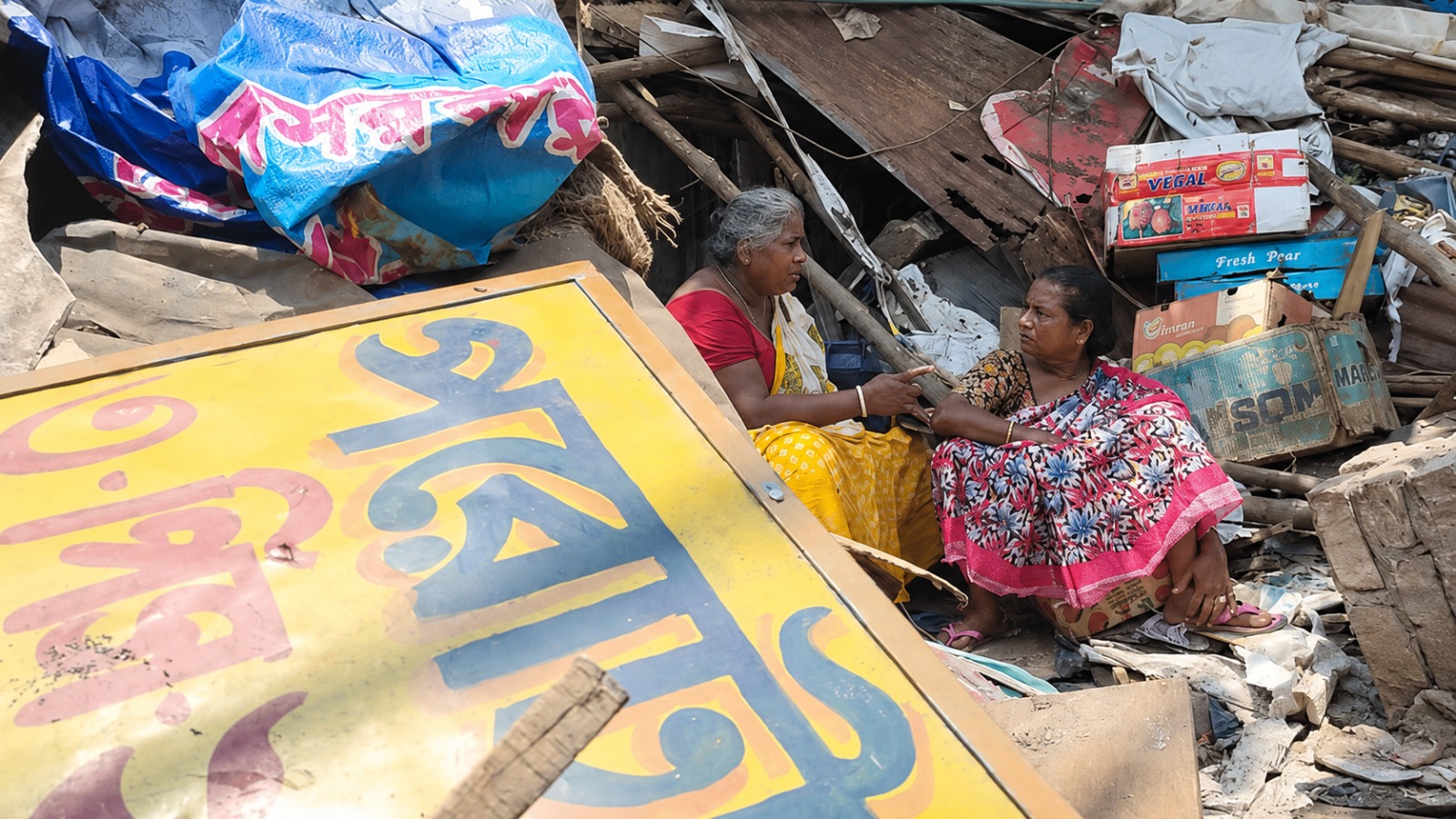
“It’s all over,” murmured Pratima Hore, her voice barely audible, as a lone tear slid down her cheek. She sat motionless atop a mound of splintered wood and twisted metal, the remains of the food stall she had run for more than two decades. Around her lay dented cooking pots, crushed jars, warped steel utensils and fragments of a life built slowly, painfully, over 22 years. Just days ago, this cramped patch near Dumdum Junction railway station had been her livelihood. Today, it is rubble.
In the wee hours of May 31, shortly after midnight on 30 May gave way to dawn, bulldozers rolled into the Dumdum Junction station area as part of an eviction drive targeting what railway authorities described as illegal encroachments on railway land. Rows of shops and stalls that had stood for years were razed in a matter of hours. For railway authorities, the operation was an exercise in reclaiming public land. For many who earned their living here, however, the demolition was not simply an administrative exercise or legal correction. It was the overnight erasure of livelihoods.
60-year-old Pratima Hore was not present on the night the demolition took place. Her daughter had recently met with an accident and was still recovering. Caring for her had kept Pratima away when the hawker eviction drive swept through the station precinct. By the time she returned, there was little left to salvage. “No one told us anything,” she said, staring blankly at the ruins. “There was no notice. We were not given time to remove our things.”
Her husband, 70-year-old Dhiraj Hore, bent over fragments of debris, carefully lifting what remained of their shop, a cooking vessel here, a mangled utensil there, as though gathering fragile memories. Occasionally, Dhiraj laughed. But it was not laughter born of humour. It came hollow and strained, the sound of a man so cornered by helplessness that grief itself seemed exhausted. “What else can I even do, too much grief can have a detrimental impact on my already fragile health,” he said. The couple had run their modest food stall near Dumdum Junction for over two decades. It paid bills, bought groceries, and sustained the family through years of uncertainty. Now, little remains except dust and unanswered questions.
Seated beside Pratima Hore on a mound of broken concrete is Sulekha Chitrakar, quietly guarding what remains of another vanished livelihood. Until recently, Sulekha and her sister ran a small fruit stall adjoining the station. “I am a widow, I moved in with my sister to make a living, but now that too is gone. We were not informed, notices were not given to us,” she said.
There is an almost painful symmetry in the scene before them. Pratima, a Hindu. Sulekha, a Muslim. At a time when politics across the country is often accused of deepening religious fault lines, there are no visible divisions here. No slogans. No ideological battles. Only shared despair. One woman lost a food stall she had run for more than two decades. The other lost the fruit stall that had helped her survive widowhood.
Since the BJP assumed power in West Bengal and formed its first government, bulldozers have increasingly become symbols of the administration’s crackdown on structures it deems illegal. From allegedly unauthorised buildings to roadside shops, the message has been clear, unlawful constructions, and in some instances, structures allegedly tied to corruption, would face demolition. Among those caught in this expanding sweep, hawkers appear to have borne some of the harshest consequences. The drive began around Sealdah railway station. Then came Howrah. Much of the focus remained on railway land and railway property. Dumdum Junction is now the latest station to join that growing list.
Not far from the debris stood Ranadip Roy, a bright red vermillion tika prominently marking his forehead. An ardent devotee of Ma Tara, Roy spent years selling incense sticks outside Dumdum Junction station. It was never a lucrative business, he admitted. But it kept life moving, medicines were bought, meals somehow managed, and the household survived. Today, like countless stalls around him, his livelihood lies bulldozed.
Slung across his shoulder is a torn, weathered bag holding what little he managed to rescue. Inside are two framed photographs, one of Ma Tara, another of Ma Kali, alongside medicines he says he has long struggled to afford. Now, with his modest trade wiped out overnight, even those medicines feel increasingly out of reach.
Yet Roy reserves little anger for faith. “I do not blame Ma Tara,” he said quietly. Instead, his appeal is directed at the newly elected BJP government in Bengal. “Give us an alternative place,” he said. “Somewhere we can sit and earn again.” He scoffs at political promises of “Parivartan”, (change), and dismisses broad assurances around the protection of Hindus. “What safety?” he asked. “What change?”
Across the road, under the fading shade of a worn umbrella, 58-year-old Lalu Mazumdar clutches his mobile phone tightly. Every few moments, his gaze drifts across to a heap of broken timber and twisted tin sheets, what was once his fruit stall.
On one side of the road lies the wreckage of a business that sustained generations of his family. On the other, he has hurriedly assembled a makeshift setup under an umbrella, displaying a few salvaged fruits in the hope of selling what remains before that too disappears. Even this arrangement, he says, has come with warnings. “They told me to remove it or face a ₹5,000 fine,” he alleged. Fear, however, feels almost meaningless to him now. Anger slips easily into his grief. Lalu bitterly accused Bengal’s new “double-engine sarkar” of bulldozing the livelihoods of the poor while protecting the interests of industrialists. “They are doing this for Adani and Ambani,” he alleged. Around him, station crowds continue moving. Trains arrive and depart. Dust rises from the roadside.
The hawkers at Dumdum Junction railway station have alleged that they were given little to no notice, and not nearly enough time to salvage their belongings before the demolition drive swept through the area in the wee hours of May 31. Protests have continued in the aftermath of the eviction, with several displaced hawkers sitting with bowls in hand, resorting to symbolic begging as they claim the government has left them with no means of livelihood and effectively compelled them to beg on the streets. Now stripped of the businesses that sustained their families for years, the hawkers have appealed to the government for rehabilitation, urging authorities to provide an alternative space where they can resume their trade and rebuild their lives.