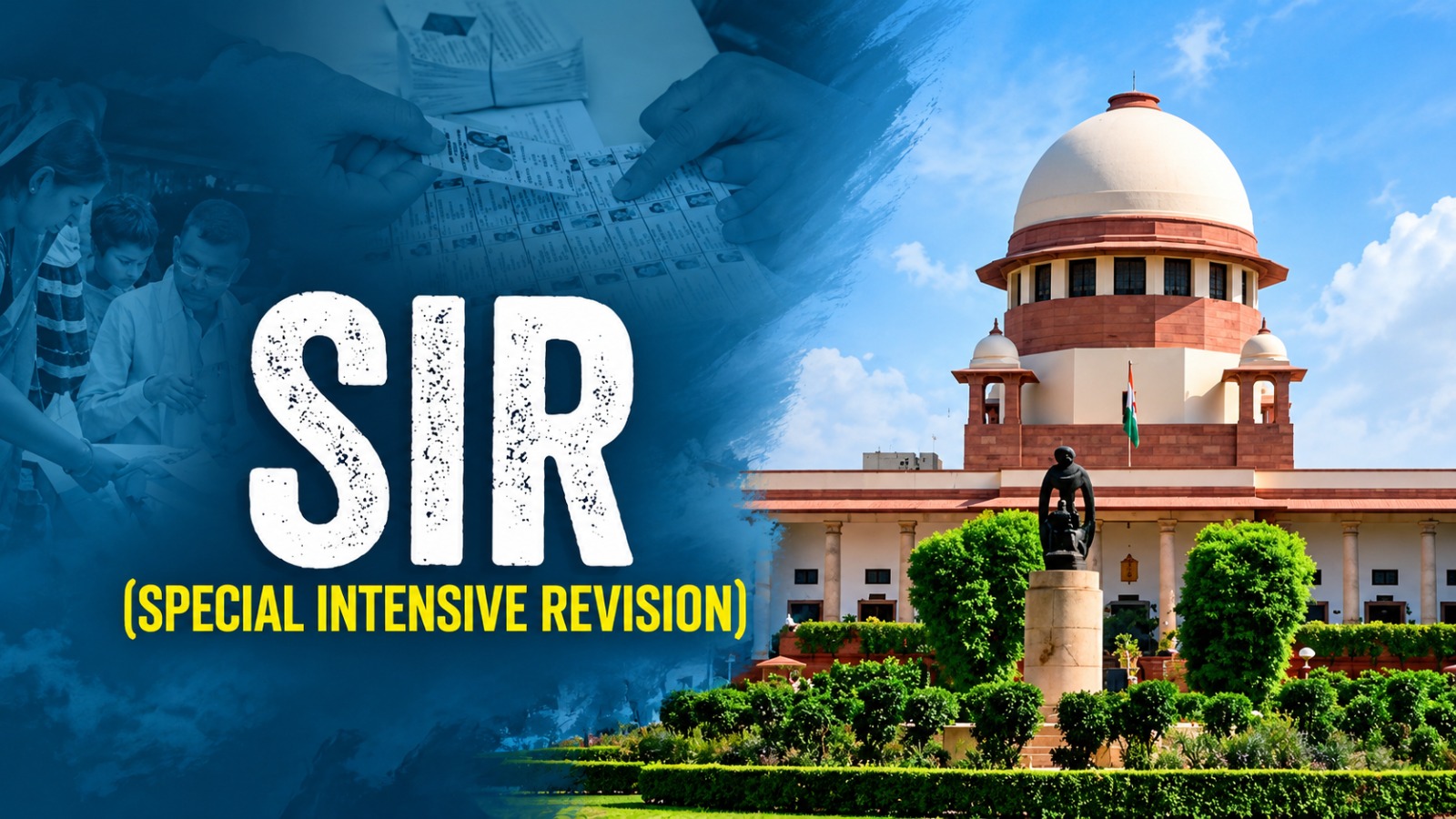
The Supreme Court on Monday sought responses from the Centre, the Election Commission of India (ECI) and the Maharashtra Chief Electoral Officer on a petition alleging that nearly three crore voters have been excluded from the electoral rolls during the ongoing Special Intensive Revision (SIR) in Maharashtra.
The petition, filed by chartered accountant and journalist Arun Anandagiri, has challenged the alleged mass deletion of voters as arbitrary, illegal and unconstitutional.
A bench comprising Chief Justice of India Surya Kant and Justices Joymalya Bagchi and V. Mohana posted the matter for hearing on November 5, a day before the scheduled publication of the final electoral rolls.
The court, however, declined to pass an interim order restraining the Election Commission from publishing the final voter list on November 6.
‘You are a whistleblower’: Supreme Court to petitioner
During the hearing, senior advocate Arvind Datar, appearing for the petitioner, urged the court to intervene and prevent the finalisation of the electoral rolls until the concerns raised in the petition were addressed.
Datar argued that nearly one-third of Maharashtra’s electorate had been affected by the revision exercise, with many voters allegedly being removed because they could not be found at their registered addresses.
Responding to the plea, Chief Justice Surya Kant told the petitioner’s counsel: “Don’t worry. You are a whistleblower. You are before us. We will see if any order is to be passed after hearing the other side.”
The bench indicated that it would consider the need for further directions after hearing the Election Commission and other authorities.
Nearly 3 crore voters allegedly affected
According to the petition, around three crore voters out of Maharashtra’s approximately nine crore electorate have been affected by the revision exercise.
Datar submitted that nearly 1.22 crore voters had been placed under the category of “logical discrepancies”, raising concerns over the manner in which their eligibility was assessed.
The petition also highlighted the large-scale redevelopment projects underway in Mumbai and Pune, arguing that many residents had been forced to move into temporary accommodation after their homes were demolished or vacated.
Datar told the court that around 3,500 redevelopment projects were underway in Mumbai and another 1,500 in Pune.
He argued that voters who had shifted temporarily during redevelopment were being marked as “person not found” and subsequently deleted from the electoral rolls.
The petitioner contended that the Election Commission had failed to adequately account for these circumstances before removing the names.
Form 6 issue raises fresh concerns
The petitioner also questioned the Election Commission’s instructions asking deleted voters to submit Form 6 to register themselves again.
Datar argued that Form 6 was meant for new voters and required applicants to declare that they had not previously been registered or voted.
He said asking previously registered voters to submit the form could force them to make a false declaration.
“Delhi High Court says — don’t worry, they will not take prosecution. But that is not an answer,” Datar told the bench, referring to a recent observation by the Delhi High Court on the issue.
Chief Justice Surya Kant responded:“Nobody will be prosecuted.”
The petitioner, however, argued that a separate form should be introduced for voters whose names had been deleted during the revision exercise.
Court says deadlines may be extended if necessary
The bench indicated that deadlines for submitting documents to establish voter eligibility could be extended if required.
The Chief Justice noted that similar extensions had been granted during SIR exercises in other states, including West Bengal and Bihar.
However, the court declined to immediately extend the deadline for filing claims and objections or to restrain the Election Commission from publishing the final rolls.
The matter will be taken up again on November 5, when the authorities are expected to respond to the petition.
Political controversy over SIR
The SIR exercise has triggered political controversy across several states, with Opposition parties alleging that the revision process could lead to the exclusion of eligible voters.
The Election Commission has maintained that the exercise is intended to ensure the accuracy of electoral rolls by removing duplicate, deceased and ineligible voters.
The Maharashtra petition adds to the growing legal scrutiny of the nationwide revision exercise, with the Supreme Court already hearing several petitions challenging aspects of the SIR process.
The court’s next hearing on November 5 is expected to determine whether any additional directions are required before the final electoral rolls are published.