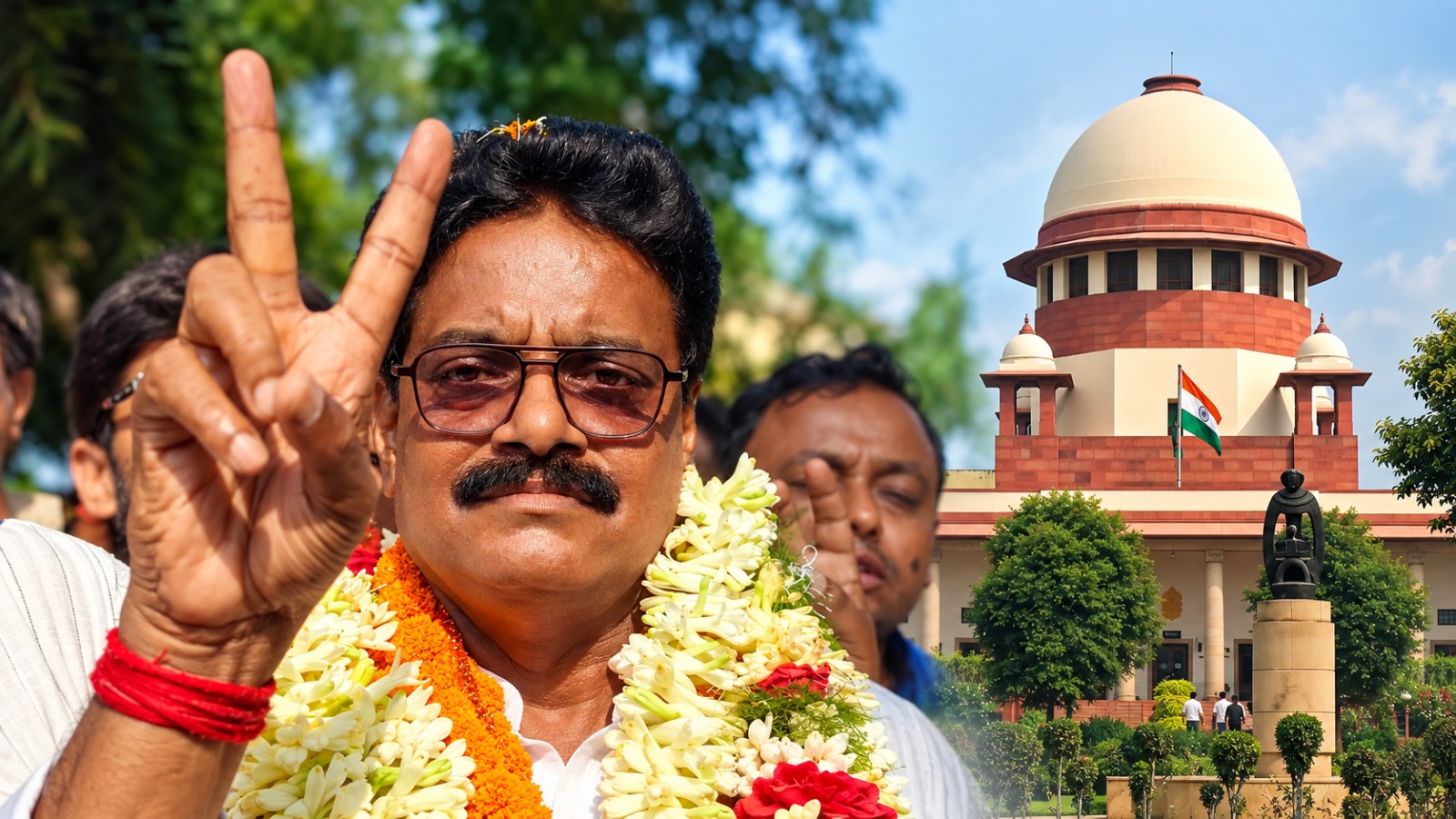

The Supreme Court on Monday questioned the Election Commission’s handling of modifications to Form 6, the statutory application used for inclusion of names in electoral rolls, making it clear that the court had not approved the altered version used during the Special Intensive Revision (SIR) exercise.
A three-judge Bench headed by Chief Justice of India Surya Kant, with Justices Joymalya Bagchi and V. Mohana, was hearing a connected petition filed by advocate Shailendra Mani Tripathi challenging alleged unilateral decisions taken within the Election Commission under Chief Election Commissioner Gyanesh Kumar. The court also issued notice in the matter and tagged it with a separate petition filed by Rakesh Kumar Singh challenging the functioning of the CEC.
The hearing assumed significance after reports that the Election Commission’s online version of Form 6 had, for the first time, included additional requirements concerning the applicant’s parents and their status in relation to the previous SIR. The statutory Form 6 itself, however, had not been formally amended. The Election Commission subsequently removed the additional SIR declaration from its ECINET portal in states where the SIR had concluded.
‘Any modified Form 6 has not been approved by us’: CJI
Senior Advocate Menaka Guruswamy, appearing for Tripathi, referred to the reported modification and argued that the additional conditions imposed on Form 6 were not authorised under the statutory framework.
“Let me give you an illustration… since it pertains to most recently, for instance, Delhi. Let us see how the SIR was conducted in Delhi. Form 6 has two new conditions added,” Guruswamy told the Bench. She said the modified forms had been circulated even though the statutory schedule did not permit such a change.
The Chief Justice responded with a categorical clarification: “Any modified Form 6 has not been approved by us… When the report will be produced, we will like to see who has modified what.”
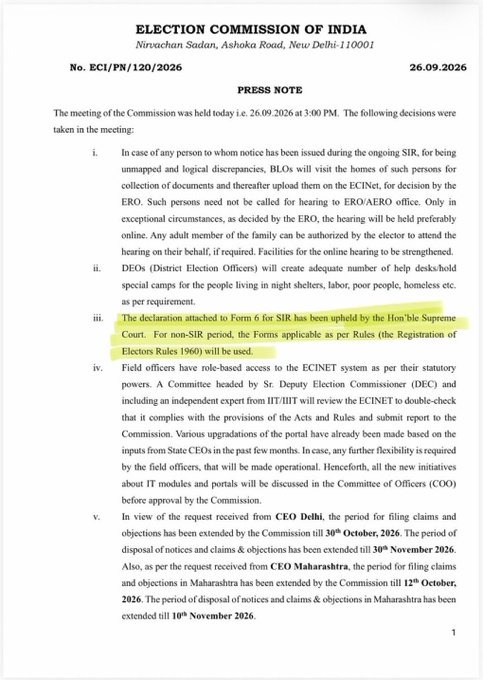
The observation came after the Election Commission had said in a September 26 statement that the SIR declaration attached to Form 6 had been upheld by the Supreme Court. The court's Monday clarification indicates that it had not approved the modification itself.
Tripathi's petition alleges that CEC Gyanesh Kumar, acting with the Election Commission's IT department, altered Form 6 digitally on the ECINET portal in July 2026. It relies on a subsequent objection recorded by Election Commissioner Sukhbir Singh Sandhu, who allegedly described the alteration as “unauthorised and illegal” and called for its withdrawal.
The petition argues that Form 6 could not be altered without the necessary legislative or statutory process under the Registration of Electors Rules, 1960. It further alleges that the changes caused difficulties for young and first-time voters.
The plea also challenges 14 decisions allegedly taken in the name of the Election Commission without the concurrence of the other two Election Commissioners, Sukhbir Singh Sandhu and Vivek Joshi. The allegations stem from documentary objections reportedly recorded by the two commissioners between October 2025 and August 2026.
Guruswamy: Issue goes beyond one state
Guruswamy argued that the dispute should not be viewed merely as a Delhi- or West Bengal-specific controversy.
She submitted that the petition concerned the functioning of the Election Commission as a national constitutional institution and alleged that the changes to the voter-registration process could have consequences for the franchise of eligible citizens. She also referred to the scale of the SIR exercise and appeals arising from the process.
The petition seeks, among other reliefs, an independent judicial inquiry or SIT headed by a retired Supreme Court judge, with technical experts, into the alleged decisions and the functioning of the electoral-roll databases. It also seeks action against officials allegedly responsible for breaches of statutory duties.
Petition challenging CEC’s unilateral functioning
In the companion petition filed by Rakesh Kumar Singh, Senior Advocate Vikas Singh argued that Article 324 of the Constitution vests the superintendence, direction and control of elections in the Election Commission as a body, rather than in the Chief Election Commissioner individually.
The petition states: “Article 324(1) of the Constitution does not vest the superintendence, direction and control of elections in an individual Chief Election Commissioner. It vests those powers in a Commission.”
Singh argued that the 2023 law requires decisions of the Commission to be taken unanimously or, where unanimity is not possible, by majority.
Seeking interim protection, Singh told the Bench that the credibility of the electoral process was at stake and urged the court to ensure that the Commission did not take decisions outside the statutory framework while the case was pending. At one point, he told the court: “The Court has to pass some interim orders, otherwise the country will burn.” He also warned that electoral-roll decisions could have consequences that could not easily be reversed after an election had already taken place.
The Bench did not, however, suspend Gyanesh Kumar at this stage. The court said it wanted an authenticated response from the respondents before examining the allegations.
Justice Joymalya Bagchi observed that if the records ultimately showed that particular decisions were neither unanimous nor taken by majority, the court could examine whether those decisions were ultra vires. But he questioned whether the court could reach that conclusion ex parte before hearing the respondents.
CJI Surya Kant similarly said the court could not proceed solely on the basis of a newspaper report, observing that a report “may be 100% correct, it may be partially correct; it may be partially incorrect.”
The court ultimately issued notice to the Election Commission, the Union government, CEC Gyanesh Kumar, Election Commissioners Sukhbir Singh Sandhu and Vivek Joshi, Deputy Election Commissioner Maneesh Garg and DG (IT) Seema Khanna.
The Election Commission has disputed the allegations of unilateral decision-making. It has maintained that its decisions relating to SIR and the Form 6 declaration were taken unanimously and had legal sanction. The Commission has also said that the statutory Form 6 itself was not amended and that the additional information was sought through an addendum.
The ECI has further maintained that differences in views, observations or suggestions among its members can form part of the deliberative process, while the final decisions of the Commission are taken collectively.