The Bharatiya Janata Party (BJP) has intensified its attack on student leader Neha Bora after a video of her praising Bangladesh’s Gen Z-led uprising triggered a political controversy, with the ruling party alleging that the Opposition’s protests against the Election Commission are aimed at bringing about “regime change” in India.
Bora, president of the All India Students’ Association (AISA), made the remarks in a video message to Bangladesh’s Socialist Students’ Front. Referring to the student-led movement that culminated in the ouster of former Bangladesh Prime Minister Sheikh Hasina in August 2024, Bora said the movement had inspired young people in India to mobilise around democratic and voting rights.
“The Gen Z movement we are seeing everywhere in this country first started in Bangladesh, and congratulations to you for showing us the way,” Bora said in the video, which circulated widely on social media.
She added that the movements in both countries were connected by demands for democratic rights and accountability.
“We know that the movement that began in Bangladesh was for democratic and voter rights. Today, the movement that young people are participating in and leading is also a movement for democratic and voting rights,” she said.
Bora also drew a parallel between the fight against religious fundamentalism in Bangladesh and the political concerns being raised by young protesters in India. She expressed hope that activists across the two countries could work together for a better South Asia.
The comments have prompted a sharp response from the BJP, which has interpreted her praise for Bangladesh’s uprising as an indication that the Opposition seeks to replicate the political upheaval in India.
BJP alleges ‘open admission’ of regime change
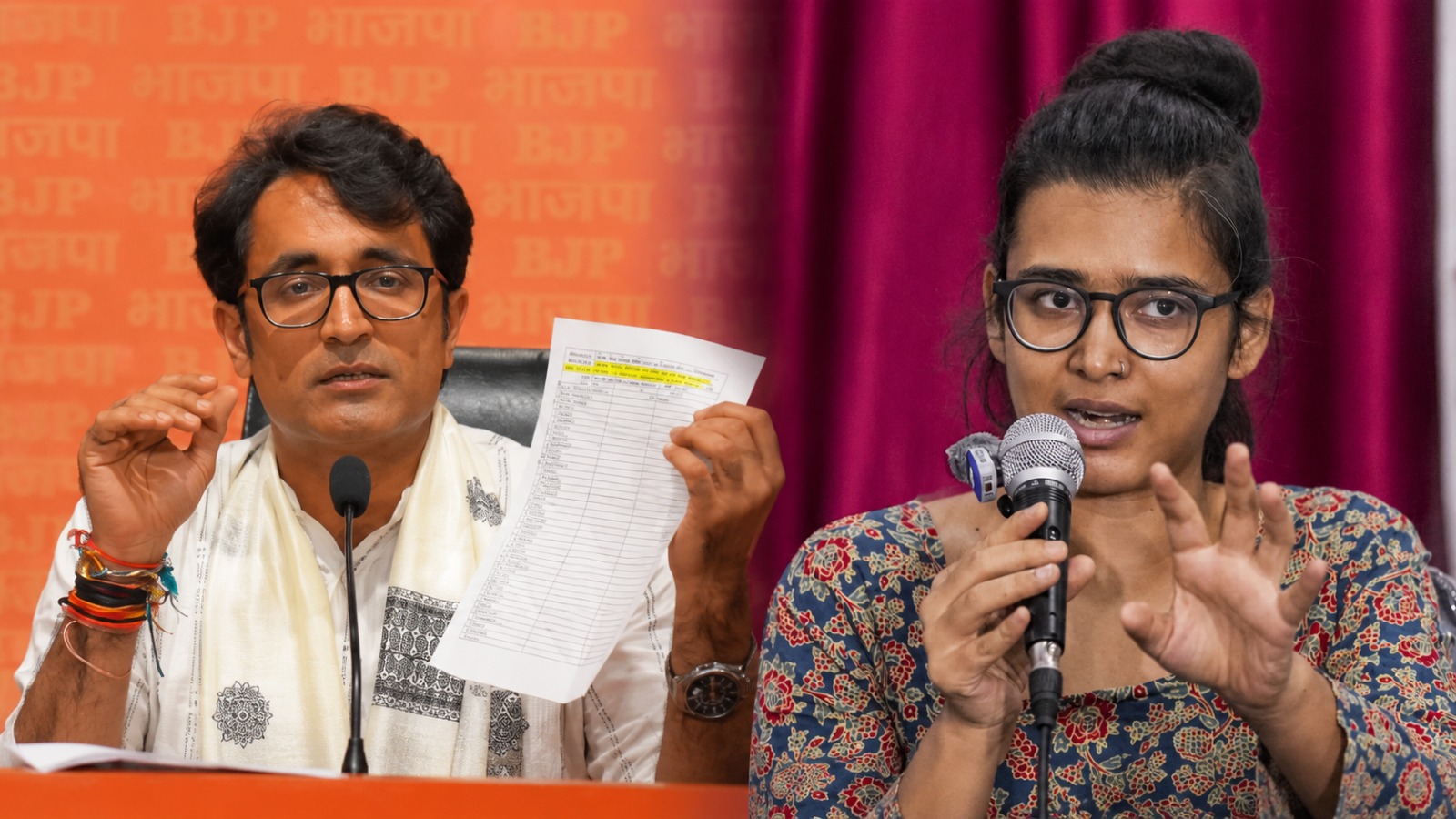
BJP national spokesperson Pradeep Bhandari seized on the video, accusing Bora of revealing what he described as the Opposition’s real political objective.
“This is an open admission of regime change,” Bhandari said in a post on X, alleging that Congress leader Rahul Gandhi and those associated with him were seeking more than conventional political opposition.
Bhandari further claimed that the objective was to bring about a Bangladesh-like upheaval in India. He accused the Congress and its political allies of attempting to undermine democratic institutions under the cover of public protests.
“Rahul Gandhi and his entire ecosystem do not wish to offer mere political resistance; they aim for regime change,” Bhandari said, according to NDTV’s report.
He also argued that Bora’s participation in protests alongside Opposition leaders demonstrated an ideological connection between the student movement and the Congress-led campaign.
The BJP has repeatedly criticised demonstrations demanding the resignation of Chief Election Commissioner Gyanesh Kumar over alleged irregularities in the Special Intensive Revision (SIR) of electoral rolls. The party has questioned the motives behind the protests, while demonstrators maintain that their campaign concerns electoral transparency and democratic rights.
Bangladesh uprising at centre of controversy
Bangladesh witnessed a major student-led uprising in 2024, initially triggered by protests against government job quotas. The agitation expanded into a broader movement against the Hasina government, culminating in her departure from office on August 5, 2024, following weeks of unrest and violence.
The BJP has cited this episode to question whether references to Bangladesh’s movement are intended to encourage similar political upheaval in India. However, Bora’s remarks in the video focused on solidarity, democratic rights and the mobilisation of young people; she did not explicitly call for the overthrow of the Indian government in the quoted passage.
Her comments have gained significance because she has emerged as a prominent face of recent demonstrations in Delhi against the Election Commission and the SIR exercise.
Congress rejects BJP’s allegations
The BJP’s criticism has also drawn the Congress into the controversy because of Rahul Gandhi’s association with the wider protest campaign.
Congress leader Rashid Alvi rejected the suggestion that the party supported unconstitutional methods to change the government. He maintained that any change of government in India must take place through democratic means.
Alvi also accused the BJP of invoking democracy selectively while seeking to discredit protests over electoral rights. He argued that the demand for the Chief Election Commissioner’s resignation was linked to allegations concerning the conduct of the electoral revision exercise.
The Election Commission has maintained that the SIR process is intended to verify electoral rolls and ensure their accuracy. Allegations of wrongful voter exclusion remain contested, with Opposition parties demanding greater transparency and safeguards.