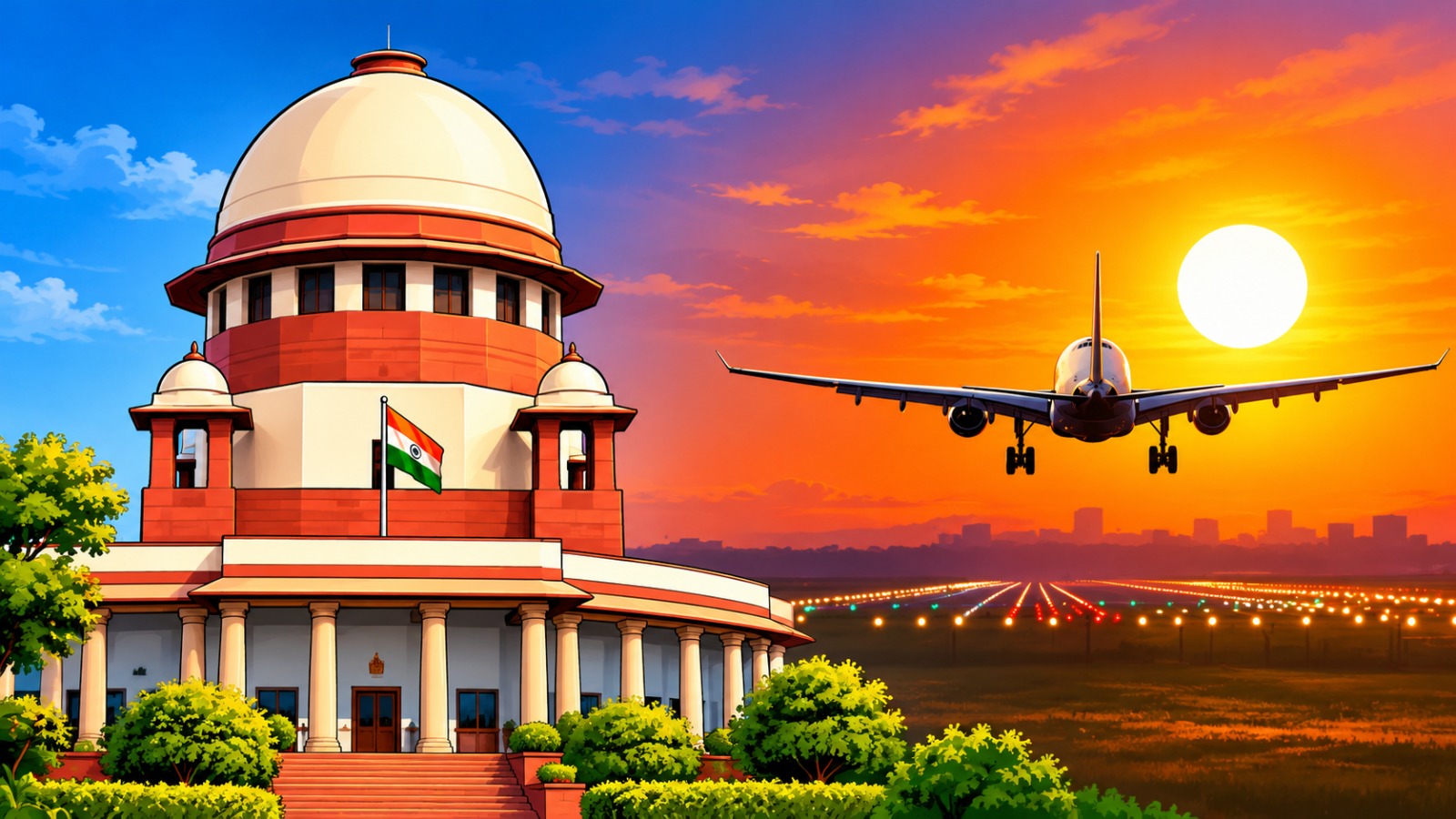
The Supreme Court on Monday declined to entertain a plea seeking intervention against alleged steep increases in domestic airfares, with Justice Vikram Nath responding to the petitioner's concerns by saying, “Don't travel by air. Next case.”
The exchange took place when an advocate mentioned the matter before the court, claiming that airfares had surged by as much as 700 per cent and arguing that air travel had become an essential service.
The lawyer also alleged that the sharp increase in ticket prices amounted to a violation of Article 14 of the Constitution, which guarantees equality before the law and equal protection of the laws.
Justice Nath, however, declined to take up the matter at that stage and proceeded to the next case.
The brief exchange has brought renewed attention to the debate over airfare regulation in India, particularly the sharp fluctuations in ticket prices during festivals, holidays and emergencies.
Plea seeks intervention against dynamic pricing
The petition reportedly challenges the practice of airlines increasing ticket prices sharply, sometimes within hours, under the dynamic pricing system.
It seeks regulatory guidelines to prevent steep and allegedly arbitrary fare hikes during periods of high demand, including festivals and emergencies.
The petitioner has argued that air travel is no longer merely a luxury for many passengers, but an essential mode of transport, particularly in situations where road and rail travel are impractical or unavailable.
The plea also raises concerns over the absence of a regulatory mechanism to monitor airfare fluctuations and protect passengers from sudden price increases.
Supreme Court has previously flagged airfare disparity
The latest exchange comes against the backdrop of earlier proceedings in the Supreme Court concerning the regulation of airfares.
In May 2026, a bench comprising Justices Vikram Nath and Sandeep Mehta had urged the Centre to rationalise airfares, pointing to significant differences in ticket prices charged by airlines for the same route on the same day.
“On the same day, for flights on the same sector, one airline charges Rs 8,000, while another charges Rs 18,000 in economy class,” the bench had observed.
The court had asked the Centre to consider providing relief to passengers facing substantial fare disparities.
In January 2026, the same bench had expressed concern over steep airfare increases during festivals and high-demand periods, describing the fare hikes during the Maha Kumbh as exploitative.
The court had indicated that it would intervene in the matter and consider appropriate orders.
Centre asked to frame rules under new aviation law
The issue has also featured in proceedings concerning the Bharatiya Vayuyan Adhiniyam, 2024, which came into force in January 2025.
In July 2026, the Supreme Court asked the Centre to place the rules framed under the new legislation before it within two weeks.
The direction came while the court was hearing a public interest litigation filed by social activist S.
Lakshminarayanan, seeking an independent aviation regulator and greater transparency in airfare pricing and additional charges.
The petition argues that airlines have considerable freedom to revise fares without prior approval, resulting in unpredictable price fluctuations that can adversely affect passengers.
It also raises concerns over reductions in complimentary check-in baggage allowances and the imposition of additional charges for services that were previously included in ticket prices.
The Supreme Court's latest response does not appear to settle the broader question of whether airfare pricing requires stronger regulatory oversight.
While the court has previously expressed concern over sharp fare increases and urged the Centre to rationalise prices, Monday's exchange saw the bench decline to take up the plea at the stage of mentioning.
The issue remains significant for passengers who depend on air travel for urgent medical treatment, family emergencies and travel to regions with limited alternatives.