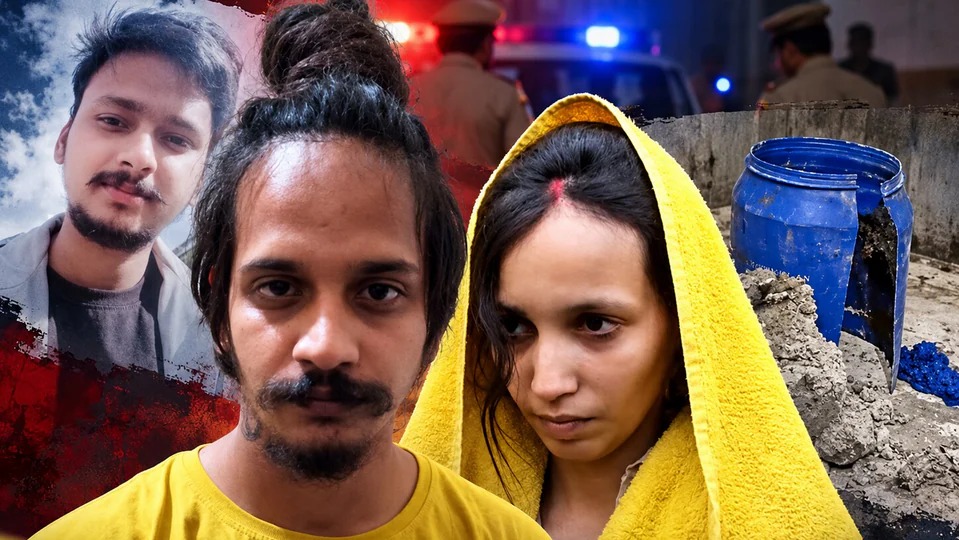
A court in Meerut, Uttar Pradesh, has sentenced Muskaan Rastogi and Sahil Shukla to death for the murder of Saurabh Rajput, a former Merchant Navy officer whose dismembered body was found concealed inside a cement-filled blue plastic drum in March 2025.
District Judge Arvind Kumar Mishra pronounced the sentence on Wednesday, around two weeks after the court convicted the pair in the high-profile murder case. The verdict followed a trial involving 126 hearings and testimony from 22 witnesses.
The case drew widespread attention after investigators recovered Rajput’s remains from the drum at his residence in Meerut. The prosecution argued that the killing was premeditated and that the accused had attempted to conceal the crime by sealing the remains inside the container with cement.
Court Cites Seriousness of the Crime
During the sentencing proceedings, the court observed that crimes of this nature create fear in society. The judge considered the circumstances of the murder and the subsequent concealment of the body while deciding the punishment.
The prosecution had sought the death penalty, arguing that the crime warranted the severest sentence under the law. The defence had challenged the prosecution’s case during the trial, including the reliance on circumstantial evidence.
The court ultimately found both Rastogi and Shukla guilty and awarded them capital punishment.
How the Murder Came to Light
According to the police investigation, Rajput was killed at his home in Meerut on March 3, 2025. Investigators alleged that Rastogi, his wife, and Shukla, with whom she was reportedly in a relationship, conspired to murder him.
The prosecution’s account stated that Rajput was rendered unconscious before being attacked. His body was subsequently dismembered, and the remains were placed inside a blue plastic drum. Investigators said the drum was filled with a mixture of sand, water and cement in an attempt to conceal the remains.
Following the incident, Rastogi and Shukla allegedly travelled to Himachal Pradesh. Police said messages were sent from Rajput’s phone to his family, creating the impression that he was away on work.
Rajput’s relatives grew suspicious when they could not establish his whereabouts and approached the police. On March 17, 2025, investigators recovered his remains from the drum at the residence.
Rastogi and Shukla were arrested two days later.
Evidence Presented During the Trial
The prosecution relied on forensic findings, witness testimony, mobile phone records and other circumstantial evidence to establish its case.
Local shopkeepers reportedly testified that they had sold items, including a drum, knives, sand and cement, linked by investigators to the alleged crime. Call detail records and mobile tower data were also presented to establish the movements of the accused around the time of the murder and their subsequent journey to Himachal Pradesh.
Post-mortem findings indicated that Rajput had sustained injuries caused by a sharp-edged weapon.
The trial lasted around 13 months and involved 126 hearings. The court convicted the two accused on September 30 before hearing arguments on the appropriate punishment.