India on Tuesday firmly rejected China’s objections to its latest move to standardise the names of strategic locations in Ladakh, reiterating that the Union Territory is an integral and inalienable part of the country and that Beijing’s denial cannot alter this position.
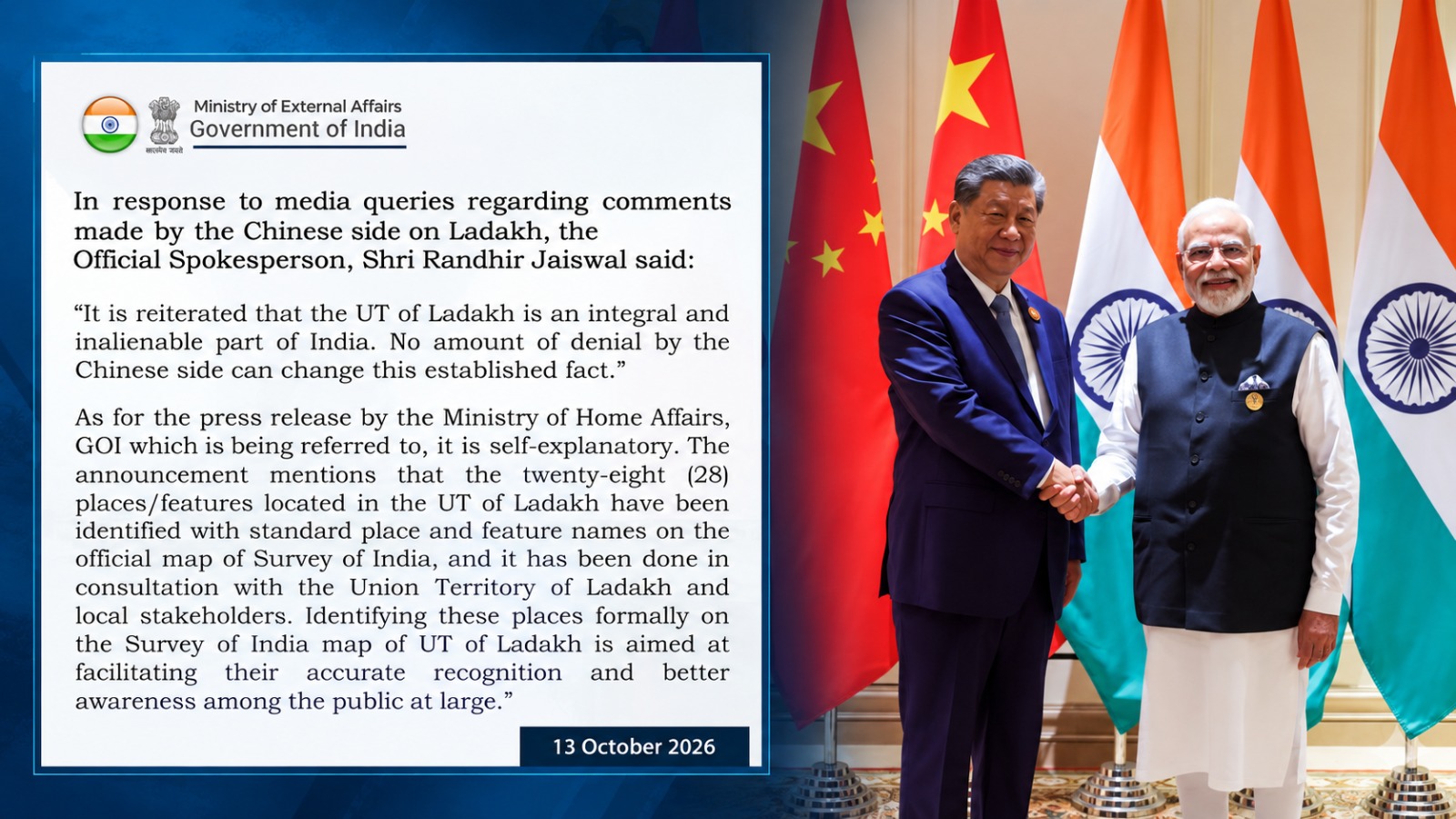
The Ministry of External Affairs (MEA) issued the response after China criticised India’s decision to formally identify 28 geographical features and strategic locations in Ladakh for inclusion on official maps. The Indian government said the exercise was intended to improve the accurate identification of places and public awareness of the sensitive border region.
“It is reiterated that the UT of Ladakh is an integral and inalienable part of India. No amount of denial by the Chinese side can change this established fact,” the MEA said in its statement.
The exchange marks another episode in the continuing dispute between New Delhi and Beijing over their contested boundary in the western sector.
India identifies 28 strategic locations
The latest exercise, announced on October 2, covers 28 locations, including mountain peaks, passes, glaciers, valleys, rivers and other geographical features. The list includes Gogra and Hot Spring, two strategically significant areas along the Line of Actual Control (LAC).
According to the Indian government, the locations were formally identified in consultation with the Ladakh administration and incorporated into the official mapping process of the Survey of India. The stated objective is to ensure consistent geographical references and improve the documentation of the region.
Gogra and Hot Spring were among the friction points during the India-China military standoff that began in eastern Ladakh in 2020. The confrontation led to prolonged military deployments along the LAC and multiple rounds of diplomatic and military negotiations.
China objects to India’s move
China’s Foreign Ministry spokesperson Mao Ning objected to the announcement, asserting that Beijing did not recognise the Union Territory of Ladakh as established by India and describing the naming exercise as “illegal and invalid”.
China also reiterated its territorial claims over areas in the western sector of the India-China boundary. New Delhi rejected the assertions, maintaining that changes in Beijing’s position or objections to Indian administrative measures cannot alter India’s territorial claim.
The latest exchange underscores the continuing differences between the two countries over the boundary, despite efforts to reduce tensions following the 2020 confrontation.
A dispute with a long history
India and China share a long and disputed frontier, with the western sector centred on the high-altitude region of Ladakh. The LAC separates areas controlled by the two countries, but the two sides have differing perceptions of parts of the boundary.
The 2020 military standoff severely strained bilateral relations after a deadly clash in the Galwan Valley in June that year. Subsequent negotiations produced disengagement arrangements at several friction points, although broader questions concerning the boundary and military deployments have remained significant challenges.
India has consistently maintained that Ladakh, along with Jammu and Kashmir, is an integral part of the country. China, meanwhile, continues to dispute aspects of India’s territorial and administrative position in the region.