Within hours of catastrophic flash floods tearing through Nepal’s Himalayan valleys, the Indian Air Force launched a high-tempo Humanitarian Assistance and Disaster Relief effort, positioning itself as the first major foreign airlift into Kathmandu while search teams still picked through mud, wrecked bridges and riverbanks.
The disaster struck on Wednesday morning after a rock-and-ice collapse on the Nepal–Tibet border sent a debris-laden surge down the Lhende tributary into the Bhote Koshi and then the Trishuli. Villages, border facilities, hydropower sites and stretches of highway in Rasuwa, Nuwakot and Dhading were smashed. Official tallies on Thursday put Nepal’s confirmed dead in the high hundreds of fatalities when combined with reports from Tibet, with more than 800 people still missing in Nepal alone - among them large numbers of tourists, including many Indian nationals on pilgrimage and travel routes. Dozens of motorable and suspension bridges were destroyed and about 40 km of road was torn away, cutting off communities that helicopters and ground teams are still trying to reach.
That is the landscape into which the IAF flew.
First wheels up from Hindon
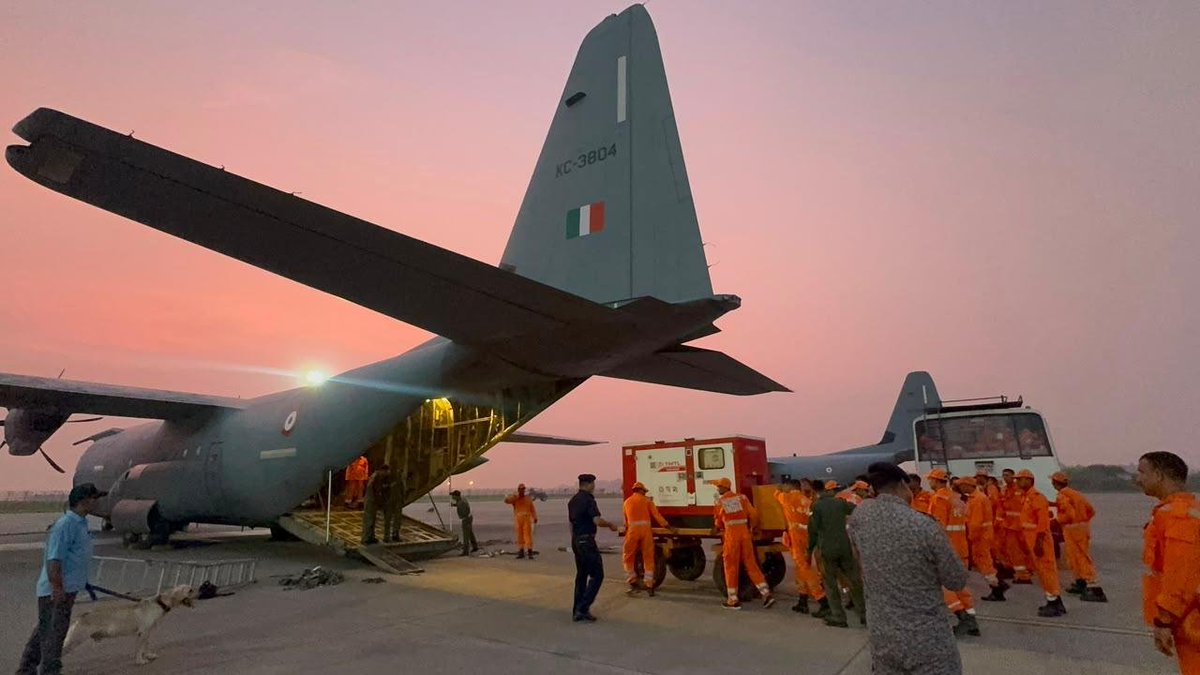
Officials at Hindon Air Force Station near Ghaziabad treated the call as a standard HADR contingency they train for. Aircraft were placed on standby the same afternoon. A C-130J Super Hercules lifted off around 8:30 p.m. on August 26 with about 10 tonnes of emergency cargo: temporary shelters, blankets, hygiene and dignity kits, solar lamps, tarpaulins, generators and medicines coordinated with the Ministry of External Affairs and the National Disaster Response Force. The flight landed in Kathmandu in roughly two hours.
On X, the IAF Media Co-ordination Centre framed the mission in four words that have become its public signature for neighbour operations: “Neighbours. Friends. First Responders.” The same post said further C-17 and C-130 sorties would follow and that helicopters had been earmarked for rescue and evacuation once landing sites and weather allowed.
The second wave
By Thursday morning the effort had scaled. A C-17 Globemaster III departed Hindon with about 37.5 tonnes of additional relief - medicines, food packets and more NDRF payload - taking the two-day airlift past 47 tonnes. Crews carried extra fuel and nominated Indian diversion airfields in case Kathmandu’s runway or weather delayed landing. The IAF again posted the departure publicly: another C-17 airborne, continuing the relief effort.
Officers at Hindon described the base as built for this tempo. Air Commodore Rajiv Dobhal, Air Officer Commanding, said the force is “ever ready” for such tasks and has flown similar missions in Nepal, Myanmar, Sri Lanka and farther afield. Group Captain Jai Ganesh, chief operating officer at the station, called Hindon “the tip of the spear” for HADR and said C-130s and C-17s were already on standby when the flood reports arrived. Wing Commander Lagnajeet Nayak, flying the follow-on load, said the second package included medical stores, dignity kits and other essentials, with a flight time of about an hour and a quarter.
C-295 transports were also kept available. Helicopters remain assigned for the harder work: lifting people off cut-off slopes, moving injured survivors, and dropping supplies where roads no longer exist.
Prime Minister Narendra Modi spoke with Nepal’s Prime Minister Balendra Shah and pledged full humanitarian help. External Affairs Minister S. Jaishankar said India had dispatched the first 10 tonnes and later confirmed the second flight; on Thursday he chaired a review with the Foreign Secretary and ambassadors in Kathmandu and Beijing on the welfare of Indians in the affected belt. The Indian Embassy in Kathmandu issued emergency numbers and said it was working with Nepali authorities on rescue and relief for Indian nationals. NDRF teams and earth-moving equipment were prepared to follow as Nepal requested.
Nepal’s own Army, police and Armed Police Force remain the backbone of the search. Thousands of personnel and dozens of helicopter sorties have already pulled hundreds of people to safety. India’s role, as described by IAF officers, is to keep the pipeline of tents, medicine, food and lift capacity open so those teams are not waiting on empty stores.
The human picture is still incomplete. Families have crowded hospitals in Kathmandu and district towns looking for names on lists that keep changing. Hydropower workers, security personnel posted at washed-out stations, and pilgrims bound for Kailash Mansarovar routes are among those still unaccounted for. Power and communications in the upper valleys were shredded. Downstream districts along the Trishuli and Narayani systems have been warned as water and debris continue to move.