India has once again firmly rejected China’s objections to the formal identification of 27 places and geographical features in Arunachal Pradesh on official Survey of India maps, reiterating that the northeastern state is an inalienable and integral part of India and that nothing can change this reality.
The latest exchange of sharp statements came after the Ministry of Home Affairs, in consultation with the Arunachal Pradesh government, marked 27 locations - including settlements, localities, mountain passes, a high-altitude lake and a war memorial - with the standard names on the official map. The move, announced on August 7, was aimed at ensuring accurate geographical identification and increasing public awareness of the historical and geographical significance of these sites.
China responded by terming the Indian step “illegal, null and void.” Chinese Foreign Ministry spokesperson Guo Jiakun said Beijing does not recognise the “so-called ‘Arunachal Pradesh’ illegally set up by India” and claimed that the region, which China calls Zangnan (South Tibet), belongs to China. He added that India’s attempt to replace names “long been used by China” with its own standard names would not alter Beijing’s position.
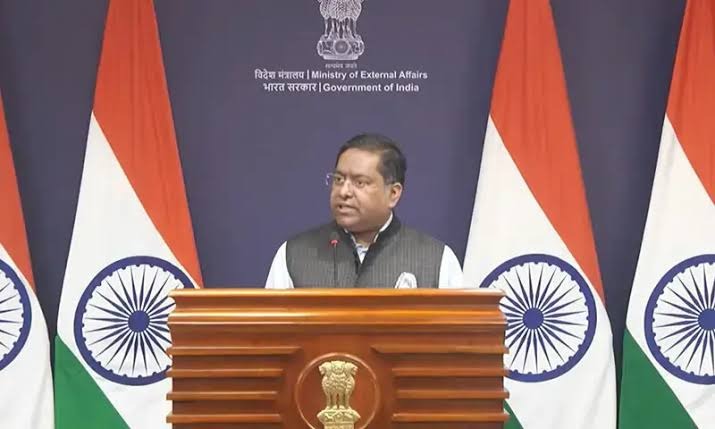
MEA spokesperson Randhir Jaiswal pushed back strongly on Tuesday. “Let me reiterate this once again that Arunachal Pradesh is an inalienable and integral part of India and this is a fact that is self-evident. At the same time, let me also underline that nothing can change this indisputable reality,” he said at a press briefing.
This is not a new confrontation. China’s periodic attempts to assign Chinese and Tibetan names to places in Arunachal Pradesh - a practice underway since 2017, with multiple batches released over the years - have consistently been rejected by New Delhi as “vain and preposterous.” India has maintained that such exercises cannot alter the ground reality that Arunachal Pradesh was, is and will always remain an integral part of India.
Several of the 27 locations carry strategic and historical weight. They include Long Ju (Longju), the site of an early India-China military clash in 1959; Thag La, associated with the opening phase of the 1962 war; high-altitude passes such as Dzo La, Riza La and Pukur La; Jairampur, an important logistics hub; and memorials linked to Indian soldiers who fought in 1962, including Jaswant Garh and the Sher-e-Thapa Memorial.
The timing of India’s mapping exercise and China’s reaction coincides with ongoing diplomatic engagement on the border. The 36th meeting of the Working Mechanism for Consultation and Coordination on India-China Border Affairs (WMCC) was held in New Delhi on August 6, where both sides discussed boundary-related issues, border management and the need to maintain peace and tranquillity along the Line of Actual Control (LAC).
India’s position on Arunachal Pradesh has remained consistent across successive governments. The state, earlier known as the North-East Frontier Agency (NEFA), has been under Indian administration since independence. India regards the McMahon Line, drawn in 1914, as the boundary in the eastern sector. China has never accepted this line and continues to claim the entire state as part of its territory.
Beijing’s latest objections and India’s categorical rejection fit a long-established pattern. Whenever China issues lists of “standardised” names for locations in Arunachal, New Delhi responds by reaffirming sovereignty and, in recent years, by formally recording Indian names and features on official maps. The current episode underscores that while both sides maintain dialogue mechanisms and have sought to stabilise the border situation after the 2020 Galwan clash and subsequent military-level talks, core differences over Arunachal Pradesh remain unresolved.
India has made it clear that any improvement in broader bilateral ties rests on peace and tranquillity along the LAC. Officials continue to stress that unilateral attempts by China to alter the status of Indian territory through naming exercises or other means will not succeed. Arunachal Pradesh, with its distinct cultural identity, elected government and full integration into India’s federal structure, remains an integral part of the country - a reality New Delhi insists is beyond dispute.